Bawling Boers and Bourgeois Revolt
The Situation of the South African Proletariat
20 Oct 2025
1. The Alliance Between International Capital and National Reaction
On January 23, President Cyril Ramaphosa signed a new Expropriation Bill into South African law.[1], [2] The law updates how the government is allowed to expropriate private property for public use, or practice “eminent domain.” Prior to the recent update, expropriation was directed under a 1975 law. This law, passed under apartheid, granted the “Minister” the power to “expropriate any property for public purposes or take the right to use temporarily any property for public purposes,” but “subject to an obligation to pay compensation.”[3] The new law passed this year, while being very similar, makes a widely-publicized change: saying that “it may be just and equitable for nil compensation to be paid where land is expropriated in the public interest, having regard to all relevant circumstances.”[4]
The change has incensed a thorn in the side of the country; namely, the reactionary sections of the white minority. The white descendants of Dutch “Boers” and English settlers, sometimes called “Afrikaners,” make up 7.2% of South Africa’s population,[5] and have hosted a very vocal showing of backwardness that still clings tightly to historical privilege. For example, Orania is a whites-only town in the central Karoo district,[6] and in 2010 there were 70 slum-settlements country-wide which were organized as whites-only by the occupants.[7] Evidently, the Afrikaners have fallen from their position of racial and political dominance quite ungracefully. Having been brought down from the vile and open privilege of apartheid, many now believe themselves victimized, adopting many racist anti-Black and anti-government theories, constituting themselves as an antagonistic force of reaction. Their delusions have gone to the extreme idea that white Afrikaners are being brutally targeted and murdered for their land as part of a misty racial conspiracy. More than 10,000 mostly white South Africans participated in a Cape Town protest aimed at bringing awareness to their invented genocide in 2017,[8] and the idea seems to have grown in both popularity and power since then.
The actual cause of the “farm murders” is much more mundane than the ridiculous conspiracies of the Afrikaner racists. Crime is very high country-wide, and a supposed epidemic of racially-motivated white “farm murders” is the chauvinistic way a backwards section of a traditionally privileged caste of people interprets the high rates of violent robbery, as well as the country’s notorious assault,[9] and murder rates,[10] though none of these disproportionately target white people. While police record keeping in rural areas is shoddy, according to the Minister of Police, from January 1 to March 31 of 2025, only twelve murders were even recorded on commercial farms, with only one of the victims being white and the others being Black African.[11]
Despite the lack of evidence, the idea of “white genocide” persists, with the invented oppression of the Afrikaners extending even beyond the bounds of the country, propped up by reactionaries globally. In 2018, a member of the 8th Parliamentary Team of the European Union, and domestically a member of the far-right National Democratic Party of Germany (NPD),[12], [13] claimed that white farmers in South Africa were murdered at six times the average national rate. He asked the EU why it had “not so far addressed the ongoing violence against white South Africans in the same way as genocide and/or human rights violations in other parts of the world,” admonishing the EU to take “steps to ensure that the protection of white South African farmers is a prerequisite for the conclusion of EU development assistance.”[14] Tucker Carlson of Fox News has called whites in South Africa victims of racism,[15] and numerous Australian news stories graphically showcase the violence committed against white farmers during supposedly racially-motivated farm invasions and robberies.[16], [17]
In no small way, international capital protects its interest in the status quo class situation of South Africa by utilizing the reactionary sections of the white Afrikaner minority. In 2018, the government attempted to expropriate the Akkerland Boerdery in Limpopo, a luxury hunting reserve that catered to primarily European tourists. It offered 20.7 million in South African Rand in exchange for the two parcels that made up the property. The white owner claimed that this was only 10% of the property’s worth,[18] and the hornet’s nest of Afrikaner reaction was riled up, permeating out to the wider international community of reactionaries, even eliciting damning tweets from President Trump.[19] In the face of this international reaction, the white South African owner successfully won an interdict in the Land Claims Court that stopped him from being evicted and allowed him to retain the property. It was later sold for R70 million (about $4 million USD) to the Australian company, MC Mining, to be used as part of an $85 million project which plans to extract coal from the property. Per the agreement, half of the 800,000 yearly tons of coke production belong to one of the project’s partners, Huadong Coal Trading Center Co, Ltd, a Chinese state-owned company.[20], [21]
Most recently, across the Atlantic Sea, Donald Trump signed Executive Order 14204 this last February, “Addressing Egregious Actions of The Republic of South Africa,” which forbids all “aid or assistance” to the country so long as it continues its “government-sponsored race-based discrimination, including racially discriminatory property confiscation.” It also instructed the Secretary of State and Secretary of Homeland Security to “take appropriate steps, consistent with law, to prioritize humanitarian relief, including admission and resettlement through the United States Refugee Admissions Program, for Afrikaners in South Africa who are victims of unjust racial discrimination.”[22]
Every threat perceived by the capitalist forces involved in South Africa – particularly every jab at private property – is dressed up as part of a political conspiracy against the white population in general, and broadcasted as such throughout the reactionary world. Again, we see white nationalism still serving as the energetic and populist defender of big money’s crudest interest.
Despite being the bogeyman in many of the reactionaries’ theories, the government of South Africa is no threat to the property rights of the white minority or to capital. Despite its anti-apartheid foundations, it has completely maintained a capitalist orientation, though it has occasionally committed minor market upsets attempting to follow through with the constitutional promises it made to perform land reform and provide restitution to the victims of apartheid.
2. “Market-Assisted Agrarian Reform”
When the African National Congress (ANC) won South Africa’s first universal suffrage elections in the spring of 1994, the ANC based the entire legal framework of the new state in stark opposition to the open discrimination of the country’s past racial apartheid. In taking power, it abolished its militant wing[23] and brought about the end of the apartheid system, composing the state’s new Constitution in 1996[24] and placing within it certain legal responsibilities on the government to right the wrongs of “past racially discriminatory laws or practices.” Section 25 subsections 5 and 6 state, respectively, that “the state must take reasonable legislative and other measures, within its available resources, to foster conditions which enable citizens to gain access to land on an equitable basis,” and “a person or community whose tenure of land is legally insecure as a result of past racially discriminatory laws or practices is entitled, to the extent provided by an Act of Parliament, either to tenure which is legally secure or to comparable redress.” The question of land reform was so important to the people of South Africa at the time that a final subsection at the end of “Property” was added that simply says, “Parliament must enact the legislation referred to in subsection(6),”[25] specifically reiterating the government’s commitment to the masses of South Africans to undo the damage of apartheid, and provide equitable land reform.
Shortly after coming to power in 1994, the ANC established the Land Claims Court and Commission, creating new bureaucracies to accept claims for restitution and, if approved, to work with capitalist owners on purchasing the land for the claimants. The state prioritized, as it still does today, capital over the desires of the people, preferring to keep the property market and individual property rights afloat and negotiate with the capitalists rather than forcefully expropriate the land. A simple monetary grant was usually all that was available to the accepted claimants. Relatively small sums ($3,300 USD in 1994) were given out,[26] as if generations of open political repression, not to mention the people’s current oppressive position within production, can be purchased away with a few thousand dollars. These grants continue on today in some form,[27], [28] but are slow to be distributed. “Willing seller, willing buyer,” and “market-assisted agrarian reform” were, and remain, the state’s slogans in carrying out their constitutional promise of equality.[29] Notably, the grant policy is beneficial to struggling capitalists, allowing for businessmen to supplement their private capital with public, and, rarely, for farm workers to pool their grants and buy shares in existing agricultural enterprises, becoming bourgeois themselves.[30]
A more energetic strategy was attempted in 2004 when the government decided to try reconciling land restitution cases by merging the claimants for restitution with existing capitalist agricultural entities owning the land, resulting in the “Strategic Partnership Model,” where both parties – the claimants and the capitalist – were constituted into a new dual-owned corporation. Between 2004-2008, only 5,382 hectares of land, or 20 square miles, was redistributed to claimant communities through this effort, and at a cost to the government of $31.7 million USD in compensation to private owners alone. The project ended prematurely when the “strategic partners” – the capitalist companies – exited the agreements, citing financial woes due to debts incurred by the partnership. The company that was “partner” to 5 out of 7 claimants actually went into liquidation shortly after, leaving the claimant communities themselves liable to millions in debts.[31]
The South African state, in its current form, can only prioritize the status quo capitalist markets over any apartheid victims, even while it flails around in half-hearted and doomed land reform projects in response to the stimulus of the struggling South African masses. This is especially true because the country is widely dependent on international financiers, who own an enormous share of the countries’ labor as well as its government. South Africa’s total external debt amounted to around $168 billion USD at the end of 2024,[32] and the World Bank alone has a combined total of around $12.6 billion in South African investments and financial exposure throughout its five institutions.[33] Relatedly, debt repayment is the South African government’s third biggest expenditure annually, constituting R270 billion (about $15 billion USD) a year, falling behind only education and social services.[34] With this kind of international financial backing/imprisonment, South Africa has only partial control over their own internal affairs, revealing the country’s relatively “colonized” economic position when compared to the great imperialist powers that house the majority of the world’s financiers.
It is no surprise then that the constitutional land reform promised by the government has been undertaken via sluggish and completely market-friendly tactics, bringing little results. Approximately 82 million hectares of South African commercial farmland was owned by white people when apartheid ended in 1994.[35] As of August of last year, 5.3 million hectares have been redistributed in the more than 30 years that have passed since[36] – only 6% – and by a government that has the acknowledgement of past racial injustice regarding land tenure, and the promise of restitution, written into its constitution.
3. The Economic Situation and the Emerging Revolt
Amongst this drama, meanwhile, the majority of the landless South African proletariat is employed in community and social services,[37] with the government’s Expanded Public Works Programme (EPWP) contributing to this sector. The EPWP dished out R9.3 billion (roughly $500 million USD) as income support to program participants in a single year between 2020 and 2021;[38] highlighting that the South African state-monopolies are a substantial employer of short-term contract-work [39] to the lower-proletariat.
Closely following is the trade/retail sector, with finance making the third most populous industry. Below these, 1.6 million workers are employed in the manufacturing sector, with construction and then domestic work under private households occupying the lives of over a million wage-slaves respectively.[40] The agricultural industry is widely export-driven,[41] and employment in agriculture is lower, constituting less than 6% of the total employed labor force and sitting at around 930,000 laborers at the beginning of 2025.[42] Despite mining employing even fewer than this, platinum, iron, and gold are among the country’s biggest and most profitable exports.[43] Additionally, an estimated 3.3 million workers are employed in the informal sector, composed of workers employed by small businesses (less than 5 employees) as well as unregistered workers, making up 13% of the total labor force.[44] Wages are horribly low, with the relatively newly established[45] national minimum wage reflecting the South African worker’s status at the lower end of global production, receiving the pittance of R28,79 an hour, or the equivalent of around $1.60 USD. Those contracted in the EPWP make less.[46]
In 2023, unionized workers represented 29% of the total workforce, and were mostly prevalent in mining (82.5% of total workers), utilities (72.6%), and services (53.9%), with no other industry rising above 33%. Most of the unions are organized into federations, with the biggest, the Confederation of South African Trade Unions (COSATU), boasting 1.8 million members.[47] Shamefully, the “Tripartite Alliance” ties COSATU as well as the South African Communist Party to the capitalist African National Congress[48] (and its capitalist economic program), making the country’s biggest union actually opposed to the interest of labor.
The wealth gap is staggering. Analyzing data from 1993-2017, the World Bank estimated that the top 0.01% of the country (3,500 individuals) held more wealth than the bottom 90%, possessing 15% of all household net worth. Additionally, it was reported that the average wealth of the bottom 50% was actually negative, meaning their assets were lower than their liabilities.[49] With this kind of massive wealth inequality, South Africa’s unemployment rate stands among the highest in the world at 33.2%,[50] and this desperate economic situation is reflected in the fact that housebreaking and home robbery occur at a very high rate. Within the one year between 2024-2025, an estimated 1.5 million incidents of housebreaking occurred, representing 5.7% of all households in the country.[51] Standing at over 13,000 in 1994 and climbing to nearly 56,000 by 2022, homelessness rose more than 400% within less than 20 years in South Africa,[52] despite the total population growing only about 41% during that same period.[53] We can assume these numbers are much higher due to the transient nature of homeless persons and the problems of gathering an accurate statistical representation.
Many of the lower classes live in shacks – unofficial shantytowns with very little access to basic human amenities, some of which have long histories. The 2022 census recorded 17.8 million households in the country, with 8.1% – more than 1.4 million households – living in these “informal settlements.”[54] Due to the deplorable conditions, these locales are a hotbed for unrest, which are usually reported as “service delivery protests” due to them breaking out over failures by the government to provide needed services. During 2009-2012, there was an average of 2.9 incidents of this type per day country-wide.[55] There is also notable unrest in the “townships,” which are the old, apartheid-era ghettos. In 2019, large-scale and widely-publicized protest marches of the poor took place from the township of Alexandra in Johannesburg[56] to the rich commercial district of Sandton,[57] and riots and looting spilled out of townships in Gauteng and KwaZulu-Natal provinces in 2021, with 72 killed and resulting in the arrest of over 1,200 people.[58]
4. Populist Players
In stark contrast to the victim delusions of the Afrikaners, the actual racial antagonisms of the country run decidedly in the white minority’s favor. Despite Black Africans making up 51.6 million people; 82% of the total population,[59] in keeping with the historical privilege of the white nationality, between the years of 2011-2015 white workers were found to have three times higher earnings than black African workers.[60] Additionally, the most recent land audit, which was performed in 2015, stated that 72% of the total agricultural land which is owned by individuals (not corporations or trusts, whose racial characteristics were excluded from the audit and make up a majority 56% of total agricultural land ownership) is owned by white people.[61] The white populace made up only 8% of the total population in 2015,[62] and is trending downward. Despite being the majority, the Black population’s disproportionate position regarding the wealth and land of the country – the actual levers of national power – gives a seemingly strong argument for nationalistic fervor, along with anti-European and anti-white sentiment.
Unsurprisingly, political associations are garnering political clout by appealing to not only the nascent revolt of the lower classes, but also the growing sense of Black Nationalism. Despite the racial reduction these forces ascribe to political economy, many political formations showcase a much more energetic program than the typical opposition party in the highly-imperial countries, revealing a radical popular spirit the entire South African political establishment must accommodate and that signifies fertile ground for social change.
Coming third in last year’s elections with over 4.5 million votes,[63] the recently established uMkhonto weSizwe (MK) Party works to “eliminate all remnants of colonialism and apartheid from cultural and political life,” stating in its manifesto that “the South African state politically protects the interests of white monopoly capitalists,” and that “South African society, removed from its foundational values, grapples with moral degradation.” Among other things, it advocates for the nationalization of certain industries, the federalization of the whole country, and state-owned construction companies for building homes. It puts itself in stark opposition to “white oligopoly power” and “neo-liberalism,” favoring the development of “domestic firms in manufacturing and tradeable services” rather than the reliance of “speculative foreign portfolio flows,” since “the foundational issues of poverty, unemployment, and inequality stem from the theft of land and mineral resources.” [64] Even with its radical posturing, the party is headed by an establishment politician, the previous president Jacob Zuma.[65]
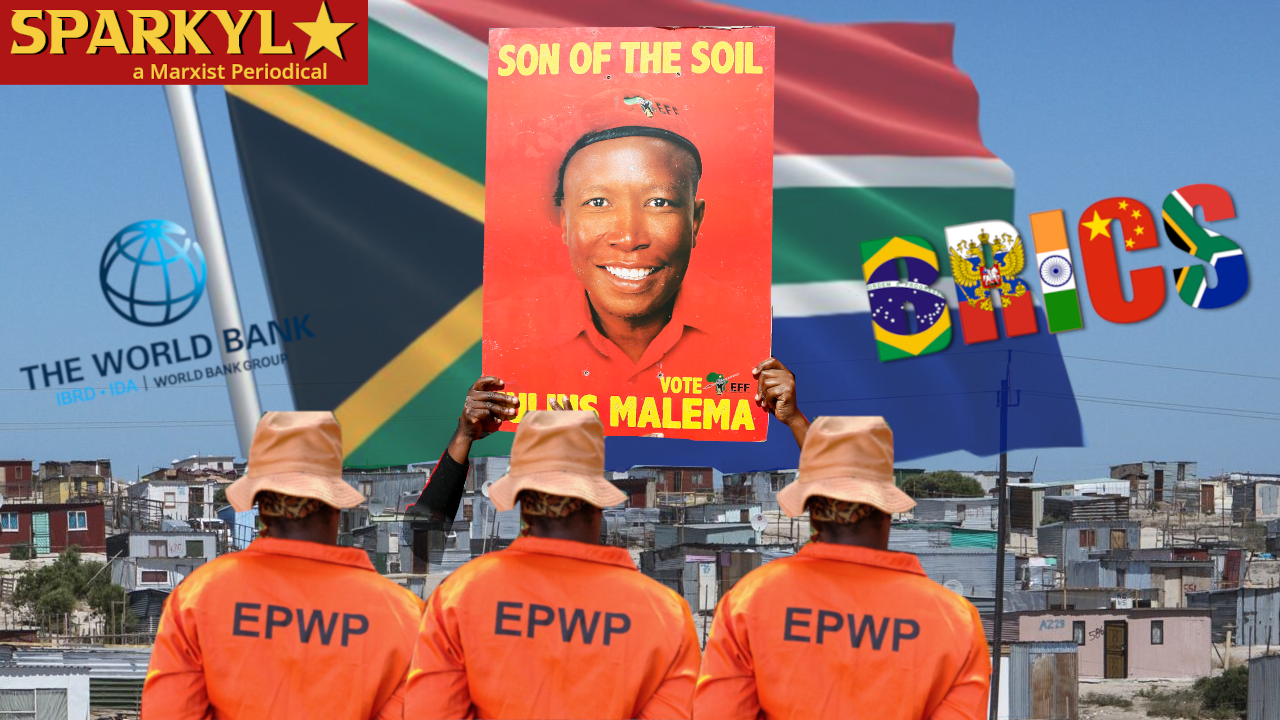
Below them, coming in fourth at just over 3 million votes,[66] was the Economic Freedom Fighters (EFF), which, ever since the party’s formation in 2013, has put forward the slogan, “economic freedom in our lifetime,”[67] describing itself in the 2025 update to its manifesto as “a radical and militant economic emancipation movement that brings together revolutionary, fearless, radical, and militant activists, workers’ movements, nongovernmental organisations, community-based organisations and lobby groups under the umbrella of pursuing the struggle for economic emancipation.”[68] Their leader, Julius Malema, is a former ANC youth leader who was let go of the party in 2012 for his fiery and public critiques of both the president and the private mining industry, which both he and the party he now heads believes should be publicly owned.[69]
Unlike the MK Party, the EFF specifically attempts to appeal to the revolutionary working class, fighting for the “economic emancipation of the people of South Africa, Africa and the world,”[70] and professing to draw “inspiration from the broad Marxist-Leninist tradition.”[71]
5. Nationalism Belongs to the Bourgeoisie
Unfortunately, rather than combat the nationalist sentiment around them with internationalism and solidarity with the global proletariat as any actual Marxist party should, building a powerful and needed alliance in their struggle to economically emancipate the South African masses, the EFF bows to these spontaneous sentiments, grafting them into something “Marxian” with tired racial/nationalist revisionism. This revisionist trend is nothing new, and is illustrated fairly well theoretically by J. Sakai in his book, Settlers: The Mythology of the White Proletariat. We addressed these errors in the article, “Demarcating the Proletariat: Internationalism, Imperialism, and the Labor Aristocracy,” from Sparkyl No. 1.
In line with this type of revisionism, the EFF holds that South Africa has “racialised capitalism” that requires “double vision to see the single unequal South African economy as two systems.”[72] Dividing the people in the same way and using the same legal definitions as their capitalist oppressors, they chop up the working class by race – African, Coloured, Indian/Asian, and White[73] – stratifying them based on their supposed position under the oppression of “white monopoly capital.”[74] In these racial theories, they cater to the Black African nationality, seeing the Black African worker as “the core of those Economic Freedom Fighters seek to emancipate from economic subjugation and oppression,” since they constitute “the core of the motive forces (forces that drive revolutionary motion) for radical change.”[75] However, the actual revolutionary “motive force” is the class of the proletariat, and the EFF does this group no service by dividing their country’s proletariat and inviting sectarianism due to national difference.
We can apparently lay this deplorable revisionism by the EFF at the feet of the liberal psychologist-poet, Frantz Fanon. At the same time, and in the very same sentence in their manifesto that they state their politics are inspired by Marx and Lenin, we see the inclusion of “Fanonian schools of thought” (referring to the contributions of the psychiatrist, Frantz Fanon, and the national “de-colonial” movements inspired by him) held at the same height as Marxist dialectical materialist science.[76] As recent as the current 2024 revision, their constitution states that the party “identifies itself as a Marxist, Leninist and Fanonian organisation.”[77]
While they blur Black Nationalism with the wider context of a “Marxian” economic view, the party has garnered international attention by enflaming racial antagonisms in populist and quite un-Marxist fashion. They incorporate the apartheid-era “struggle song,” “Dubul’ iBhunu (Kill the Boer)” – which contains the lyrics, “kill the Boer,” and “kill the farmer” – in their political rallies, with their “Commander in Chief,” Malema himself, leading the chant.[78] Additionally, speaking of the party, Malema has stated at rallies and in a 2018 interview that “we have not called for the killing of white people, at least for now. I can’t guarantee the future.”[79]
These examples – along with the chimera of their political philosophy – show that the EFF is actually quite skilled at melding the racial antagonisms and general philosophy of national revolt with seemingly “Marxist” working-class politics, revealing itself as one of the better and more successful examples of Sakai’s revisionist trend taking political force. In addition to playing into the theatre being set up for the masses by the international capitalist community, giving further impetus for the Afrikaners and their extra-national white nationalist reactionary forces, the limited and racial view of the South African contradictions promoted by both the MK Party and the EFF necessarily fails to explain the real material position of the South African proletariat and lower-classes, and thus ultimately reinforces their economic slavery.
The man whose name makes up a part of the EFF’s professed tendency – Lenin himself – revealed the limits of “working-class nationalism” and how it ultimately serves the capitalist camp.
The elements of democratic and socialist culture are present, if only in rudimentary form, in every national culture, since in every nation there are toiling and exploited masses, whose conditions of life inevitably give rise to the ideology of democracy and socialism. But every nation also possesses a bourgeois culture (and most nations a reactionary and clerical culture as well) in the form, not merely of “elements”, but of the dominant culture. Therefore, the general “national culture” is the culture of the landlords, the clergy and the bourgeoisie. This fundamental and, for a Marxist, elementary truth, was kept in the background by the Bundist,[1] who “drowned” it in his jumble of words, i.e., instead of revealing and clarifying the class gulf to the reader, he in fact obscured it. In fact, the Bundist acted like a bourgeois, whose every interest requires the spreading of a belief in a non-class national culture.
– V. I. Lenin, Critical Remarks on the National Question, 1913[80]
Here, Lenin dissects national culture in general. Because the capitalists have the power within society, their dominance over society is also dominance over any national sentiment that springs up. The unifying call for greater national autonomy, while taken up by the working and poor classes, actually signifies greater autonomy for only a specific section of the economy: the beleaguered petty and small-level bourgeoisie of the nationality, the “nationalist petty bourgeois” Lenin mentions.
Regarding South Africa, this section of low-level bourgeoisie seeks to throw off foreign “white wealth,” or otherwise promotes radical racial politics, in an effort to rid the country of the foreign monopolist presence that antagonizes their business, hoping to create their own monopolies in the vacuum left. They are relegated to low-level domestic production, scraping together whatever labor forces they can but never able to do so with much success because they are unable to compete with the relatively higher wages offered by the monopolists and their lower costs of business, who take in the lion’s share of both South African labor and the profit to be gained by its exploitation. Crunched down, these smaller bourgeois forces are always falling into the proletariat proper and need a popular movement simply to maintain their status as economic parasites, and popular movements are formed by the majority of society; namely, the working and poor classes.
Nationalism in general and even the EFF’s “working class nationalism” and its revisionist “Marxism” brings political form to this altogether spontaneous movement among a section of crunched bourgeoisie. While it promises and will – with the support of the working masses of the country – be capable of producing tangible economic benefits to these capitalist labor-owners, it can offer nothing to the working class but the promise of eventual reforms, and aims to ultimately develop the productive forces of the country against them and along capitalist lines, as we shall see.
Like the bourgeoisie who propagate it, nationalism is constantly being eroded by the overwhelming cohesive force of the productive forces, a point Marx made himself. National sentiment is mostly idealism, and because it supplants ideas and feelings over objective material class relations, it is rejected by Communists for solidarity with the international proletarian class, which has no country, especially with the fall of the socialist economies in China and Eastern Europe.
Generally speaking, big industry created everywhere the same relations between the classes of society, and thus destroyed the peculiar individuality of the various nationalities. And finally, while the bourgeoisie of each nation still retained separate national interests, big industry created a class, which in all nations has the same interest and with which nationality is already dead; a class which is really rid of all the old world and at the same time stands pitted against it.
– Karl Marx and Friedrich Engels, The German Ideology, 1845[81]
We can look at the nationalist contradiction between the oppressed Ukrainians and the political and economic supremacy of the “Great Russian” nationality, a contradiction that has only become sharper today in light of the Russia/Ukraine War, for guidance on how proletarians should view national or “racial” antagonisms. Lenin diagnosed the problem way back in 1913, and his proletarian view of the contradiction can be applied in a general way, including to the situation in South Africa.
If a Ukrainian Marxist allows himself to be swayed by his quite legitimate and natural hatred of the Great-Russian oppressors to such a degree that he transfers even a particle of this hatred, even if it be only estrangement, to the proletarian culture and proletarian cause of the Great-Russian workers, then such a Marxist will get bogged down in bourgeois nationalism. Similarly, the Great-Russian Marxist will be bogged down, not only in bourgeois, but also in Black-Hundred nationalism,[2] if he loses sight, even for a moment, of the demand for complete equality for the Ukrainians, or of their right to form an independent state.
The Great-Russian and Ukrainian workers must work together, and, as long as they live in a single state, act in the closest organisational unity and concert, towards a common or international culture of the proletarian movement, displaying absolute tolerance in the question of the language in which propaganda is conducted, and in the purely local or purely national details of that propaganda. This is the imperative demand of Marxism. All advocacy of the segregation of the workers of one nation from those of another, all attacks upon Marxist “assimilation”, or attempts, where the proletariat is concerned, to contrapose one national culture as a whole to another allegedly integral national culture, and so forth, is bourgeois nationalism, against which it is essential to wage a ruthless struggle.
– V. I. Lenin, Critical Remarks on the National Question, 1913[82]
We wage this struggle against bourgeois nationalism by remaining consistent materialists, and advocating for the proletarian class, which we correctly understand is an international class, over any one particular section of any one national culture.
In advancing the slogan of “the international culture of democracy and of the world working-class movement”, we take from each national culture only its democratic and socialist elements; we take them only and absolutely in opposition to the bourgeois culture and the bourgeois nationalism of each nation...
The question is whether it is permissible for a Marxist, directly or indirectly, to advance the slogan of national culture, or whether he should oppose it by advocating, in all languages, the slogan of workers’ internationalism while “adapting” himself to all local and national features...
Those who seek to serve the proletariat must unite the workers of all nations, and unswervingly fight bourgeois nationalism, domestic and foreign. The place of those who advocate the slogan of national culture is among the nationalist petty bourgeois, not among the Marxists.
– V. I. Lenin, Critical Remarks on the National Question, 1913[83]
6. The Disastrous Loss of “Winning Over” the Bourgeoisie
Lenin not only spoke of the dangers of following the bourgeoisie blindly down the path of national struggle, but also of the need for working-class policy that separates itself from the policy of the capitalists; the proletariat only going the same direction with the bourgeoisie at times, but never having the same destination.
The bourgeoisie, which naturally assumes the leadership at the start of every national movement, says that support for all national aspirations is practical. However, the proletariat’s policy in the national question (as in all others) supports the bourgeoisie only in a certain direction, but it never coincides with the bourgeoisie’s policy. The working class supports the bourgeoisie only in order to secure national peace (which the bourgeoisie cannot bring about completely and which can be achieved only with complete democracy),[3] in order to secure equal rights and to create the best conditions for the class struggle...What every bourgeoisie is out for in the national question is either privileges for its own nation, or exceptional advantages for it; this is called being “practical”. The proletariat is opposed to all privileges, to all exclusiveness. To demand that it should be “practical” means following the lead of the bourgeoisie, falling into opportunism.
– V.I. Lenin, The Right of Nations to Self-Determination, 1914[84]
While, after achieving power, the proletariat, as the state organized as the dictatorship of the proletariat, must inevitably take the capitalists into consideration and even occasionally put forward capitalist policy, it does not shy away from the fact that its role is to liquidate the capitalists as a class, and it makes use of every reasonable opportunity to do so, never losing sight of the fact that the proletarian class and proletarian governance is oppositional to the bourgeoisie in the final view.
It’s true that, if the dictatorship of the proletariat were to act too rashly and put forward only aggressive proletarian policy which acts against the capitalist class, it would be inviting the movement to be crushed and all our gains lost by counterrevolutionary bourgeois forces, who would become incensed by the energetic increase in their oppression and become militant and call out for help to their allies in the international community. Therefore, there is a need for pragmatism regarding the liquidation of the capitalists as a class.
This question of pragmatism on the part of the dictatorship of the proletariat, which reveals the clear fact that socialism cannot be won overnight and must necessarily accommodate capitalism to some degree in its early stages, has been completely misunderstood by many modern “Marxists” as an open invitation to painstakingly wash over objective capitalist policy with the wishful thinking and rose-colored glasses of a sentimental amateur to the movement. They have accepted the complete liquidation of the power of the proletariat, and even before they have begun and while they still struggle powerless beneath the rule of the capitalists. In some absurd incremental revolution occurring only in their deluded minds, rule by capitalists and capitalist development betrays its own nature and inevitably spins around into socialism. Moreover, this blatant co-option of the proletariat is a desired and needed tactic in their minds, supposedly called for by the objective material conditions of society.
The EFF supports this revisionist idea openly, garnering the support and sympathy of the bourgeoisie even to the point of making them a core of the party. In their “Marxism FAQ” document – one of the few explicitly “Marxist” resources available on the EFF’s website – they deny the contributions of actual revolutionaries for the working-class, Stalin and Mao,[85] and bring up the cursed “Transitional Program” of Trotsky, using it as the philosophical grounding for the party’s blatant bourgeois co-option.[86]
So what do we say to small farmers? In fact, what do we say to all small business people, small shopkeepers, etc.? From a historical point of view these elements are condemned to disappear under capitalism due to the relentless competition of the big farmers, the big supermarkets, etc.
But they still exist in this society and it is our duty to develop a program that would win them to the revolutionary party. Trotsky takes this up in the Transitional Program, and also in other writings. [87]
In line with this philosophy, the EFF supports the tired neo-liberal policy of gutting the public taxes and turning them into subsidies for private capitalists. Building bourgeois relations and growing the private market is supposedly how they carry out “economic freedom struggle.”
The professionals and small scale entrepreneurs also stand to objectively benefit (from the party program) because economic freedom struggle will guarantee them access to workable development finance and enterprise support, which will not be based on Sureties, which they do not have.[88]
Contrary to Trotskyite and EFF revisionist “duty” to small business, Engels describes the actual view that the working class should have towards the small sections of capitalists.
The struggle between usurer and industrial capitalist is one within the bourgeoisie itself, and though no doubt a certain number of petty bourgeois will be driven over to us by the certainty of their impending expropriation de la part des boursiers (English: by the money-bags), yet we can never hope to get the mass of them over to our side. Moreover, this is not desirable, as they bring their narrow class prejudices along with them.[89]
If even this relatively weak and oscillating section of petty bourgeois owners liquidates the movement with their class prejudices, how much more is the liberation of the proletariat liquidated by the inclusion of “small and mediumsized enterprises,” which the EFF plans to provide with “sustainable finance”? Listen to how they court the capitalists’ favor:
The manner in which South Africa finances and provides support to small and mediumsized enterprises, most of which have the potential to grow, is not adequate. The EFF will develop a model that will provide sustainable enterprise finance and development without requiring sureties from previously disadvantaged individuals and youth, who do not own anything as surety, but have workable and bright ideas and innovations that can make business sense.[90]
It is not the duty of a working-class party, and especially a so-called “Marxist” party, to put forward policy pleasing to the bourgeoisie or to “win over,” in a general way, an oppressor class to the cause of the revolution. The latter idea breaks the entire philosophical foundations of Marxist class struggle entirely. While – as mentioned before – the dictatorship of the proletariat will have to rely on the market and pass capitalist legislation in an effort to keep the class antagonisms of their society together, this should be a bump in a road of clear bourgeois suppression and expropriation of their capital and property, coinciding with collectivization of the economy under the state and gradual passing of both the productive forces and the state apparatus into the hands of the workers. This is the policy of the proletarian party, despite whatever bourgeois concessions it must make once achieving power.
Rather than allow the proletariat’s demands to take center stage, as an actual working-class party would, the EFF has the proletariat make concessions in the here and now, allowing itself to be led by an entirely bourgeois program.
7. Oscillation and Opportunism
These concessions are many. Outside of Communist aesthetics, the EFF gives mostly the illusion of attainable bourgeoisdom to the working class, tantalizing them with land ownership and cheap business investments. Practically the only labor-specific benefit the EFF guarantees to the workers is minimum wages;[91] certainly not the cutting-edge of proletarian policy. The party’s platform guarantees R6,000 (about $345 USD) a month, or just a little over $2 an hour,[92] which is only about 40 cents (USD) an hour higher than what the current ANC government offers.[93] Mostly, it seems the workers are to content themselves with the “massive development of the African economy,” – development that will actually be against them since they are the oppressed source of economic profit – and that will bring with it “millions of sustainable jobs.”[94] Ronald Reagan’s “trickle-down” economic theory is apparently operating as the true guiding light of the party.
While advocating for state-control of the “commanding heights of the economy,” the EFF – a supposed Marxist party – has stated that “there will never be wholesale nationalisation and state control of every sector of South Africa’s economy.”[95] Apparently these “Marxists” do not believe Marx when he says to seize the means of production. However, the party states that “nationalisation of strategic sectors and assets will be blended with a strong industrial policy to support social and economic development.”[96] Though they do commit to further monopolization of private industry by the state, the EFF actually plans to lay the state monopoly prostrate at the feet of the private sector. This is not the socialist state-owned command-economy of a Marxist-Leninist party, but an attempt to break the current capitalist monopoly with the power of the state so that a smaller capitalist monopoly can develop; perpetuating the slavery of the working class by enriching the small bourgeoisie and helping them along in their quest to extract the surplus labor value of the proletariat.
The party even plans to serve the labor of some of the most unfortunate South Africans, those who live in townships, to the bourgeoisie directly. Their 2024 election platform states that “under the EFF government, township economy equates to township industrialization” and they “will declare township areas as special tax-free zones in exchange for 2,000 full-time jobs per investor paying a minimum wage and pension contribution per company.”[97]
Regarding one of South Africa’s most contentious issues – the question of land – the party upholds that restitution from apartheid has not been performed. However, it simultaneously holds that land should be entirely expropriated by the state, contracted out at 25 year increments to be worked according to “sustainable-development purposes,”[98] while also stating its intention to mobilize “established industrial entrepreneurs and corporations behind a consolidated national economic-developmental plan.”[99] There is an apparent fantasy going on with the merging of these two concepts, as “established corporations” and “entrepreneurs” will never agree with the complete gutting of the real-estate industry – not to mention the disruption of their land tenure – that full public expropriation of land entails. When faced with this contradiction, the EFF shows every sign that it will undoubtedly side with “established corporations,” and ease up on the more aggressive land policies the party has built a reputation on if or when it achieves power. It will likely, like the current previously “revolutionary” party in South African government, the ANC, tell the workers and the poor to wait for the aggressive land reform they demand (though this demand, in its current form, is mostly a symptom of their spontaneity; looking backwards to the widely exterminated peasant economy of South Africa’s past and, understandably, swooning over the potential for private property and its promise of higher economic standing) while it develops both the land and the economy against their interests.
Last December[100] the EFF blatantly revealed its capitalist nature by a resolution made during their 3rd “National People’s Assembly.” They decided that the party would acquire “commercial properties to generate rental income,” becoming, evidently, the people’s landlord.[101] Surely, because it is being done by “Economic Freedom Fighters,” the bourgeois actions of investing capital and gaining a return from the speculative real-estate market aren’t actions of a bourgeois party (sarcasm). Even at its most “Marxist,” the party resuscitates the dead theory of economism with such tactics, betraying the working class and any real call for popular and energetic land reform by its objective investments in commercial markets. Still, at the same Assembly that this resolution was agreed upon, the party renewed its classic demand for full expropriations of land, adding their recent call for the establishment of democratically-elected “People’s Land Councils”[102] within the High Courts of each of the provinces[103] to oversee what is apparently to be a racial handover of the land. Their 2024 platform contains the promise to “transfer 50% of the land to black people within the first five years in government.”[104] The party better make their real-estate investments fast or their own supposed land reclamations will drop the bottom out of the market! More sarcasm, of course – highlighting the contradictions and incoherence an opportunist “Marxist” party finds itself hopelessly mired in.
More incoherence: in their manifesto, the EFF calls for “free trade across the entire African continent, with common tariffs for goods and services from country to country” on page 25,[105] and then, contradictorily, argues for strict protectionism on page 11, calling for “massive protected industrial development to create millions of sustainable jobs.”[106] These are two economic ideas that are quite mutually exclusive of one another and reflect the contradicting class interests of differing levels of bourgeoisie – with the larger and more successful regional capitalists in favor of a “free trade” Pan-African approach, and the smaller domestic capitalists favoring the rigorous protection of their small markets through national protectionist measures. The EFF covers both of these bourgeoisie bases by announcing their conflicting economic needs as part of its program, despite the contradiction in upholding both.
Neither of these ideas belongs to the working-class however, whose own economic program would consist of the expropriation of private capital and the construction of collectively or state-owned markets to produce commodities of immediate use to the South African people. This is, in-fact, what anti-capitalism is in the proper materialist sense, something a Marxist party that “is premised on building solidarity and working relationships with all movements in the world that identify ideologically with anti-capitalism”[107] should understand.
This incoherence is acceptable and, in many ways, desirable for a party like the EFF. They provide a confused jumble of working-class slogans, “leftist” pop-culture dog whistles, and contradictory economic policies amid their capitalist economic planning because they are opportunists, and rely on the confused state of the masses in order to bring large swathes of them into their influence, which is the only way the party can be successful. At the core of their party however, is the small nationalist bourgeoisie.
It is these same smaller radical nationalist capitalists behind the nationalism and quite similar economic policies of the ex-president Zuma and his non-Marxist MK party, whose Zulu name, uMkhonto weSizwe, harkens back to the defunct apartheid-era military wing of the now neo-liberal and ruling ANC party.[108] It was a similar small radical nationalist section of capitalists – decades ago – that carried the ANC itself into its current position of power. Now, this contingent from 30 years ago has grown into big bourgeoisie who are wholly in the camp of the international financiers, riling up the smaller bourgeoisie below them into sentiments of national revolt.
The entire history of the country post-apartheid reveals the truth that the bourgeoisie of any nationality is incapable of bringing out actual “economic freedom,” and that the antagonisms between the international financiers and the domestic bourgeoisie within the country will not be solved by nationalism but by the conscious motion of the class conscious (as opposed to nationally conscious) proletariat, who alone is committed to the elimination of all capitalist relations.
8. “Marxists” and the BRICS Wall
The EFF’s bourgeois constituents are desperate for investment (as all bourgeois are), and while claiming to reject “global imperialism”[109] the party does not disguise its love for the world’s second-most powerful association of capitalist-imperialist nations, who are also the country’s up-and-coming trade-partners. In this regard, it has a lot in common with the non-Marxist MK party, which itself desires to “foster closer trade, research, and development and investment relationships with the BRICS countries to foster technological upgrading.”[110] In tune, the EFF’s National Assembly, bizarrely, resolved last year to advocate for the “establishment of the BRICS+ Global Museum with an intention to highlight the unique rich heritage and histories of the BRICS+ countries.” According to the resolution, the museum will “act as a tool to facilitate Cultural Diplomacy and relations between BRICS+ countries and further counter the Euro-Western and Imperialistic canon that seeks to position Europe as the maker of universal history and leader of modernity.” Here we see the idealist nationalism of the party allowing for cooperation with (and we could say the canonization of) capitalist-imperial countries. In this regard, the party stoops low, even to the incredible point of advocating for the Russian president, “His Excellency, Vladimir Putin,” to have political immunity during the G20 summit this November.[111]
BRICS+ being “good” while NATO and “Western” capital being “bad,” reflects, again, a lower section of bourgeoisie’s political interest, and also a global revisionist trend within Marxism and “the left” generally that should be viciously countered. This trend erroneously holds that proletarian liberation comes from critically supporting junior capitalist-imperialist countries against their bigger capitalist-imperialist rivals. It completely fails to understand the basic capitalist in-fighting that always occurs within capitalist markets, and wrongfully and romantically performs all kinds of mental gymnastics to proscribe proletarian characteristics to the junior player, “critically” supporting them, not unlike the liberal who, recognizing the evil of the extra-national corporation, busies themselves with the politics of “buying local.” Despite being promoted by so-called “Marxists,” who should be standing on the side of the proletarians and the poor, this is actually the line of mostly Chinese and Russian bourgeoisie, the folks who dominate the BRICS+ alliance and who are engaged in a vicious tug of war not only to maintain their current access to labor, but to make new accumulations over and against their Western adversaries as dictated by the growth of profit required of their productive forces. The BRICS+ capitalists promote their own nationalities and ally with the smaller bourgeoisie in the EFF because they share a similar goal to “counter the Euro-Western and Imperialistic canon,” and for the same capitalist purpose of pushing back “Western” NATO capital to make room for their own accumulations. All that can come from this arrangement is the creation of new monopolist forces and South African comprador capitalists who are in the service of China and Russia rather than the U.S. and Europe.
As a bone thrown to the lower-classes however, the EFF does “demand that Brazil, Russia, India, China and South Africa (BRICS+) evolve into a vehicle of revolutionary change.”[112] But only the ignorant would believe that an association of global financial capitalist nations will or could transform themselves and their entire societies away from the violence of capitalist-imperialism due to the “demand” of a single South African party.
9. Conclusion
This article does not claim to give a full picture of the position of the South African proletariat. Much more study should be done, and especially by principled South African Communists themselves who are obviously best capable of arriving at an accurate perspective. However, we have attempted to provide a brief and we believe valuable overview to all interested readers that offers some clarity to the class situation, and conveys needed lessons to the movement regarding the capitalist role of reaction, popular revisionism, and bourgeois co-option.
Unfortunately, we are forced to admit that the country’s largest “leftist” party, which we have spent considerable time on for taking the name of Marx and Lenin in vain, has not risen above the base spontaneous nature of a bourgeois-dominated revolt thus far, despite our own personal wishes that a strong party of workers and the poor was making real strides for the proletarian movement, garnering millions of votes and constituting the global Communist vanguard in the desperate situation of post-apartheid South Africa. In fact, the economic situation makes the country a prime candidate for such an organization, but the vanguard is forever delayed so long as “Marxists” and “Communists” continue to blind themselves to the truth, accept revisionism, the nationalism of the capitalists, and the liquidation of the movement.
In 2013, the National Union of Metalworkers of South Africa (NUMSA), the largest trade-union in the country, took up the radical and working-class position that trade unions should take a commanding role in the government with the establishment of a special congress.[113] They were expelled from the labor federation, COSATU, because to argue this meant not supporting the ANC in the 2014 elections, which COSATU is obliged to do due to the stipulations of the Tripartite Alliance, as mentioned before.[114] The labor party NUMSA formed in 2018, the Socialist Revolutionary Worker’s Party (SRWP), is an openly Marxist-Leninist political party calling itself “the only political Party interested in destroying the exploitative class system that is capitalism and building a society free of oppression and economic exploitation where power will rest in the hands of the majority: SOCIALISM.”[115] The party participated in the 2019 election but fared poorly.[116] Their website is now defunct, and they have not been public since, but NUMSA still claims its existence, Marxism-Leninism, and continues to pursue politics, advising its members on the intricacies of the platforms of bourgeois candidates and pushing them away from the most reactionary parties.[117]
This one seemingly small anecdote – and, decidedly, a political defeat – still shows that Communism is alive in South Africa, and it is informing the consciousness of at least somewhat energetic workers. Whether NUMSA is capable of moving beyond nationalism and the tactics of petty trade unionism entirely and craft a vanguard party from its legions of metal workers, or that role will be left to some other political formation that ties living labor to the Marxist philosophy of social revolution, the task will be done sooner or later, and then the socialist cause will make real strides in South Africa.
The country’s economic antagonisms are sharp and getting sharper. The ANC’s unfulfilled promises of equality have grown rancid, and they are inching towards more aggressive measures of land reform in order to maintain their legitimacy with the people, incensing an international community of reaction. The growing bourgeois revolt, with its rise in political parties who are catering to labor and the poor in order to build their political base, signals a steady rise in the political consciousness of the country. This will also illuminate to the lower classes their real oppression at the hands of the bourgeoisie, and, through Marxist science, clearly reveal to them the hurdles they must successfully scale in overcoming the ruling class and their mode of production.
The proletariat and the poor in South Africa continue to express their discontent with their oppressed conditions via “service delivery protests,” riots in the townships, illegal land occupations, and a strong populist “no vote” sentiment;[118] spontaneous expressions which will develop into political movements of the dispossessed sections of society, and, through practice, into the revolutionary class-conscious South African proletariat. Though, while there fails to be a strong enough and principled enough Marxist voice to give form to their movement and make it a true proletarian liberation movement, the South African poor and proletarians will have to carry on a vicious struggle within and against the organizations of bourgeois revisionists and liberal radicals who provide non-materialist “answers” to their oppression, “answers” that are completely conducive to the capitalist-imperial mode of production and their own economic enslavement as a whole, in order to find themselves politically.
In the same infamous 2018 interview about “the killing of white people,” Julius Malema correctly said, “if things are going the way they are, there will be a revolution in this country I can tell you now.”[119]
What kind of revolution will South Africa face? Will it be one in service to not only the masses of South Africa, but the whole world – the socialist class revolution of the proletariat/poor taking the leading role and carrying out the Communist program? Or will it be another tired inter-class revolt of the bourgeoisie – capitalism again using nationalist sentiment to recycle itself with the misled energy of the masses, granting privilege to a small section of business owners while reinforcing wage-slavery and the oppression of the masses at a time when it might actually be thrown off? The answers to these questions are at least somewhat dependent on the ability of principled Marxists to perform ideological work among the masses, saturating society with the Marxist dialectical materialist worldview and vigorously combatting all revisionism so that the workers of the whole world may be given an appropriate internationalist class view of their situation to break through all petty bourgeois and nationalist propaganda.
The people everywhere must prioritize this ideological work so that a true Marxist party may form from the rejection of revisionism that the imparting of actual Marxist dialectical materialism entails; either rising from the ashes of the old revisionist and reformist formations, or through a conscious and organized struggle within them which sidelines the revisionists and wins the party for the energetic cause of proletarian liberation.
There is immense political opportunity in South Africa for a principled formation to make serious gains...for the whole international proletarian class and thus for the whole world. But it must shake off the dead weight of revisionist nonsense, wipe the crust from its tired eyes, remember what is at stake, and keep its eyes always on the world that it will gain; never being afraid to leave the one it has behind.
Footnotes
[1] The “Bundists” were a group of Jewish socialists who promoted Jewish cultural autonomy and sectarianism along national lines in addition to supporting workers.
[2] The “Black Hundreds” were groups of militant counter-revolutionary reactionaries that formed after the first Russian Revolution of 1905. They were anti-semitic, and upheld the national supremacy of the “Great Russians” over other minorities.
[3] By “complete democracy” Lenin refers to economic democracy, i.e. socialism.
Endnotes
[1] The Presidency of the Republic of South Africa. “President assents to Expropriation Bill.” Republic of South Africa. 23 Jan 2025. https://www.thepresidency.gov.za/president-assents-expropriation-bill.
[2] Government Gazette. No. 51964. Vol. 715. Republic of South Africa. 24 Jan 2025. https://www.parliament.gov.za/storage/app/media/Acts/2024/Act_13_of_2024_Expropriation_Act_2024.pdf
[3] Government Gazette. No. 1314. Vol 121. Republic of South Africa. 9 Jul 1975. Pg. 4. https://www.gov.za/sites/default/files/gcis_document/201505/act-63-1975.pdf.
[4]Government Gazette. 24 Jan 2025. Pg 28.
[5] Department: Statistics South Africa. “Mid-year population estimates 2024.” Republic of South Africa. 30 Jul 2024. Pg. 11. https://www.statssa.gov.za/publications/P0302/P03022024.pdf.
[6] Adepitan, Ade. “Visiting a whites-only town in South Africa was difficult. Even sadder was the racist backlash in the UK.” The Guardian. 26 Mar 2024. https://www.theguardian.com/commentisfree/2024/mar/26/whites-only-town-south-africa-racist-backlash-uk-documentary.
[7] Sexwale, Tokyo. “Address by the Minister of Human Settlements, Tokyo Sexwale MP, on the
occasion of the Human Settlements Budget Vote, National Assembly, Cape Town.” 21 Apr 2010. https://www.dhs.gov.za/sites/default/files/speeches/21042010_minister.pdf.
[8]Adriaanse, Dominic. “#BlackMonday: City swamped by more protesters than planned.” Independent Online. 31 Oct 2017. https://iol.co.za/capetimes/news/2017-10-31-blackmonday-city-swamped-by-more-protesters-than-planned/.
[9] Crime Registrar Head Office. “Police Recorded Crime Statistics Republic of South Africa Fourth Quarter of 2024-2025 Financial year (January 2025 to March 2025).” 2024. Pg. 8. https://www.saps.gov.za/services/downloads/2024/2024-2025_Q4_crime_stats.pdf.
[10] World Bank. “Intentional homicides (per 100,000 people) - South Africa.” 2021. https://data.worldbank.org/indicator/VC.IHR.PSRC.P5?locations=ZA.
[11] South African Police Service. “Minister Senzo Mchunu: Release of 2024/2025 Fourth Quarter Crime Statistics.” 23 May 2025. https://www.gov.za/news/speeches/minister-senzo-mchunu-release-20242025-fourth-quarter-crime-statistics-23-may-2025.
[12] European Union. “MEPs European Parliament, Udo VOIGHT.” https://www.europarl.europa.eu/meps/en/124832/UDO_VOIGT/history/8#detailedcardmep. Accessed on 26 Sep 2025.
[13] Die Hiemat. “Udo Voight.” Accessed on 26 Sep 2025. https://die-heimat.de/udovoigtgedenken/
[14] Voight, Udo. “Question for written answer E-000476-18 to the Commission (Vice-President/High Representative)
Rule 130.” 29 Jan 2018. https://www.europarl.europa.eu/doceo/document/E-8-2018-000476_EN.html.
[15] Bauder, David. “Fox’s Carlson stunned by reaction to stories on South Africa.” AP News. 24 Aug 2018. https://apnews.com/article/69edd18af846491fa2c27b5bd3d483d4.
[16] Chung, Frank. “‘Bury them alive!’: White South Africans fear for their future as horrific farm attacks escalate.” News.com.au. 25 Mar 2017. https://www.news.com.au/finance/economy/world-economy/bury-them-alive-white-south-africans-fear-for-their-future-as-horrific-farm-attacks-escalate/news-story/3a63389a1b0066b6b0b77522c06d6476.
[17]SkyNews. “White minority ‘targeted’ in South Africa.” 12 Mar 2018. https://www.skynews.com.au/world-news/news-corp-australia-chief-reporter-paul-toohey-says-white-farmers-in-south-africa-are-enduring-extreme-conditions-with-wide-spread-violence-occurring-across-rural-areas/video/b2cbf62170b2765cdd8a36bd43d575d0/
[18] Faku, Dineo. “MC Mining gets key properties at long last.” Independent Online. 16 Nov 2018. https://iol.co.za/business-report/companies/2018-11-16-mc-mining-gets-key-properties-at-long-last/.
[19] Dwyer, Colin. “Here's The Story Behind That Trump Tweet On South Africa — And Why It Sparked Outrage.” NPR. 23 Aug 2018. https://www.npr.org/2018/08/23/641181345/heres-the-story-behind-that-trump-tweet-on-south-africa-and-why-it-sparked-outrage.
[20] Faku.
[21] Cuddihy, Claire. “MC Mining finalises coal purchase agreement.” World Coal. 30 Oct 2018. https://www.worldcoal.com/coal/30102018/mc-mining-finalises-coal-purchase-agreement/.
[22] The White House. “Addressing Egregious Actions of The Republic of South Africa.” 7 Feb 2025. https://www.whitehouse.gov/presidential-actions/2025/02/addressing-egregious-actions-of-the-republic-of-south-africa/.
[23] Lissoni, Arianna. “Umkhonto we Sizwe (MK): The ANC’s Armed Wing, 1961–1993.” Oxford Research Encyclopedias. 22 Dec 2021. https://oxfordre.com/africanhistory/display/10.1093/acrefore/9780190277734.001.0001/acrefore-9780190277734-e-1098.
[24] Republic of South Africa. “The Constitution of the Republic of South Africa.” 4 Dec 1996. https://www.gov.za/documents/constitution/constitution-republic-south-africa-04-feb-1997.
[25] Ibid. https://www.gov.za/documents/constitution/chapter-2-bill-rights#25.
[26] Deininger, Klaus. “Making Negotiated Land Reform Work: Initial Experience from Colombia, Brazil and South Africa.” World Development. Vo 27. Issue 4. Apr 1999. Pg. 26. https://landwise-production.s3.amazonaws.com/2022/03/Deininger_Making_Negotiated_Land_Work_initial_experience_from_brazil_colombia_and_south_africa_1999-1.pdf.
[27] Department: Land Affairs. “GRANTS AND SERVICES POLICY OF THE DEPARTMENT OF LAND AFFAIRS, Version 7.” Republic of South Africa. 16 Jul 2001. https://www.gov.za/sites/default/files/gcis_document/201409/landgrantsservices0.pdf.
[28] Republic of South Africa. “Agriculture, Land Reform and Rural Development on resolution of land claims.” 19 Jun 2024. https://www.gov.za/news/media-statements/agriculture-land-reform-and-rural-development-resolution-land-claims-19-jun.
[29] Lahiff, Edward. “’Willing Buyer, Willing Seller’: South Africa’s Failed Experiment in Market-Led Agararian Reform.” Third World Quarterly. Vol 28, No 8. Taylor & Francis, Ltd. 2007. Pg. 1580. https://www.jstor.org/stable/20455018.
[30] Ibid. Pg 1581.
[31] Basu, Soutrik. “Community, Conflict and Land: Exploring the Strategic Partnership Model of South African Land Restitution.” Journal of International Development. Vol 28. Issue 5. Pg. 6-7. https://www.researchgate.net/publication/283959786_Community_Conflict_and_Land_Exploring_the_Strategic_Partnership_Model_of_South_African_Land_Restitution.
[32] South African Reserve Bank. “Quarterly Bulletin - June 2025.” Jun 2025. Pg. 4 https://www.resbank.co.za/en/home/publications/publication-detail-pages/quarterly-bulletins/quarterly-bulletin-publications/2025/june.
[33] Finances One. “South Africa.” World Bank Group. Accessed on 27 Sep 2025. https://financesone.worldbank.org/countries/South%20Africa.
[34] Finance Standing Committee. “Finance Minister on R11 billion World Bank loan.” Parliamentary Monitoring Group. 1 Feb 2022. https://pmg.org.za/committee-meeting/34165/.
[35] Lahiff. Pg. 1578.
[36] Land Reform and Rural Development Committee. “Land Reform and Rural Development programmes & legislation overview.” Parliamentary Monitoring Group. 21 Aug 2024. https://pmg.org.za/committee-meeting/39296/.
[37] Department: Statistics of South Africa. “Statistical Release P0211 Quarterly Labour Force Survey Quarter 1: 2025.” Republic of South Africa. 13 May 2025. Pg. 2. https://www.statssa.gov.za/publications/P0211/P02111stQuarter2025.pdf.
[38] Republic of South Africa. “Public Works on Expanded Public Works Programme.” 3 Jun 2021. https://www.gov.za/news/media-statements/public-works-expanded-public-works-programme-03-jun-2021.
[39] Ministry Public Works and Infrastructure. “National Assembly Written Reply, Question 3293.” Republic of South Africa. 20 Oct 2023. https://pmg.org.za/files/RNW3293-231115.docx.
[40] Department: Statistics of South Africa. “Statistical Release P0211…” 2025. Pg. 2.
[41] Internal Trade Administration. “South Africa Country Commercial Guide.” 30 Jan 2024. Last accessed on 27 Sep 2025. https://www.trade.gov/country-commercial-guides/south-africa-agricultural-sector.
[42] Department: Statistics of South Africa. “Statistical Release P0211...”. 2025. Pg. 2.
[43] Observatory of Economic Complexity. “South Africa.” Last updated Jul 2025. Last accessed on 27 Sep 2025. https://oec.world/en/profile/country/zaf.
[44] Department: Statistics of South Africa. “Statistical Release P0211...”. 2025. Pg. 1.
[45] Republic of South Africa. “President Cyril Ramaphosa signs National Minimum Wage Bill into law.” 26 Nov 2018. https://www.gov.za/news/media-statements/president-cyril-ramaphosa-signs-national-minimum-wage-bill-law-26-nov-2018.
[46] Government Gazette. No. 11792. Vol. 716. Republic of South Africa. 4 Feb 2025. http://www.epwp.gov.za/documents/EmploymentLabour_NMW.pdf.
[47] African Continental Free Trade Area. “South Africa Trade Fact Sheet.” Oct 2024. Pg. 10-11. https://lrs.org.za/wp-content/uploads/2024/11/South-Africa-Trade-Fact-Sheet.pdf.
[48] African National Congress (ANC). “Tripartite Alliance Summit.” 1 Sep 2013. Accessed on 28 Sep 2025. https://www.anc1912.org.za/tripartite-alliance-summit-declaration/.
[49] Chatterjee, Aroop; Czajka, Léo; Gethin, Amory. “Wealth Inequality in South Africa, 1993–2017.” The World Bank Economic Review. No. 36(1). 2022. https://openknowledge.worldbank.org/server/api/core/bitstreams/4e572124-f2e2-49d9-89e7-900c94a39e00/content. Pg 1-2.
[50] Department: Statistics South Africa. “Media Release Quarterly Labour Force Survey (QLFS) – Q2: 2025.” Republic of South Africa. https://www.statssa.gov.za/publications/P0211/Media%20Release%20QLFS%20Q2%202025.pdf.
[51] Department: Statistics South Africa. “Housebreaking tops household crime list in South Africa.” Republic of South Africa. 26 Aug 2025. https://www.statssa.gov.za/?p=18715.
[52] Department: Statistics South Africa. “Homelessness in South Africa Grows Amid Ongoing Social Challenges.” Republic of South Africa. 6 Mar 2025. https://www.statssa.gov.za/?p=18158.
[53] Worldometer. “South African Population.” Accessed on 28 Sep 2025. https://www.worldometers.info/world-population/south-africa-population/.
[54] Department: Statistics South Africa. “Media Release: Census 2022 Population Count Results 10 October 2023.” Republic of South Africa. 13 Oct 2023. https://www.statssa.gov.za/?p=16716.
[55] Alexander, Peter. “Protests and Police Statistics: Some Commentary.” University ofJohannesburg. Mar 2012. https://www.researchgate.net/publication/305399004_Protests_and_Police_Statistics_Some_Commentary. Pg. 1.
[56] Mjo, Odwa. “Alex protest timeline: Anger, ignored pleas, and threats.” Times Live. 9 Apr 2019. https://www.timeslive.co.za/news/south-africa/2019-04-09-alex-protest-timeline-anger-ignored-pleas-and-threats/.
[57] Simelane, Bheki C. “Alex residents march to Sandton, determined to have their grievances heard.” Daily Maverick. 8 Apr 2019. https://apnews.com/article/africa-business-johannesburg-riots-south-africa-fe49fed65c696d0e9d587b9b5ad26aca.
[58] Magome, Mogomotsi; Meldrum, Andrew. “Deaths climb to 72 in South Africa riots after Zuma jailed.” Associated Press. 13 Jul 2021. https://www.cnbc.com/2021/07/13/deaths-climb-to-72-in-south-africa-riots-after-zuma-jailed.html.
[59] Department: Statistics South Africa. “Inside the Numbers: SA Population Trends for 2025.” Republic of South Africa. 28 Jul 2025. https://www.statssa.gov.za/?p=18613.
[60] Department: Statistics South Africa. “How Unequal is South Africa?” Republic of South Africa. 4 Feb 2020. https://www.statssa.gov.za/?p=12930.
[61] Department: Rural Development and Land Reform. “Land Audit Report Phase II: Private Land Ownership by Race, Gender, and Nationality, Version 2.” Republic of South Africa. Nov 2017. Pg. 2-3. https://www.gov.za/sites/default/files/gcis_document/201802/landauditreport13feb2018.pdf.
[62] Department: Statistics South Africa. “P0302 Mid-year population estimates 2015.” Republic of South Africa. Pg. 2. https://www.statssa.gov.za/publications/P0302/P03022015.pdf.
[63] Electoral Commission of South Africa. “Results Dashboard 2024 National and Provincial Elections.” Last accessed on 29 Sep 2025. https://results.elections.org.za/dashboards/npe/.
[64] uMkhonto weSizwe (MK) Party. “The People’s Mandate, Reclaiming Our Birthright, a Manifesto Towards a Developmental Agenda.” April 2024. Pg. 3-10. https://mkparty.org.za/wp-content/uploads/2024/04/MK-Manifesto-The-Peoples-Mandate-Paths-Final-2.pdf.
[65] Du Plessis, Carien. “South Africa: Jostling over who will head MK party after Zuma shakes it up, again.” The Africa Report. 6 Jun 2025. https://www.theafricareport.com/385545/south-africa-jostling-over-who-will-head-mk-party-after-zuma-shakes-it-up-again/.
[66] Electoral Commission of South Africa.
[67] Economic Freedom Fighters (EFF). “About Us.” Last Accessed on 29 Sep 2025. https://effonline.org/about-us/.
[68] Economic Freedom Fighters (EFF). “Founding Manifesto 2025.” 2025. Pg. 9. https://effonline.org/2025-2/.
[69] BBC. “Julius Malema: ANC expels fiery youth leader.” 29 Feb 2012. https://www.bbc.com/news/world-africa-17215155.
[70] EFF. “Founding Manifesto...” Pg. 2.
[71] EFF. “Founding Manifesto...” Pg. 9.
[72] Ibid. Pg. 30.
[73] Ibid. Pg. 30-32.
[74] Ibid. Pg. 29.
[75] Ibid. Pg. 30-31.
[76] Ibid. Pg. 9.
[77] Economic Freedom Fighters (EFF). “EFF Amended Constitution Document.” Dec 2024. Pg. 4. https://effonline.org/eff-amended-constiution-document/.
[78] Nyathi, Mandisa. “EFF to use ‘kill the boer’ as part of 2026 election strategy.” Mail & Guardian. 28 May 2025. https://mg.co.za/politics/2025-05-28-eff-to-use-kill-the-boer-as-part-of-2026-election-strategy/.
[79] TRT World. “Full interview with Julius Malema | Crossing the Line.” YouTube. 13 Jun 2018. 32:08. https://www.youtube.com/watch?v=qrQC_Llej_E&ab_channel=TRTWorld.
[80] Lenin, V. I.. “Critical Remarks on the National Question.” Prosveshcheniye. Nos. 10, 11, and 13. 1913. Lenin Collected Works. Vol. 20. Progress Publishers. 1972. https://www.marxists.org/archive/lenin/works/1913/crnq/2.htm#v20pp72-023.
[81] Marx, Karl; Engels, Friedrich. A Critique of the German Ideology. 1846. Progress Publishers. 1968. Pg. 30. https://www.marxists.org/archive/marx/works/download/Marx_The_German_Ideology.pdf.
[82] Lenin. “Critical Remarks...” https://www.marxists.org/archive/lenin/works/1913/crnq/3.htm#v20pp72-027.
[83] Ibid. https://www.marxists.org/archive/lenin/works/1913/crnq/2.htm#v20pp72-023.
[84] Lenin, V. I.. “The Right of Nations to Self-Determination.” Prosveshcheniye. Nos. 4, 5 and 6. 1914. Lenin’s Collected Works. Volume 20.Progress Publishers. 1972. https://www.marxists.org/archive/lenin/works/1914/self-det/ch04.htm.
[85] Economic Freedom Fighters (EFF). “Marxism Frequently Asked Questions.” 2024. Pg. 1. https://effonline.org/wp-content/uploads/2024/01/Marxism-FAQ.pdf.
[86] Ibid. Pg. 12.
[87] Ibid. Pg. 12.
[88] EFF. “Founding Manifesto...” Pg. 31.
[89] Engels, Friedrich. “Friedrich Engels to Laura Lafargue in Paris.” 2 Oct 1886. Selected Correspondence. Progress Publishers. 1975. https://www.marxists.org/archive/marx/works/1886/letters/86_10_02.htm.
[90] EFF. “Founding Manifesto...” Pg. 28.
[91] Ibid. Pg. 10.
[92] Economic Freedom Fighters (EFF). “2024 Election Manifesto.” 2024. Pg. 40. https://effonline.org/wp-content/uploads/2024/02/A5-EFF-2024-Manifesto-full-version.pdf.
[93] Department: Employment and Labour. “Minister of Employment and Labour adjusts the National Minimum Wage to R28,79 per hour.” Republic of South Africa. 5 Feb 2025. https://www.labour.gov.za/minister-of-employment-and-labour-adjusts-the-national-minimum-wage-to-r28-79-per-hour.
[94] EFF. “Founding Manifesto...” Pg. 10.
[95] Ibid.
[96] Ibid.
[97] EFF. “2024 Election Manifesto.” Pg. 40.
[98] EFF. “Founding Manifesto...” Pg. 13.
[99] Ibid. Pg. 15.
[100] Economic Freedom Fighters (EFF). “EFF Statement on the Successful Third National People’s Assembly.” 16 Dec 2024. https://effonline.org/eff-statement-on-the-day-of-reconciliation/.
[101] Economic Freedom Fighters (EFF). “The 3rd NPA Resolution.” 15 Dec 2024. Pg. 21. https://effonline.org/3rd-npa-resolution/.
[102] Ibid. Pg. 2.
[103] EFF. “2024 Election Manifesto.” Pg. 32.
[104] Ibid. Pg. 31.
[105] EFF. “Founding Manifesto...” Pg. 25.
[106] Ibid. Pg. 11.
[107] Ibid. Pg. 25.
[108] McKenna, Amy. “uMkhonto weSizwe Party.” Encyclopedia Britannica. Last Accessed on 29 Sep 2025. https://www.britannica.com/topic/uMkhonto-weSizwe-Party.
[109] EFF. “Founding Manifesto...” Pg. 10.
[110] MK Party. “The People’s Mandate...”. Pg. 22.
[111] EFF. “The 3rd NPA Resolution.” Pg. 12-13.
[112] Ibid. Pg. 12.
[113] Independent Online. “Numsa wants Cosatu to split from ANC.” 20 Dec 2013. https://iol.co.za/news/politics/2013-12-20-numsa-wants-cosatu-to-split-from-anc/.
[114] Hunter, Qaanitah. “Numsa expelled from Cosatu.” Mail & Guardian. 8 Nov 2014. https://mg.co.za/article/2014-11-08-numsa-expelled-from-cosatu/.
[115] Socialist Revolutionary Worker’s Party (SRWP). Post beginning with “Today is election day comrades...”. Facebook. 8 May 2019. https://archive.ph/QmDeQ.
[116] Grootes, Stephen. “End of the road for the Socialist Revolutionary Workers’ Party? And what future for Numsa?”. Daily Maverick. 20 May 2019. https://www.dailymaverick.co.za/article/2019-05-20-end-of-the-road-for-the-socialist-revolutionary-workers-party-and-what-future-for-numsa/.
[117] National Union of Metalworkers of South Africa (NUMSA). “NUMSA press statement on the Special NEC decision on NUMSA’s posture towards the May National Elections.” May 2024. https://numsa.org.za/2024/05/numsa-press-statement-on-the-special-nec-decision-on-numsas-posture-towards-the-may-national-elections/.
[118] Mazarura, Tatenda. “Red-flagging the record low election turnout, a clear threat to SA’s democracy.” Daily Maverick. 23 Jun 2024. https://www.dailymaverick.co.za/opinionista/2024-06-23-red-flagging-the-record-low-election-turnout-a-clear-threat-to-sas-democracy/.
[119] TRT World. “Full interview with Julius Malema | Crossing the Line.” 32:34.