

Marxism and Monopoly
29 Aug 2026
1. Introduction: the monopoly monster
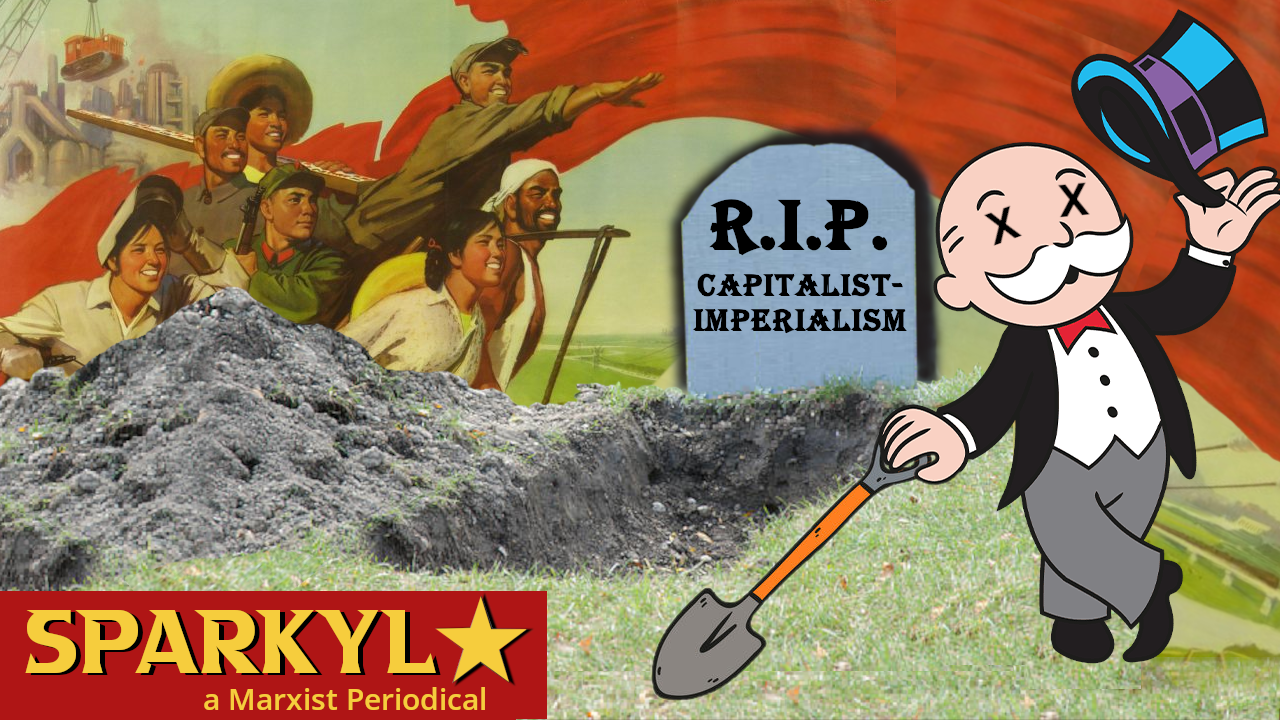
From tech to industrial supply, from the cereal aisle to your apartment utilities, from the bombs built for governments to your toothpaste brand, monopoly, and the power of the class of imperial financiers who own and perpetuate monopolistic enterprises, surrounds both consumer and commodity. The competition of the capitalists that dominated the previous period of production – the days of nascent capitalism – has turned one-sided, and, although there are many consumer brands, only a few select enterprises entirely dominate market forces, owned by only a few big financial bourgeois. General Mills owns your cereal and General Dynamic owns your state weapons. Axon, Flock, and Palantir own your public “safety” while Alphabet owns your data. These and many more companies like Nestle, Amazon, Meta, Apple, and the historical remnants of Standard Oil (ExxonMobil, Chevron, Marathon, et al.) hold monopolies in all aspects of consumer life. Meanwhile, venture capitalist companies like Vanguard and BlackRock hold the majority of their stock. Devoid of direct competitors, the monopolist owners of these enormous enterprises set prices and organize production according to their narrow interest, often creating alliances with other monopolists globally, stringing the whole world’s masses along for the ride.
The fact of monopoly – the fact that production is dominated by finance and large, multi-national corporations, not small domestic operators – is easily discernable, though often misunderstood, even by many Marxists. In their misunderstandings, they tend to fall into either side of the same ditch, both mistaking the position of the smaller bourgeois element within monopolistic production. On one side, monopoly is raised up as a monolith, as the cartoonish, Orwellian, and all-encompassing domination of an evil sect, brainwashing the whole world’s masses and turning them into something less than workers, leading to new bleak scenarios that require revisions on Marx’s theories. This idea represents a consciousness that has just woken up to the domination of the ruling class, merging basic ignorance of both socialism and economy with the populist mystifications regarding emergent technologies, forming a logical absurdity that has led to the common term “techno-feudalism” being thrown around so often.
On the opposite side of the same ditch, monopoly is downplayed, removed from the realm of production and reduced to a cudgel that competing bourgeois use against each other. In this similarly wrong and one-sided view, “monopoly” becomes synonymous with “crony capitalism,” and is utilized as a calling-card for bourgeois to form political movements against larger capitalist elements. These kinds of bourgeois revolts have mystified even those on the so-called “left,” with the exact same drama being played out geopolitically between the so called “anti-imperial” BRICS+ and the NATO cliques that is being played out domestically between “local business” and larger corporations; in both contradictions, the former is portrayed as “good” and “progressive” in contradistinction to the “crony” or otherwise “bad” larger force. Using this faulty framework, monopoly is stripped of its economic character, of its actual material existence, and reduced to accommodating the base and bourgeois needs of nations and the antagonisms between them, with BRICS+ bourgeois painting their own monopolies and imperial accumulation as “good” in contradiction to the “bad” monopolies of the dominant “West.”[1]
Despite both these errors that view it one-sidedly, monopoly and its oligarchies are not an impenetrable fortress, or a deviation within production that can be avoided through the development of a “good” capitalism. Rather, monopoly, and all the cronyness associated with it, is at the core of all capitalist accumulation today, created by the productive forces themselves, and, far from being impregnable, monopoly engenders its own negation via its own internal contradictions; specifically, the contradiction between the larger and the smaller bourgeois elements within monopolistic production itself, an opposition between two very uneven competitors that drives production forward at the rising expense of the global proletariat and the small bourgeois worldwide, and can’t be surpassed except through the socialist revolution.
We can see this opposition at play when we consider the route of the capitalist in society. Generally speaking, since most capitalists are not monopolists who sit at the height of production, capitalist production generally yields to one of two outcomes: subsumption into previously established monopoly, or the proletarianization of the owner, with little deviation from these outcomes. Capital is already developed. There are no new commons to privatize, and if one wants to exploit labor, one must pass through the current apparatus of capitalist gatekeepers. Every small bourgeois “startup” seeks the investments, distribution, and market-space of established monopolists, developing products for imperial markets, folding themselves into joint private ventures (essentially maintaining their organizational identity but sharing extracted surplus value) or otherwise ingratiating themselves into the production lines of their betters. Those who cannot do so, and, from their feeble class position, end up competing with the monopolists and their hydra in a direct way, inevitably fall into debt and foreclosure, becoming proletarian. Bourgeois are only granted their bourgeois status so long as their forces fit into the wider production of the monopolists. If they do not, then they are turned away, and are all the more likely to face proletarianization.
If they are lucky enough to be incorporated into the production of the big bourgeois, the smaller capitalists are hit with the imperialists’ double-punch: becoming both debtors of imperial finance and captive customers to the imperialists’ industrial monopolies – monopolies who create the industrial and ancillary business products the smaller element requires for their own production – placing the smaller bourgeois into an antagonistic contradiction not only with other smaller bourgeois, who are often forced to compete with each other while being chained to the exact same imperialists, but especially with the imperialists themselves, who strangle their profit through debt and the growing costs of supply.
Just this year, a London academic, Gerard Hanlon, described how monopoly over market forces is able to suppose the production of other smaller producers, using Apple as an example:
If the machine process creates “an economy of abundance” the business enterprise develops artificial scarcity – brands, copyright, patents, etc. – and power. For example, Apple deploys supply chain power by making Foxconn, Pegatron, and Luxshare Precision compete, thereby ensuring it gains better control of value distribution. Apple famously collects the bulk of surplus value in its iPhone supply chains, for example in 2010 it gathered 58.5 per cent of distributed value.[2]
In this field of what we could call, “controlled competition” – given that the smaller bourgeois certainly compete with each other for imperial favor – the imperialists and their monopolies entirely dominate, cornering markets, buying-out competitors, and raising prices. As Lenin puts it in Imperialism, the Highest Stage of Capitalism:
We no longer have competition between small and large, between technically developed and backward enterprises. We see here the monopolists throttling those who do not submit to them, to their yoke, to their dictation.[3]
Money flows one way; capital accumulates at a narrowing pole as the imperialists draw the smaller and petty bourgeois, as well as legions of workers, into their fold. The system is oriented towards fewer and fewer owners, while the consumer is inundated with false choice regarding these owners. The fact that there are still many companies – or, as Lenin puts it, that “the general framework of formally recognised free competition remains,”[4] – casts the illusion of choice onto both the market and the consumer, obscuring also the dominating position of the imperialists, hiding them behind the twist-and-turns of equity ownership over a vast field of both multi-national corporations and their domestic attaches.
But the imperial monopolists don’t have a peaceful existence as ruler, and must constantly keep up the race for profit, over and against a few other big monopolists globally and especially against the smaller bourgeois element they dominate. In this race in which the only rule is to exploit as much labor as you can for as cheaply as you can, the imperialists draw the whole of their society, as well as a few others, into themselves, forming international groupings of nations around their production, with the geopolitical alliances of nations, as well as the current orientation of global exchange, in line with their profit motives and reflecting their conflicts. Their monopolies, formed from corporate, state, or corporate-and-state entities, find themselves bounding from nation to nation, performing the same actions internationally as they did domestically, expropriating small producers into their organization, putting numerous others out of business and into the ranks of the proletariat. In doing so, they monopolize not simply the production of commodities and the accumulation of capital wherein, but trade, even directly chaining the governments of foreign nations to themselves through the use of their financial power, through the vehicle of debt via institutions like the World Bank and International Monetary Fund. The domination of foreign imperialists mold the less dominant nations into a form pleasing to them, enshrining austerity and low-wages, suppressing local development so that the country can be made to be a playground of cheap labor, over and against the interest of the nationals living there. In this way, the imperial monopolists assert their hegemony throughout the totality of production, antagonizing billions and enflaming national conflicts worldwide.
The global corporations of the imperialists are above any single state, with governments bowing to their empires openly, offering subsidies and tax breaks to curry the favor of the big monopolists so that they will open-up shop in their locale, bringing in jobs and tax revenue. The nations of the world do not command these entities; they are subordinate to them, whole countries reduced to fulfilling a role in the imperialists’ production, representing the complete political domination of the bourgeois class above nations. The extraction of value from one bloc of monopolist financiers to another — through the vehicle of debt in peaceful times and numerous other legal and military methods when contradictions are sharp — is the dominating political force of the world. All nations are dependent on the global imperial network of markets, some as beneficiaries, but most turned dependent and oppressed by the richer nations holding the most imperialists.
There is no escape from their grasp – not for the bourgeoisie and especially not for the worker, who, in addition to likely working for a monopolist, must purchase the commodities of the monopolists at every turn in their everyday economic relations, with fewer and fewer actual consumer options, liable to have their wages suppressed indefinitely, the labor market having been virtually cornered.
2. Monopoly and competition; two sides of the same coin
While the rest of the world was enamored with the individual “freedoms” that industrialization and capitalism were bringing to a small section of European bourgeois, Marx was already ringing the warning bell on monopoly, understanding that capitalism, far from being a meritocracy where “the best man wins” in the market, has the tendency to centralize capital into fewer and fewer hands, against the interest of the masses. In Capital, he says,
As soon as this process of transformation has sufficiently decomposed the old society from top to bottom, as soon as the labourers are turned into proletarians, their means of labour into capital, as soon as the capitalist mode of production stands on its own feet, then the further socialisation of labour and further transformation of the land and other means of production into socially exploited and, therefore, common means of production, as well as the further expropriation of private proprietors, takes a new form. That which is now to be expropriated is no longer the labourer working for himself, but the capitalist exploiting many labourers. This expropriation is accomplished by the action of the immanent laws of capitalistic production itself, by the centralisation of capital. One capitalist always kills many.[5]
Even as he acknowledges “the centralization” of capital and capitalism’s tendency towards monopoly, Marx does not see this centralization as one-sided, like many of our “comrades” today. He says in The Poverty of Philosophy,
In practical life we find not only competition, monopoly and the antagonism between them, but also the synthesis of the two, which is not a formula, but a movement. Monopoly produces competition, competition produces monopoly. Monopolists are made from competition; competitors become monopolists.[6]
The above passage might be confusing to someone new to Marxism, but it is a perfect encapsulation of the problem of monopoly, elucidated through the lens of dialectical materialism. Marxists understand the movement and development of history as a dialectical process; one which cements the negation on the basis of a prior relation. In the following passage from the same work, Marx elaborates more, revealing monopoly’s contradiction from both its dialectical sides, showing that the basic process of capital accumulation, the reinvestment of surplus value (expropriated from labor power) into new capital, builds both competition and monopoly, and that this process is indispensable to the system as a whole. He says:
But we all know that competition was engendered by feudal monopoly. Thus, competition was originally the opposite of monopoly and not monopoly the opposite of competition. So that modern monopoly is not a simple antithesis, it is on the contrary the true synthesis.
Thesis: Feudal monopoly, before competition.
Antithesis: Competition.
Synthesis: Modern monopoly, which is the negation of feudal monopoly, in so far as it implies the system of competition, and the negation of competition in so far as it is monopoly.[7]
Following Marx’s logic, we understand that modern monopoly grows out of competition, at the same time as it engenders further competition in its attempt to maintain itself. If we think back to Hanlon’s Apple example given before, it is not unreasonable to imagine a scenario in which Foxconn, Pegatron, and Luxshare Precision, under the immense pressure of the Apple imperialists to compete and develop their own little piece of monopolist production, outgrow the bounds of the masters, take in more capital from the international market, from the grand collection of imperialists globally, than their overlord can contain. This would be helped along, especially, by advancements in technology, which would be sought out by the more desperate smaller element. If acquired and under the best circumstances, this technology would be copyrighted and made available for license to a monopolist, granting the smaller element economic leverage against their betters and a peculiarly powerful position within the economy, relatively speaking. Under these circumstances, which are entirely plausible if not probable at some given point, the smaller element could constitute themselves as master, that is, become a monopolistic power in their own right, perhaps even dominating the expired forces of the old monopolist entity themselves. This would be the moment that monopoly could be said to be negated by its competitive element, which, in turn, creates its own monopolistic system of domination and its own subsequent competitors. This is what Marx means when he says that monopoly and competition are a “movement;” a cycle that pushes capitalist development on even as it recycles a good portion of itself in the process. Monopoly and competition, while opposed to each other, are two indispensable sides of the same process of capitalist production.
Lenin understood Marx and also recognized this truth about monopoly.
Capitalism arose and is constantly arising out of small production. A number of new “middle strata” are inevitably brought into existence again and again by capitalism (appendages to the factory, work at home, small workshops scattered all over the country to meet the requirements of big industries, such as the bicycle and automobile industries, etc.). These new small producers are just as inevitably being cast again into the ranks of the proletariat.[8]
He understood as well, as early as 1916, that production had matured beyond a domestic capitalism of “competitors” and become a system of monopoly,serving a narrowing stratum of financiers, a feature of late-stage capitalism, or capitalist-imperialism. He instructed the whole Communist tradition on this fact and the workings of the capitalist-imperialist economy more broadly in his pamphlet, Imperialism: The Highest Stage of Capitalism.
Half a century ago, when Marx was writing Capital, free competition appeared to the overwhelming majority of economists to be a “natural law”. Official science tried by a conspiracy of silence, to kill the works of Marx, who by a theoretical and historical analysis of capitalism had proved that free competition gives rise to the concentration of production, which, in turn, at a certain stage of development leads to monopoly. Today, monopoly has become a fact. Economists are writing mountains of books in which they describe the diverse manifestations of monopoly, and continue to declare in chorus that “Marxism is refuted”. But facts are stubborn things, as the English proverb says, and they have to be reckoned with, whether we like it or not. The facts show that differences between capitalist countries, e.g., in the matter of protection or free trade, only give rise to insignificant variations in the form of monopolies or in the moment of their appearance; and that the rise of monopolies, as the result of the concentration of production, is a general and fundamental law of the present stage of development of capitalism.[9]
This development of monopoly, the concentration of vast amounts of capital into only a few hands, is what allows also for the development of modern finance capital.
...the development of capitalism has arrived at a stage when, although commodity production still “reigns” and continues to be regarded as the basis of economic life, it has in reality been undermined and the bulk of the profits go to the “geniuses” of financial manipulation. At the basis of these manipulations and swindles lies socialised production; but the immense progress of mankind, which achieved this socialisation, goes to benefit ... the speculators.[10]
The bourgeois who succeeded in the competition of capitalism’s past cemented their capital into a central and highly parasitical position within the world economy. Banking and finance, which used to serve as middlemen between differing capitalist industrial enterprises, is now the dominating force of global economy, as Lenin describes in the below passages from Imperialism.
As banking develops and becomes concentrated in a small number of establishments, the banks grow from modest middlemen into powerful monopolies having at their command almost the whole of the money capital of all the capitalists and small businessmen and also the larger part of the means of production and sources of raw materials in any one country and in a number of countries. This transformation of numerous modest middlemen into a handful of monopolists is one of the fundamental processes in the growth of capitalism into capitalist imperialism.[11]
When carrying the current accounts of a few capitalists, a bank, as it were, transacts a purely technical and exclusively auxiliary operation. When, however, this operation grows to enormous dimensions we find that a handful of monopolists subordinate to their will all the operations, both commercial and industrial, of the whole of capitalist society; for they are enabled—by means of their banking connections, their current accounts and other financial operations—first, to ascertain exactly the financial position of the various capitalists, then to control them, to influence them by restricting or enlarging, facilitating or hindering credits, and finally to entirely determine their fate, determine their income, deprive them of capital, or permit them to increase their capital rapidly and to enormous dimensions, etc.[12]
Today, more than a hundred years after Lenin, the power of finance over industry has grown to a high pitch, spreading its tendrils throughout all production. For the consumer, this is reflected as debt. The whole of society is in rising debt,[13] and venture capitalist companies like BlackRock and Vanguard are increasingly monopolizing stock markets, a relatively “new” economic occurrence which is disintegrating the smaller element at an alarming rate, allowing speculators an “industry” by which to directly buy out, dominate, and sell companies, outside of any traditional “borrowing or lending” services. The development of finance capital in turn develops monopoly. Paths of entry into markets are restricted and competitors suppressed unless they coincide with the narrow financial interest of a few oligarchs.
Finance capital, concentrated in a few hands and exercising a virtual monopoly, exacts enormous and ever-increasing profits from the floating of companies, issue of stock, state loans, etc., strengthens the domination of the financial oligarchy and levies tribute upon the whole of society for the benefit of monopolists. [14]
The nation which houses the imperialists is induced to share in both their tribute andin their parasitism, pushed further away from the mass of workers and closer to the bourgeois and labor aristocracy, as Lenin describes in the following passage from Imperialism.
The export of capital, one of the most essential economic bases of imperialism, still more completely isolates the rentiers from production and sets the seal of parasitism on the whole country that lives by exploiting the labour of several overseas countries and colonies.[15]
The imperialists themselves, the masters of monopoly, though they live within some nation, are above all nations, forging them together and tearing them apart through war, and all according to the whims of their market, with near-infinite means to flit themselves safely away from the consequences of their oppression should it ever threaten their way of life.
3. The peeling of the “shell”
But this concentration of capital and power has another side. Monopoly and imperialism persist, developing technologies and relations far beyond their initial emergence, but also developing their own doom at a quicker and quicker rate.
In Socialism: Utopian and Scientific, Engels explains this fact in the following words,
Whilst the capitalist mode of production more and more completely transforms the great majority of the population into proletarians, it creates the power which, under penalty of its own destruction, is forced to accomplish this revolution.[16]
Marx explains this in more detail in his Capital.
Hand in hand with this centralisation, or this expropriation of many capitalists by few, develop, on an ever-extending scale, the co-operative form of the labour process, the conscious technical application of science, the methodical cultivation of the soil, the transformation of the instruments of labour into instruments of labour only usable in common, the economising of all means of production by their use as the means of production of combined, socialised labour, the entanglement of all peoples in the net of the world market, and with this, the international character of the capitalistic régime. Along with the constantly diminishing number of the magnates of capital, who usurp and monopolise all advantages of this process of transformation, grows the mass of misery, oppression, slavery, degradation, exploitation; but with this too grows the revolt of the working class, a class always increasing in numbers, and disciplined, united, organised by the very mechanism of the process of capitalist production itself. The monopoly of capital becomes a fetter upon the mode of production, which has sprung up and flourished along with, and under it. Centralisation of the means of production and socialisation of labour at last reach a point where they become incompatible with their capitalist integument. Thus integument is burst asunder. The knell of capitalist private property sounds. The expropriators are expropriated.[17]
Just as feudal monopoly was negated by the introduction of capitalist competition (which feudal monopoly itself helped to create, in the most general view, through the competition of the feudal lord’s monopolies amongst themselves), capitalist production will be negated by the working class, which, at the same time as it exploits them, is also bringing them together and uniting them against itself. Lenin, as great a Marxist he was, saw this feature of capitalism as mature in the monopolies of his own time.
Ownership of shares, the relations between owners of private property "interlock in a haphazard way". But underlying this interlocking, its very base, are the changing social relations of production. When a big enterprise assumes gigantic proportions, and, on the basis of an exact computation of mass data, organizes according to plan the supply of primary raw materials to the extent of two-thirds, or three-fourths, of all that is necessary for tens of millions of people; when the raw materials are transported in a systematic and organized manner to the most suitable places of production, sometimes situated hundreds or thousands of miles from each other; when a single centre directs all the consecutive stages of processing the material right up to the manufacture of numerous varieties of finished articles; when these products are distributed according to a single plan among tens and hundreds of millions of consumers (the marketing of oil in America and Germany by the American oil trust)—then it becomes evident that we have socialization of production, and not mere "interlocking", that private economic and private property relations constitute a shell which no longer fits its contents, a shell which must inevitably decay if its removal is artificially delayed, a shell which may remain in a state of decay for a fairly long period (if, at the worst, the cure of the opportunist abscess is protracted), but which will inevitably be removed.[18]
The mechanisms of capitalism hold a dual nature: one that both advances the contradictions of class society and cements its own negation, or destruction. In creating the working class, as well as systems of competition and accumulation, the capitalist class has created the pathway toward its own end. The advanced development of monopoly capitalism, particularly in its persistently global character, has achieved a new epoch of waning and emerging empires, each with numerous attendants in the form of the dependent nations, and each vying to divide an already-divided globe. However, they are not above the basic contradictions of production, and the high-pitch at which the imperialists conduct business and dominate the globe antagonizes these foundational contradictions immensely. This is why Lenin correctly saw in monopoly the fall of the capitalists’ system.
Monopolies, oligarchy, the striving for domination and not for freedom, the exploitation of an increasing number of small or weak nations by a handful of the richest or most powerful nations—all these have given birth to those distinctive characteristics of imperialism which compel us to define it as parasitic or decaying capitalism.[19]
Marx recognized also this tendency for decay in the monopolies of his own time, and how these monopolies spell victories for the working class.
If the monopolists restrict their mutual competition by means of partial associations, competition increases among the workers; and the more the mass of the proletarians grows as against the monopolists of one nation, the more desperate competition becomes between the monopolists of different nations. The synthesis is of such a character that monopoly can only maintain itself by continually entering into the struggle of competition.[20]
Capitalist-imperialism and its monopolies certainly do grow capitalism, but they also grow the overthrow of the capitalist system as a whole through revolution, the creation of, to restate a portion of Engels’ quote before, a “power which, under penalty of its own destruction, is forced to accomplish this revolution,” namely the revolutionary proletariat, which is being united under fewer and fewer owners and having its quality of life lowered in turn, allowing its eyes to be opened to both its oppression and its power. It is they who will remove the “shell” of private property relations (which are already practically removed for the vast majority of society) and usher in the socialist society, constituting themselves as the dictatorship of the proletariat.
With fewer owners holding capital and political power over a nation, and more and more of the workers brought under the specific domination of monopolist financiers, the masses are able to, and inevitably will,subvert them through revolutionary class conflict, and the whole bourgeois productive system with them. The anarchistic social relations of exchange within production, even now, are being brought to a head, isolated, and then raised up for elimination by their dialectical opposition, represented in the fact that capital possesses fewer and fewer owners, owners that antagonize the vast majority of people, workers and bourgeois alike. The march of the workers, whose position within production enables them, alone, to cast the imperialists into the ashbin of history, will assert political supremacy in class society. In doing so, they will form the dictatorship of the proletariat, that organization which is tasked with the process of expropriating private property into working class control. Utilizing this tool of governance, the workers’ revolution is able to work with the movement of production in eliminating the parasitical element: the capitalist class. By changing private accumulation into public accumulation, the workers proletarianize the whole society under the state, and utilize their political power to complete the socialization of the means of production which, under normal conditions, rest practically socialized in monopoly, but with capital flowing to the parasitical private interest.
4. State-monopoly, only a rung on the ladder to socialism
The centralization of capital and the productive forces over the course of production enshrines the state as the final stop for capitalist productive forces, which, outgrowing their “shell” of private ownership, now must be intertwined with an organ ostensibly representing all of society. But, far from representing the heights of progress or the pinnacle point of socialist production, state ownership, so long as private property is maintained, is simply the state serving its historical role as the arbiter of classes, and fulfilling also its role as servant of the bourgeoisie.
The state is, therefore, by no means a power forced on society from without; just as little is it "the reality of the ethical idea", "the image and reality of reason", as Hegel maintains. Rather, it is a product of society at a certain stage of development; it is the admission that this society has become entangled in an insoluble contradiction with itself, that it has split into irreconcilable opposites which it is powerless to dispel. But in order that these opposites, classes with conflicting economic interests, might not consume themselves and society in fruitless struggle, it became necessary to have a power seemingly standing above society which would alleviate the conflict and keep it within the bounds of "order"; and this power, having arisen out of society but placing itself above it, and alienating itself more and more from it, is the state.[21]
When taking this definition of the state from Engels’ Origin of the Family into consideration, should it be any surprise at all that the monopolies of the capitalists, when stretching across the globe and pulling millions of people into themselves, tend to incorporate themselves with the state apparatus? There are numerous ways for this to happen — either directly via nationalization, or indirectly through the entanglements private interest creates in seeking government subsidies, or otherwise leeching off of public taxes, which in turn put state regulations onto the private interest, effectively making it a functionary of state duties.
Arms manufacturers are given specific subsidies to produce and fulfill contracts for the state, their primary customer. Amazon facilitates the total mechanism of distribution of small goods, and the bourgeois’ dependence on both their marketplace and distribution enables them to utilize public services like USPS to extend the reach of its mechanisms in the name of “public good.” In these and many other numerous examples of informal “interlockings,” the state creates legal, executive, and judicial apparatuses to accommodate their arrangement with the capitalists, sealing private interests with the government.
Beyond these indirect modes of state-ownership, there are more direct examples, wherein the state owns and runs corporations as the state. For example, UNICOR is the government-owned corporation that utilizes required prison labor in the United States, developing products for sale under the guise of “rehabilitation.”[22] Further, the Federal National Mortgage Association, known as Fannie Mae, is a private company that was charted by Congress,purchasing mortgages and turning them into securities for global investment, typically to provide liquidity for mortgage lenders to utilize as capital. A similar state-sponsored institution which serves the same purpose is Freddie Mac, also known as the Federal Home Loan Mortgage Corporation. Both were placed under official government conservatorship after the 2008 housing crisis,[23] the state fulfilling Engels’ classic definition and providing “order” to the anarchy of the housing loan market by its own direct power.
Additionally, many nations have, under the influence of the lower-classes, nationalized their industries consciously, as a response to revolutionary activity within the nation. Venezuela's nationalization of its oil reserves, or China’s state-owned enterprises are representative of this group.
Regardless of whether the state officially holds production or not, the end result of capitalist production and the monopolies it creates is that the state, the arbiter of the classes, must inevitability arbitrate also over production. As the productive forces must necessarily be collectivized under the state for socialism to develop, Lenin calls this form of state-monopoly capitalism the “threshold of socialism.”
State-monopoly capitalism is a complete material preparation for socialism, the threshold of socialism, a rung on the ladder of history between which and the rung called socialism there are no intermediate rungs. Please note that this was written when Kerensky was in power, that we are discussing not the dictatorship of the proletariat, not the socialist state, but the “revolutionary democratic” state. Is it not clear that the higher we stand on this political ladder, the more completely we incorporate the socialist state and the dictatorship of the proletariat in the Soviets, the less we ought to fear “state capitalism?”[24]
Lenin makes the crucial distinction between the “revolutionary democratic state,” and the dictatorship of the proletariat, saying that, regarding the latter, “there is nothing terrible” in state-monopoly, because the dictatorship of the proletariat is “a state in which the power of the workers and the poor is assured.”[25] Understanding this, and seeing the necessity of industrializing Russia, and also the necessity of incorporating the bourgeoisie to do so, he and the other leaders of the USSR established the New Economic Policy (NEP) between the years of 1922-1928. Among other things, this legislation ended the government seizures of surplus, the “War Communism” that was enforced throughout the revolutionary years, and, instead, instituted a tax in kind on each good, allowing producers to keep their surplus for sale on the market. Lenin advocated for such actions in “The Tax in Kind” by saying,
We must do everything possible to develop trade at all costs, without being afraid of capitalism, because the limits we have put to it (the expropriation of the landowners and of the bourgeoisie in the economy, the rule of the workers and peasants in politics) are sufficiently narrow and “moderate.”[26]
Local or imported salt; paraffin oil from the nearest town; the handicraft wood-working industry; handicrafts using local raw materials and producing certain, perhaps not very important, but necessary and useful, articles for the peasants; “green coal” (the utilisation of small local water power resources for electrification), and so on and so forth—all this must be brought into play in order to stimulate exchange between industry and agriculture at all costs. Those who achieve the best results in this sphere, even by means of private capitalism, even without the co-operatives, or without directly transforming this capitalism into state capitalism, will do more for the cause of socialist construction in Russia than those who “ponder over” the purity of communism, draw up regulations, rules and instructions for state capitalism and the co-operatives, but do nothing practical to stimulate trade.[27]
Some who are new to Marxism (or any suffering from the disorder of left-“communism”) might think of the NEP as a retreat, but Marx himself understood that the transition from capitalism to socialism would still have many capitalist features. He wrote in Critique of the Gotha Programme,
What we have to deal with here is a communist society, not as it has developed on its own foundations, but, on the contrary, just as it emerges from capitalist society; which is thus in every respect, economically, morally, and intellectually, still stamped with the birthmarks of the old society from whose womb it emerges.[28]
State-capitalism is desirable, and even capitalist influence, tolerable, to the socialist government so long as the class of workers are truly in charge and sufficient measures are in place to keep them in charge. Utilizing the theories of Marx and Engels, Lenin and the Party understood the NEP as necessary in those years to build the productive forces and the proletarian populations (due to what he called, the “extreme ruin” of Russian conditions after the war and after the famine of 1920[29]), a necessary “birth mark” they would have to accommodate in the new society. But they knew also that it meant supplying the kulak class, the small and petty rural bourgeois, with the necessary ownership over private property to cement capitalist production and their class identity. This was allowed and even promoted, because Lenin understood that, in enacting these new policies,
The proletarian power is in no danger, as long as the proletariat firmly holds power in its hands, and has full control of transport and large-scale industry.[30]
Though they had accumulated with their “own” productive forces, the kulaks’ production was oriented to the state-monopolies, and thus they played a role as the effective “vassals” of Soviet government, a government of councils composed of workers and soldiers, and thus of the empowered proletarian class. If we understand both Lenin’s application of the NEP and dialectical materialism, we can understand the Stalin era and the institution of “5 Year Plans” that followed in 1928 as the synthesis of the contradiction that the NEP was: the expropriation of the lesser bourgeois forces it created. When the NEP ended, collectivization and the expropriations of the kulaks and other petty bourgeois elements began. This was a violent process, the absolute destruction of many small bourgeois who found their wealth and their class standing within the confines of the NEP. But it was a necessary “terror” (not simply on the basis of shifting property rights, but on the basis of the bourgeois’ resistance to the people’s expropriations) that allowed for the means of production built by capitalism to pass into the collectivized sector, into socialism and the command of workers, and out of the private market through the process of so-called “Stalinization.”
When bourgeois are maintained, even in state-capitalism, the state and society more generally accommodates these private forces. Many of the Party members and “NEPmen” that were liquidated during the Stalin era represent this exact accommodation of capital into the economy and even the Party itself — sections built by the NEP that required liquidation by the revolution, otherwise they act against it. When the revolution refuses to be revolutionary and step forward — like the USSR did in ending the NEP, liquidating the kulaks, and purging the Party of counterrevolutionary bourgeois elements — the bourgeois move against the revolution.
Now that we have seen how the “Stalinist” era played out, we can see how the NEP was utilized and then negated to great success, evidenced by the USSR’s rapid industrialization, which allowed it to stand up against the fascist powers during the Second World War all while maintaining guaranteed economic rights that were miles ahead of the bourgeois “democracies.” The NEP built capitalists and private property, but, at the same time, it developed the necessary conditions which allowed for the expropriation of these productive forces — the growth of economy and production that could then be used by the state against the bourgeois classes of the whole world — which the Soviet Union, in fact, did. It’s within this kind of framework that state-capitalism can exist and still be developing towards socialism.
While advocating for state-capitalism within this dialectical framework, Lenin was always clear that,
At the same time socialism is inconceivable unless the proletariat is the ruler of the state. This also is ABC.[31]
5. False friends
Today, after a period of successful socialist revolutions that have, in our own time, fully degenerated, falling to their class opposition, many revisionist “socialist” and even “Marxist” states stand tall on their still-existing state-monopolies, claiming their societies are in-line with socialist construction because they have some element of state production and control over their economies. But Marxism has always taught us that the socialization of production by the state is only the preparation for socialism, and is not socialism itself. Engels made this point expressly clear in Socialism: Utopian and Scientific, as far back as 1880.
But, the transformation, either into joint-stock companies and trusts, or into State-ownership, does not do away with the capitalistic nature of the productive forces. In the joint-stock companies and trusts, this is obvious. And the modern State, again, is only the organization that bourgeois society takes on in order to support the external conditions of the capitalist mode of production against the encroachments as well of the workers as of individual capitalists. The modern state, no matter what its form, is essentially a capitalist machine — the state of the capitalists, the ideal personification of the total national capital. The more it proceeds to the taking over of productive forces, the more does it actually become the national capitalist, the more citizens does it exploit. The workers remain wage-workers — proletarians. The capitalist relation is not done away with. It is, rather, brought to a head. But, brought to a head, it topples over. State-ownership of the productive forces is not the solution of the conflict, but concealed within it are the technical conditions that form the elements of that solution.[32]
The revisionist “Marxist” government of China purports their own state monopolies to be exactly this “solution.” While they are the loudest to say this is in-keeping with socialism, and using the good name of Marxism-Leninism to do so, which is especially egregious to our movement, the same logic is in play regarding certain other “socialist” governments, like Venezuela, Cuba, Vietnam, and a few others. All of these use the fact that they have nationalized industries to effectively stop marching for socialism, telling the workers that their rule will come at a certain point in the future because of the current orientation of production and the state. In many ways, both consciously and unconsciously, these opportunists are distorting Lenin’s teachings regarding the NEP and “The Tax in Kind.” They say they cannot collectivize industry further, that they must maintain “market-socialism” and build bourgeois, that their bourgeois are under similar “narrow” limits as those of Lenin’s USSR, and that their society’s orientation is in-keeping with socialist “transition,” mystifying thousands of “Marxists” who wish that it was true.
We will look at China more particularly, since their government is the most egregious example of this trend, revealing the sobering fact that, despite how many on “the left” view the revisionist “Marxist” state, they are on a path of capitalist construction, and have already transformed the Communist Party into a tool for such construction. The private sector grows while the state monopolies, which at one time dominated the country, diminish.[33] The Peterson Institute for International Economics, utilizing data from China’s own National Bureau of Statistics, reported that, in 1978, enterprises with majority state ownership were responsible for 78% of China’s gross industrial output, but, by 2011, that figure had fallen to 26%.[34] In 2024, utilizing data from both the National Bureau of Statistics of China as well as China’s State Administration for Industry and Commerce, researchers from 6 universities (including China’s own Tsinghua and Fudan Universities) studied 40 million Chinese firms, and found that only 373,712 were 100% state-owned — less than 1% of the total. This small, state-owned fraction of the economy is not even centralized under the federal government, as is commonly understood to be the case, but split between federal, city, and provincial authorities; anarchy in ownership that is undesirable to any actual Marxist-Leninist, but wholly acceptable to bourgeois who wish to create multiple organs of investment to expand a bourgeois economy. Outside of this small sector, there is a much larger section of quasi-state companies, companies where the state (in whatever form, federal, city, or provincial) owns some equity, but is not the majority shareholder. But even accounting for this section, including companies in which government of any kind owns any equity at all as “state-owned,” the number of “state-owned” enterprises in China sits at less than 1.4 million, again, out of the 40 million total – rising only to 3.5% of firms.[35]
It is by including these decidedly not state-owned “state companies” that China “blows up” its own statistics regarding state ownership. Often cited is the statistic portraying China’s market-capitalization as driven by the state-owned companies, claiming that 60% of market-capitalization rests with the state-owned sector. However, the study from which this statistic is gained is relegated to only the 100 biggest companies, an absurdly small sample size that is used to imply China’s economy as a whole. Furthermore, it defines as “state-owned” any entity in which the state owns 10% equity or more,[36] which is a devious stretch on any practical definition of “ownership.” This statistic and others like it succeed at mystifying our comrades who are ignorant on economy, painting the story that, though they are not numerous, the state sector is a lion, dominating industry, while the multitudes of bourgeois are small and insignificant, which looks a lot like Lenin’s justification for the New Economic Policy. This could not be further from the truth however, and in fact, the actual economic trend in China shows weakening collective sectors and dominating private ones. While the state-owned sectors still carry significant portions of industry, the total aggregated capital of fully state-owned firms fell from 41% in 1999 to 25% in 2017, with the proportion of central government capital, in relation to local and provincial governments, dropping 6% in the same period.[37]
The trend of increased privatization is striking when we look at employment. Private sector employment in China grew astronomically from only 0.2% of urban employment (150,000 workers) in 1978 to nearly two‐thirds of the urban labor force (a whopping 253 million laborers) by 2011. Meanwhile, and relatedly, employment in state‐owned and state‐controlled enterprises (the analysis included any enterprise where the state is majority holder in making this delineation) dropped significantly, from 59.8 million workers (25% of the urban workforce) in 1999 to 45.1 million (12.5%) by 2011.[38]
Under their revisionist smokescreen, the practical monopoly China’s capitalists hold over critical minerals,[39] gained mostly through international investments in African countries like the Democratic Republic of the Congo (where Chinese companies control 8 of the 14 largest mines in the country)[40] is propped up as international aid,when any sober analysis of the situation can see in China’s “development” the proletarianization of Africans, the tying of these impoverished labor forces to an enriched foreign imperial capitalist class, and the creation of African comprador bourgeois in service to a small section of Chinese capitalist financiers – the basic process of capitalist-imperialist production in action. China’s state monopoly is a bourgeois monopoly, and serves the same purpose as the bourgeois monopolies of self-identifying capitalist states, maintaining both the state and the power of the capitalists beneath it, a lever on the international market that allows autonomy for their national capitalists as well as their ability to accumulate in the market globally. This is a basic feature of any nation that could be said to be “independent,” that is, any nation that is a dominant player in capitalist-imperialism. Every nation must maintain its own monopolies if it wants to even be able to maintain its own national sovereignty, which will inevitably be eroded along with its economic sovereignty if it fails to do so. For example, without the US’s monopoly on oil, especially taking into consideration its dependency on private motor vehicles, the monopolists within OPEC would have a much more controlling interest in US affairs, and over their bourgeois.
Despite the fact that the state in China owns productive forces and organizes them according to a “plan,” this kind of economic planning by and for bourgeois financiers can’t be considered socialist strategy. It fails to orient production away from the private sector and, as the facts show, does the exact opposite, growing imperialist tendrils beyond even its national boundary. The revisionists in China’s government preach “market socialism,” saying that it is appropriate for their conditions, not because they are under some “extreme ruin,” but because they are bourgeois, wishing to maintain both private property and their dominant position in production, many directly accumulating in the growing private sector as Party members, which was made legal, and even encouraged by the “Three Represents” doctrine under Jiang Zemin in 2002.[41]
History has got us here. The revolution in China was souring even under Mao,[F1] and it soured completely under Deng’s capitalist “reforms.” The struggle between the New Democratic revolution on the one side and the socialist revolution on the other, a struggle that was at the core of the revolution in China and that Mao mentions numerous times in his works,[42] has been temporarily won by the bourgeois forces of the former, and all the Marxists putting their stock in China as the socialist vanguard need to wipe the scales from their eyes and have a good cry about it already. Of course, for these ignorant “comrades” among us, it would be much more convenient if we would allow them to reduce the tasks of the moment to “critically supporting” a bourgeois nation, portraying this support as the pinnacle of all revolutionary praxis. But despite how these “comrades” of ours couch their social-chauvinism[F2] in Marxian aesthetics, their idealist defense of China’s revisionist government and their complete denial of class analysis removes them from the realm of both Marxism and sense.
Despite employing an astonishingly successful plan of bourgeois construction, the path walked by the Communist Party of China today was blazed already by the late USSR, who, despite being the #1 bogeyman of the United States during the cold war, had its own similar economic and political “reforms” for development, and maintained a similar bourgeois “mixed-economy” and name-only revisionist “Marxism” for nearly 40 years before finally ceding to capitalism openly and establishing the Russian Federation. Mao himself rejected these “reforms” in the Soviet Union, most notably in the work, On Khrushchov's Phoney Communism and its Historical Lessons for the World,[43] and he carried this struggle against revisionism into China’s revolution, with the Cultural Revolution he supported labeling Deng the “No. 2 Capitalist Roader.”[44] Understanding both history and the fact of bourgeois counterrevolution, it is easy to see what Mao and Stalin saw, that any society that clings to “market-socialism” like any old imperialist superpower clings to “free-trade” is met with the same result: the growth and dominance of the capitalist class. The contradiction of imperialism is not solved by “winning” imperialism, by raising productive levels, or by becoming a capable player on the global market for some certain time, like the Khrushchev revisionists told us back when, the Dengist revisionists tell us now, and the “Actual Existing Socialism” idealists, who are ignorant of both socialism and actual existence, repeat endlessly. Imperialism is solved through the vehicle of the dictatorship of the proletariat, by the elimination of commodity production and the capitalists who maintain and reproduce it, the empowerment of the working class, and the implementation of a planned economy based on consumer need – all things the “market-socialists” are incapable of doing, and backtrack from even in their words.
Are we really to assume, like some must, that Xi Jinping and his Party of “Marxists” have simply forgotten these words of Marx and Engels from the Manifesto?
The proletariat will use its political supremacy to wrest, by degrees, all capital from the bourgeoisie, to centralise all instruments of production in the hands of the State, i.e., of the proletariat organised as the ruling class; and to increase the total of productive forces as rapidly as possible.[45]
Perhaps we can give them credit — as many bourgeois do[46] — for increasing the productive forces rapidly, but with China representing the world’s second-most powerful economy, how long are the workers to wait on “development” that oppresses and acts against them before they wrest some capital and centralize some production? The fact that they have not done so is because China’s proletariat lacks political supremacy. The productive forces of China are developed — enough to compete even with the biggest global players — but the proletariat, in regard to its political and revolutionary capabilities, is not. It is dominated by the capitalists. With the firm establishment of a mixed-economy, and the entrance of bourgeoisie into the government from both the state and private owned enterprises, the government is incapable of wresting capital from their bourgeoisie in any kind of definite way, and must inevitability allow capitalists, both foreign and domestic, to frolic in their field of oppressed labor. Under these conditions, it will require a whole new “burst” of revolutionary spirit, which will likely not come except after a “burst” of its economic monopolies, before the proletariat of China will be able to constitute itself as the ruling class.
6. True goals
No one, I think, in studying the question of the economic system of Russia, has denied its transitional character. Nor, I think, has any Communist denied that the term Soviet Socialist Republic implies the determination of the Soviet power to achieve the transition to socialism, and not that the existing economic system is recognised as a socialist order.[47]
-Lenin, “The Tax in Kind,” 1921
We should adopt this same view, and apply the term “socialist” towards any government that is legitimately striving towards socialism. To do otherwise and be rigid and idealistic, overly critical and one-sided to governments that are in a legitimately transitional period (as any legitimate socialist society must inevitably be for some time), condemning the revolution as degenerated before it has even gotten on its legs, is to fail entirely as a Marxist, because we have failed to unite with the real movement as it must be carried out in reality.
Still, if we abandon all principal and theory, and pretend that we don’t know where socialism should be going, or the Marxist-Leninist methods that must be used to get there, and use the excuse of transition to sit soundly in complacency — soundly in bourgeois rule — we error in a completely opposite, but equally treacherous direction. Every reasonable effort, taking into account as many sides of the situation as possible, must be made to guide society towards the form that Marx describes in his Critique of the Gotha Programme.
...the individual producer receives back from society – after the deductions have been made – exactly what he gives to it. What he has given to it is his individual quantum of labor. For example, the social working day consists of the sum of the individual hours of work; the individual labor time of the individual producer is the part of the social working day contributed by him, his share in it. He receives a certificate from society that he has furnished such-and-such an amount of labor (after deducting his labor for the common funds); and with this certificate, he draws from the social stock of means of consumption as much as the same amount of labor cost. The same amount of labor which he has given to society in one form, he receives back in another.
Here, obviously, the same principle prevails as that which regulates the exchange of commodities, as far as this is exchange of equal values. Content and form are changed, because under the altered circumstances no one can give anything except his labor, and because, on the other hand, nothing can pass to the ownership of individuals, except individual means of consumption. But as far as the distribution of the latter among the individual producers is concerned, the same principle prevails as in the exchange of commodity equivalents: a given amount of labor in one form is exchanged for an equal amount of labor in another form.[48]
Socialism is not dependent on arbitrary timelines (like the year 2050, which Xi has set as the point “socialist modernization” will be “basically realized,”[49]) but on the real form of the productive forces. Until all private property is socialized, and, moreover, the worker, through the course of production, receives an equitable amount of their labor value back in the form of goods (taking into account “reductions” for public good) a society is not a socialist society, in the proper economic sense. There will always be setbacks and advances in this task, but to obscure the true teachings of Marx and turn socialism into nothing more than the basic impulse of bourgeois society to develop and increase productive forces over and against foreign competitors is despicable and puts our movement soundly in the ditch.
The nationalization of private property, the expropriation of the bourgeoisie, and the guiding of society into actual socialist production is the absolute task of the dictatorship of the proletariat and can’t be performed by any other form of government, or any other class than the workers. While the measures undertaken to bring about socialism are “different in different countries,” they must occur, and if they are not being attempted, or are being sidelined when it is reasonable to attempt them,we cannot honestly say a state is pursuing socialism, no matter what it says about itself.
7. Conclusion
Our current period witnesses the decay of our dominant monopolies more acutely day by day, the necessary result of monopolist accumulation, and the “shell” is ready to be peeled off, with the monopolists themselves ever more ready and willing to throw the nations of the world into war due to their own-high level antagonisms, and inability to procure adequate profit.
It is a shame that the workers, as they are currently, are too undeveloped to take on their historic tasks in an effective way, even while their revolution is demanded by the forces of production. There is no short-cut to changing their sleepy circumstances, but, as the imperialists demand more from the dependent nations, casting their proletariat into circumstances that are entirely intolerable, the working class there will be granted opportunities to radically organize itself for political rule, to assert its dominance, to overthrow the standing government, to establish worker’s councils and the dictatorship of the proletariat, to plan the economy according to need and the construction of a revolutionary Red Army, and to break the back of foreign monopoly via collectivizing productive forces that the foreign imperialists themselves put there. This is a circumstance that the forces of production have primed and ready, with the bourgeois “anti-imperialist” movements in the dependent nations representing an inherent spontaneous revolt that is created by the forces of production itself, one that can and must be utilized for the cause of socialism there.
Regardless of the country’s revolutionary potential, which is considerably less when we consider the circumstances of the imperially dominant countries, no worker’s movement can become effective and adopt the Marxist political consciousness it must without the work of the conscious revolutionary element, those principled comrades who are knowledgeable in Marxism-Leninism, and are capable of discerning the path ahead for the class. It is of the utmost importance that these types of comrades are united and put to practical work for the movement, a task that Sparkyl has undertaken and put forward concretely in our plan for organizing, Where to Begin When We Already Started?: Revisionism and Organizational Strategy. Only through an organization of the type we lay out in that pamphlet can the workers receive what they need to carry out the destiny the productive forces have given them.
Footnotes
[1] Despite what the left revisionists or so-called “ultras” hold about the Cultural Revolution, us thinking Marxists have to see the mass uprisings and disorganized struggle of the workers and students in defense of the “Gang of Four” as an act springing from desperation, and certainly not sound strategy to be emulated!
[2] We defined the social-chauvinist revision to Marxism in some detail in the appendix to our pamphlet on organization, Where to Begin When We Already Started? Revisionism and Organizational Strategy.
Endnotes
[1] Moody, Andrew & Yanrong, Zhao. “China erodes Western monopoly.” China Daily. 26 Apr 2013. https://www.chinadaily.com.cn/kindle/2013-04/26/content_16736313.htm.
[2] Hanlon, Gerard. “Branding and capitalist social relations of production – property rights, monopoly capitalism, and consuming subjectivities.” Consumption Markets & Culture. Vol 29, Issue 1. 2026. https://www.tandfonline.com/doi/full/10.1080/10253866.2025.2584253#abstract.
[3] Lenin, V. I. Imperialism: The Highest Stage of Capitalism. Written in 1916. Published as a pamphlet in 1917. Lenin Collected Works. Vol 22. Progress Publishers. 1977. Pg. 206.
[4] Ibid. Pg. 205.
[5] Marx, Karl. Capital, Volume 1. 1867. Marx and Engels Collected Works. Volume 35. Lawrence &Wishart Electric Book. 2010. Pg. 750.
[6] Marx, Karl. The Poverty of Philosophy. 1847. Marx and Engels Collected Works. Volume 6. Lawrence &Wishart Electric Book. 2010. Pg. 195.
[7] Ibid. Pg. 195.
[8] Lenin, V. I. “Marxism and Revisionism.” Symposium of Karl Marx. 1908. Lenin Collected Works. Vol 15. Progress Publishers. 1977. Pg. 39.
[9] Lenin, V. I. Imperialism: The Highest Stage of Capitalism. Written in 1916. Published as a pamphlet in 1917. Lenin Collected Works. Vol 22. Progress Publishers. 1977. Pg. 200.
[10] Ibid. Pg. 207.
[11] Ibid. Pg. 210.
[12] Ibid. Pg 215.
[13]Federal Reserve Bank of New York. “Household Debt and Credit Report (Q1 2026).” Accessed on 8 Aug 2026. https://www.newyorkfed.org/microeconomics/hhdc.
[14]Imperialism. Pg. 232.
[15] Ibid. Pg. 277.
[16] Engels, Friedrich. Socialism: Utopian and Scientific. 1880. Marx and Engels Collected Works. Volume 24. Lawrence &Wishart Electric Book. 2010. Pg. 320.
[17]Capital Vol 1. Pg. 750
[18]Imperialism. Pg. 302-303.
[19] Ibid. Pg.300.
[20]Poverty of Philosophy. Pg. 196
[21] Engels, Friedrich. The Origin of the Family Private Property and the State. Hottingen-Zurich. 1884. Marx and Engels Collected Works. Volume 26. Lawrence &Wishart Electric Book. 2010. Pg. 269.
[22] UNICOR. “About UNICOR.” Accessed 18 Aug 2026. https://www.unicor.gov/About.aspx.
[23] Lockhart, James B. III. “The Present Condition and Future Status of Fannie Mae and Freddie Mac.” Federal Housing Finance Agency. 3 Jun 2009. https://www.fhfa.gov/news/testimony/the-present-condition-and-future-status-of-fannie-mae-and-freddie-mac.
[24] Lenin, V. I. “The Tax in Kind (the Significance of the New Policy and Its Conditions).” April 1921. Lenin Collected Works. Vol 32. Progress Publishers. 1977. Pg.336.
[25] Ibid. Pg. 333.
[26] Ibid. Pg. 352.
[27] Ibid. Pg. 354.
[28] Marx, Karl. Critique of the Gotha Programme. Die Neue Zeit. Vol. 1. No. 18. 1891. Marx and Engels Collected Works. Volume 24. Lawrence &Wishart Electric Book. 2010. Pg. 85.
[29] “The Tax in Kind.” Pg. 364.
[30] Ibid.
[31] Ibid. Pg. 334.
[32] Engels. Socialism: Utopian and Scientific. Pg. 319.
[33] Zhu, Ying. Cavusgil, S. Tamer. van der Vegt, Sebastian. “How China's Private Sector Policies are Evolving: Navigating Control, Growth, and Reform.” Rutgers Business Review. Vol. 9, No. 2. Fall 2024. Pg. 149. https://rbr.business.rutgers.edu/sites/default/files/documents/rbr-090201.pdf.
[34] Lardy, Nicholas. “Markets over Mao: The rise of private business in China.” Peterson Institute for International Economics. 2014. https://z-lib.sk/book/PM9WVvE253/markets-over-mao-the-rise-of-private-business-in-china.html. Figure 3.2 Gross industrial output of state enterprises, 1978–2011.
[35] Allen, Franklin and Cai, Junhui and Gu, Xian and Qian, Jun and Zhao, Linda and Zhu, Wu and Liu, Mark H., “Centralization or Decentralization? The Evolution of State-Ownership in China.” 20 Oct 2024. Available at SSRN: https://ssrn.com/abstract=4283197 or http://dx.doi.org/10.2139/ssrn.4283197. Pg. 2.
[36] Huang, Tainlei & Véron, Nicolas. “China’s state vs. private company tracker: Which sector dominates?” 27 Jul 2023. Peterson Institute for International Economics. https://www.piie.com/research/piie-charts/2023/chinas-state-vs-private-company-tracker-which-sector-dominates.
[37] “Centralization or Decentralization?...” Pg. 13.
[38] “Markets over Mao...” Table 3.7 Urban registered private enterprise and individual business employment, 1978–2012.
[39] Gaudiaut, Tristan. “China's Monopoly on Critical Minerals.” Statista. 5 Nov 2025. https://www.statista.com/chart/35398/china-dominant-share-in-global-mining-production-of-critical-minerals/?srsltid=AfmBOopaKCpan1NYgkcvjmwq4qQzHbaDjYpz_vvCJtzxQYNetxKNHC1A.
[40] Suleyman, Altiparmak O. Waters, Keith. Thies, Cameron G. Shutters, Shade T. “Cornering the market with foreign direct investments: China's cobalt politics.” Renewable and Sustainable Energy Transition.Vol 7. Jun 2025. https://www.sciencedirect.com/science/article/pii/S2667095X25000121.
[41] Dickson, Bruce J. “Integrating Wealth and Power in China: The Communist Party's Embrace of the Private Sector.” The China Quarterly. No. 192. Dec 2007. https://www.jstor.org/stable/20192850. Pg. 40.
[42] Tse-tung, Mao. On New Democracy. Jan 1940. Foreign Languages Press. Jan 1965. Selected Works of Mao Tse-tung. 2nd Edition. Paris 2021. Pgs. 317-363.
[43] Tse-tung, Mao. On Khrushchov’s Phoney Communism and its Historical Lessons for the World: Comment on the Open Letter of the Central Committee of the CPSU (IX). Foreign Languages Press. 14 Jul 1964.
[44] Xiaoping, Deng. “We Shall Draw on Historical Experience and Guard Against Wrong Tendencies.” 30 April 1987. Den Xiaoping Works. https://www.marxists.org/reference/archive/deng-xiaoping/1987/120.htm.
[45]Marx, Karl. Engels, Friedrich. Manifesto of the Communist Party. Feb 1848. Marx and Engels Collected Works. Vol 6. Lawrence & Wishart Electric Book. 2010. Pg. 504.
[46] Prasad, Eswar S. China's Growth and Integration into the World Economy, Prospects and Challenges. International Monetary Fund (IMF). 17 Jun 2004. Pg. 1. https://www.elibrary.imf.org/display/book/9781589062580/ch01.xml.
[47] Tax in Kind. Pg. 330.
[48]Critique of the Gotha Programme. Pg. 86.
[49] Jinping, Xi. “Secure a Decisive Victory in Building a Moderately Prosperous Society in All Respects and Strive for the Great Success of Socialism with Chinese Characteristics for a New Era.” Speech delivered at the 19th National Congress of the Communist Party of China. 18 Oct 2017. https://www.xinhuanet.com/english/download/Xi_Jinping's_report_at_19th_CPC_National_Congress.pdf.