

Where to Begin When We Already Started?
Revisionism and Organizational Strategy
31 Mar 2026
Contents
Introduction
- The Importance of Theory and Ideological Work
- Who is Being Condescending?
- The Class Feature of Science and the Science of Marxism
- Overview
1. The Temporary Defeat of the Working Class
2. “Socialism” on the Rise
3. The General Character of Revisionism
4. The Historical Development of Revisionism
5. The Immediate Importance of the Anti-Revisionist Struggle
6. The Dual Problem
7. A Country-Wide Media Group
8. Ideological Work
9. The Organizing Angle
10. The Media Group’s Relationship to the Current “parties” and to the Party
11. The Media Group’s Particular Tasks and Structure
Conclusion
Appendix: Prominent Revisionist Trends
1. Reformism
- Liberal “Democracy,” the Dictatorship of the Bourgeoisie
- The Communists and Parliamentarianism
2. Eclecticism
- Upholding Marxism-Leninism and Developing Marxism
- Eclecticism in the Tendencies
3. Social-Chauvinism
- “International” Social-Chauvinism
- Individualistic “Nationhood”
- Nationalism and the Proletarian Revolution
Introduction
The Importance of Theory and Ideological Work
“Without revolutionary theory there can be no revolutionary movement. This idea cannot be insisted upon too strongly at a time when the fashionable preaching of opportunism goes hand in hand with an infatuation for the narrowest forms of practical activity.”
— Lenin, What is to Be Done?, 1902[1]
Lenin’s words written over 100 years ago ring true now — in our own time. Opportunism is fashionable, and the majority of Communists today sideline their theoretical development in favor of what is popular, jumping into the spontaneous pot of “leftist” organizations and debasing themselves with what Lenin called the “narrowest forms of practical activity.” What are some of these forms today? Mutual aid organizations are some of the most common and also the narrowest, usually doing the same work of churches, “grassroots” charity groups, or non-profits with little ability or desire to develop into professional political operators for the proletarian class. Outside of these and other types of “local orgs,” there are the big “socialist” parties, some even claiming Marxism, but their activity is also narrow and opportunistic. They are mostly election-machines, and act as stages for non-profits and petty bourgeois to garner an audience (and customer base). Beyond organizing per se, within the sphere of agitation, this narrowness takes the shape of numerous individual Marxist “influencers” all creating “content” in an individual way.
In their disorganized state, none of the Marxists involved in the narrow activities mentioned above will ever be able to spread Marxism efficiently or achieve any real political goals. This is a lesson they need to understand, and quickly: the longer they muck around in their own disjointed, narrow efforts (with disjointed and narrow theory to match), the more the unified front of capital acts against our movement.
Large sections of the socialist movement are infatuated with “getting involved,” but by “getting involved” they bow to the spontaneous, narrow activities in the current bourgeois “community” —before any real “community” of conscious proletarians is capable of forming. The failure of these comrades is that they have not broadened their understandings, and they exhaust themselves on what sounds good instead of what is correct — meaning, what will build the power of the proletarian class and lead to its liberation. They are unaware that their current understandings are lacking, and that their activities and outlook have already been put to rest in the literary tradition of the Communist movement. It is the comrades’ failure to engage with theory that is at least partly responsible for our movement’s current losing streak, trapping today’s revolution in an endless cycle of spontaneous disunity and amateurishness within organizations of opportunism, wasting the potential of talented political operators on mundane Sisyphean tasks that go nowhere, when they should be organized for the high-level tasks that must be completed to seize political power and turn the tides of the class struggle in a real and complete way. The only way these kinds of tasks can be communicated to our movement and to the people is through the use of sound theory, which, when it is applied correctly, always leads to tangible results.
As it stands now though, the results we need seem far from tangible. The mutual-aiders, “Democratic Socialites,” “Maoists,” and “join your local org” sloganeers are all very loud, and all display a profound ignorance of organizing, mired as they are in the narrow duties of purely local work. In defending their ignorance, many are hostile to revolutionary theoreticians, and even to the basic foundational tenets of Marxism-Leninism that at least some of them state allegiance to. Butthurt, they repeat the same old anti-intellectual sentiment against theory that the revisionist newspaper of Lenin’s time, Rabocheye Dyelo, threw at the Bolsheviks more than 100 years ago. They misused Marx’s quote from his Critique of the Gotha Program to justify their own ignorance of theory, saying, “Every step of real movement is more important than a dozen programmes.”[2]
What did Lenin say to these “Marxists” who hold their nose up at theory? He wrote:
To repeat these words in a period of theoretical disorder is like wishing mourners at a funeral many happy returns of the day. Moreover, these words of Marx are taken from his letter on the Gotha Programme, in which he sharply condemns eclecticism in the formulation of principles. If you must unite, Marx wrote to the party leaders, then enter into agreements to satisfy the practical aims of the movement, but do not allow any bargaining over principles, do not make theoretical “concessions”. This was Marx’s idea, and yet there are people among us who seek—in his name— to belittle the significance of theory![3]
We agree with Lenin (and with Engels, who wrote that the theoretical struggle was one of three “sides” of revolutionary development[4]) that our movement must be guided by strong theory, and that all comrades must take their theoretical development seriously. In What is to Be Done? Lenin says:
...what at first sight appears to be an “unimportant” error may lead to most deplorable consequences, and only short-sighted people can consider factional disputes and a strict differentiation between shades of opinion inopportune or superfluous.[5]
We cannot afford to be short-sighted. There is too much at stake, and the lives of the people are wasted day by day. We must raise the consciousness of comrades out of narrow local matters and into a level that coincides with the high-level political organizing that must be completed to carry out the revolution. The only way this can be done is through principled ideological and theoretical work. The tasks of organizing that lead to the empowered Communist Party and dictatorship of the proletariat must be conveyed, and the ideas of how they are completed, or even that they must be completed, propagated among the class of proletarians and the masses as a whole. Ideas like the dictatorship of the proletariat, the class struggle, Marxist economics, imperial parasitism, dialectical materialism and much more must be understood by the masses in the course of the revolution if it is to be successful and lasting. The comrades engaged in producing material that conveys these ideas — talented Communist propagandists, agitators, and theoretical strategists —must be supported and allowed to develop.
Who is Being Condescending?
This principled demand riles up the liberal character of many of our narrow locals. They hurl the accusation that we are being condescending to the workers by not accepting their current political understandings, or that we are trying to lead them along some intellectual path of our own design when we say that they must develop into class revolutionaries, and that this entails a proper Marxist-Leninist education.
As far back as 1905 however, Stalin explained who is actually condescending to the workers when they keep them from true theory. Listen to his diagnosis:
If the working-class movement is not combined with scientific socialism it inevitably becomes petty, assumes a “narrow trade-unionist” character and, consequently, submits to trade-unionist ideology.
“But that means belittling the workers and extolling the intelligentsia!”— howl our “critic” and his Social-Democrat. . . . Poor “critic”! Miserable Social-Democrat! They take the proletariat for a capricious young lady who must not be told the truth, who must always be paid compliments so that she will not run away! No, most highly esteemed gentlemen! We believe that the proletariat will display more staunchness than you think. We believe that it will not fear the truth![6]
Despite employing a misogynistic stereotype to make his point, Stalin does succeed here in highlighting the paternalistic attitude some “Marxists” actually hold towards the proletariat when they keep it from the most advanced theory. How can we claim to act in the proletariat’s interest when we fail to take seriously the need for the proletarians, as a whole international class, to adopt the best theories and tactics towards their liberation? If we accept incorrect theories simply because they are prevalent, we aren’t acting in the masses’ best interest at all.
The Class Feature of Science and the Science of Marxism
Despite what the revisionist and spontaneity-worshipping “local work” “Marxists” would have us believe, Communism is a scientific worldview that, for the most part, must be inserted into the class of the proletariat from without it, and does not manifest from the class itself. The following quote by pre-renegade Karl Kautsky, which is included in Lenin’s What is to Be Done?, explains this fact further. It also highlights the difference between conscious Marxism and the spontaneous class struggle of the workers.
Socialist consciousness appears to be a necessary and direct result of the proletarian class struggle. But this is absolutely untrue. Of course, socialism, as a doctrine, has its roots in modern economic relationships just as the class struggle of the proletariat has, and, like the latter, emerges from the struggle against the capitalist-created poverty and misery of the masses. But socialism and the class struggle arise side by side and not one out of the other; each arises under different conditions. Modern socialist consciousness can arise only on the basis of profound scientific knowledge. Indeed, modern economic science is as much a condition for socialist production as, say, modern technology, and the proletariat can create neither the one nor the other, no matter how much it may desire to do so; both arise out of the modern social process. The vehicle of science is not the proletariat, but the bourgeois intelligentsia [K. K.’s italics]: it was in the minds of individual members of this stratum that modern socialism originated, and it was they who communicated it to the more intellectually developed proletarians who, in their turn, introduce it into the proletarian class.[7]
Because of this fact, it is the more privileged strata who take on the ideological work of the revolution in the pre-revolutionary or early revolutionary period. The fact that non-workers must work for the workers is a necessary contradiction that must be accommodated, brought into our movement due to the uneven relations of the forces of production. The science of socialism cannot excuse itself from the historical materialist fact that all science, as we know it,has its birthplace in the halls of the higher classes. Marx was not a proletarian, and neither was Engels. From an individual class standpoint, they were both clearly social-parasites benefitting from the collective labor of the working class, and were very much aware of this. But it was partly this parasitism which allowed them the ability to carry out their vital work for the proletariat, work that culminated in scientific socialism and the ideology of the working class, Marxist Communism.
Under the domination of the capitalists and their society, Marxism remains an intellectual artifact, and a proletarian may be the best Marxist that they can be in their oppressed capacity, but, in their oppressed capacity, they generally lack the time, social connections, and material ability to learn Marxism on their own, not to mention perform professional revolutionary Marxist work at any real capacity. Stalin remarks on precisely this fact in the same pamphlet of his we quoted previously:
It is said that in some countries the working class itself worked out the socialist ideology (scientific socialism) and will itself work it out in other countries too, and that, therefore, it is unnecessary to introduce socialist consciousness into the working-class movement from without. But this is a profound mistake. To be able to work out the theory of scientific socialism one must stand at the head of science, one must be armed with scientific knowledge and be able deeply to investigate the laws of historical development. But the working class, while it remains a working class, is unable to stand in the van of science, to advance it and investigate scientifically the laws of history; it lacks both the time and the means for that.[8]
The proletarians’ round-the-clock position as desperate wage-slaves to the capitalists requires the theoretical and organizational work of the more privileged strata in order that a foundational “stage” may be set for them to enter into political life as a class with their own revolutionary program and demands, and not as an appendage of bourgeois parties. We Communists carry out our work in the name of and for the mass of the proletariat, building political organizations in their name and creating real and firm ties with the proletariat and their organizations, so as to raise them up to the level of Communist leaders, no matter what class we come from as individuals.
Especially in periods of low class-consciousness, the revolutionary work of only a few dedicated organizers outside the proletarian class is responsible for bringing coherence and unity out of the spontaneity of mass revolt, bringing the demands of the working class to the forefront and unifying them under a program that will lead to their ultimate liberation. It is the duty of the Communists now, even though they widely reflect the labor aristocracy, the petty bourgeois, and the intelligentsia, to raise the working class out of spontaneity and into a political consciousness capable of taking command of society, at which point our movement is capable of being led by the workers themselves, and not their representatives in the over-classes.
We should not fall into idealism and get disgruntled and disheartened when we hear that Marxism is, in fact, somewhat foreign to the workers in the general sense. We should not despair and act as if some “proletarian purity” has been tainted when we learn that scientific socialism (Marxism) was born from the minds of members of the intelligentsia and bourgeois classes — members of the ruling stratum —like all science in class society. The science of Marxism and dialectical materialism is the ideology of not just the proletariat, but the whole world, as it is the only consistent worldview that is capable of taking in humans and their society in their totality. That said, it is a science that empowers and educates the proletariat for its historical tasks as the leaders of society, and as such, is very much the ideology of the whole working class specifically. We clarify this point so that we may fully leave spontaneity behind and think clear-headedly about the organizational task of raising the proletariat into a proper Marxist understanding, free from revisionism.
Overview
We invite the reader to keep all of this in mind as they engage with the following text, Where to Begin When We Already Started?: Revisionism and Organizational Strategy, a pamphlet which attempts to bring unity out of the division of the current socialist movement by centering the comrades on clear Marxist science and the contributions of Marxism-Leninism, as well as provide a practical plan for organizing the immense ideological and theoretical work that must be performed in service to the socialist revolution.
To aid the reader’s comprehension, and so as not to “bury the lead,” we wanted to provide a brief overview of the pamphlet here, emphasizing its main proposition: that the comrades take seriously the anti-revisionist struggle and begin the construction of a country-wide media group, organized under Marxist-Leninist principles. In addition to being a source of strong Marxist agitation across numerous social media and traditional media channels, the group would prioritize the creation of study circles, engage in diplomatic work within the labor movement, delineate revisionist trends, as well as unite the anti-revisionist comrades for practical work in opposition to the current revisionist parties and formations, building a strong base for our movement.
Leading up to this proposition, Where to Begin When We Already Started? explains the current situation of the Communist movement from the perspective of both the working class as a whole, and the socialist revolutionaries, showing that both have not risen above their own sections’ spontaneity. We show how the workers are generally disorganized and unconscious of themselves as a class, in need of ideological instruction. They see themselves not as a global class of oppressed laborers but, adopting the eyes of their capitalist oppressors, as individual employees within their respective liberal societies. The socialists and even a good portion of “Communists” have only exacerbated this shameful situation. Because they are not capable or not willing to excise bourgeois liberalism completely, they bow to revisionism and the many so-called “Marxist” parties of revisionism, turning themselves into agents of counterrevolution and ensuring a disdainful level of ignorance among the proletariat generally. The explorations and critiques of three of the most prominent revisionist trends today — reformism, eclecticism, and social-chauvinism — are included as an appendix.
When weighing the dual problem of widespread Marxist revisionism and the supreme lack of class education among the proletarians, we arrive at the conclusion that we must build strong groups of ideological workers and organizers. A media group of the kind we propose is best capable of meeting the goals of today and of transforming into the future organization capable of meeting tomorrow’s goals. In other words, a Communist media group for the whole country is the best organizational form in the here and now to bring about the dictatorship of the proletariat and guide society towards the elimination of all classes under communism. We hope that this pamphlet receives as wide dissemination as possible, and that the comrades who are open and ready to engage in real revolutionary work will unite with Sparkyl, with the political line put forward in this pamphlet and our other publications,and with other principled formations like our own the world over as we begin the task of building organizations that we desperately need.
Yet what we need is not a solution of the question in principle, but its practical solution; we must immediately advance a definite constructive plan through which all may immediately set to work to build from every side. Now we are again being dragged away from the practical solution towards something which in principle is correct, indisputable, and great, but which is entirely inadequate and incomprehensible to the broad masses of workers, namely, “to rear strong political organisations”! This is not the point at issue. The point is how to go about the rearing and how to accomplish it. — Lenin, What is to Be Done?, 1902[9]
1. The Temporary Defeat of the Working Class
As we are Communists, comrades, we must have our vision firmly fixed on the working class. This means never shying away from revealing to them the truth of the class situation they are entangled in. In case anyone is confused on this point, capitalism is still the dominant mode of production, and the real situation for every worker in the whole world, generally speaking, is that they are in the exact same class position they were in when Marx first formed his theories: dominated by the capitalist owners. This is the same situation they have been in since capitalism’s inception, and it is the same situation they are in now.
We should always remind ourselves of the dialectical truth that follows from this situation, a truth that is intimately important for any practical revolutionary. This truth is that, because of the violence involved in their oppressive station, the workers, historically and in the final view, cannot take this slavish position sitting down. Rather, both history and the current relations of production show that they will frequently enter periods of revolt. This is the case with the lower classes in any class society. In the previous epoch of production, feudalism, the peasants, crushed by the feudal lords, frequently found ways to resist this oppression, and would often spring up against their masters in various ways. The same is true of the workers — the proletarians — who are oppressed by capitalism. The entire history of the labor movement shows workers constantly engaging in revolt against their capitalist masters, and the products of their revolts can be seen in the progressive labor legislation the liberal state was forced to incorporate into its body within the countries where this struggle between capital and labor developed the most completely.
Over the course of the last two centuries, the revolt of the oppressed proletarian class, with Marx’s dialectical materialism and Communism as their guiding light, developed into a politically class-conscious revolution, and they formed powerful revolutionary organizations across the whole globe for the overthrow of capital. Consequently, the 20th century saw huge sections of the globe liberated from abject capitalist rule by successful Communist revolutions. These revolutions made real theoretical and material gains towards the socialist mode of production within their respective societies, and were supported by the masses of workers, a fact that raised the workers out of ignorance and into class-consciousness, where, through the guiding hand of the Communist Party, they became capable political operators for their class and for the revolution generally.
Unfortunately, the international Communist movement that spearheaded and brought unity to this revolution of the proletariat is, today, in a state of temporary defeat, forced to reevaluate its strategies and reorganize its fighters from a state of powerlessness and disorganization. The reasons for this temporary defeat are many, and beyond the scope of this pamphlet, but we all must look soberly at the fact that the powers of global capital, along with their ideological weapon of revisionism, have certainly won over for the time being. In the past when the Communist movement was strong, the revolutionary working class posed a real threat to the capitalist owners, and not just those within one country or even a few countries, but worldwide. As such, the Communist states and projects that came from the movement were always under immense pressure from the powers of global capital — from the powers of counterrevolution. Ultimately, the socialist economies and empowered Communist Parties in Eastern Europe and China succumbed to this pressure, abandoning the workers and the development of socialism as they gave way to the rule of capital, openly in the country modern-day Russia inherited from the Soviet Union and still concealed (for now) behind a “Marxian” façade in the revisionist “Communist” country the Dengists instituted in modern China. Now, there is no country which has adopted the dictatorship of the proletariat, and our movement has no conscious “vanguard.” This fact signifies, admittedly, a momentous step backwards in the revolution compared to only a few generations ago.
As a response to the void created by the absence of strong Communist organization, bourgeois ideas and bourgeois organizations for the workers have proliferated unchallenged, with many proletarians, again, taking on the missions of their capitalist masters with a kind of dogmatic religiosity. Regrettably, the present situation for the proletarians globally can be defined by this putrid wallowing in bourgeois philosophy, with their class displaying the low level of class-consciousness that results from such. There are many workers, but you will not often find them as “workers,” but as disorganized, isolated, and individualist-minded “employees,” blending in seamlessly with the liberal masses of society. Shamefully, many of them think their low-status is only temporary, and that high-wages and stability are just around life’s bend so long as they stay focused on their toils as wage-slaves. This is especially the case in the leading imperial countries, where the workers, through their adjacency to the highest levels of the bourgeoisie, suffer from parasitism, abandoning working class ideology and adopting bourgeois ideology more thoroughly as a result. Labor consciousness has fallen away, as well as any real sentiment that acknowledges the need for labor to struggle against owners as a class at all. Class analysis in general has even become rare — even among the intelligentsia — while political radicals are mostly content to raise spontaneity into a “science,” disjointedly casting up the never-ending pit of non-class national and social antagonisms; spurred on by academia and their very class-phobic capitalist handlers. Additionally, the political labor movement everywhere — that is, the labor parties — has lost its connection to the politics of actual laborers. Even the “socialist” parties (and there are more of these within a country sometimes than there are of even labor parties) have been de-fanged by so-called “democratic socialism” and are cozy with the owning class, preaching reformism and revisionist “Marxist” trends that were laid to rest a hundred years ago as if they are cutting-edge thought. As is plain to see, the proletariat has no current political outlet for its frustration and revolutionary aspirations.
Just read these words of Stalin’s, which describes a proletariat quite different from our own; one that is ready, willing, and able to take on the tasks that coincide with the revolution:
The proletariat has also a number of other organisations, without which it cannot wage a successful struggle against capital: trade unions, co-operatives, factory organisations, parliamentary groups, non-Party women’s associations, the press, cultural and educational organisations, youth leagues, revolutionary fighting organisations (in times of open revolutionary action), Soviets of deputies as the form of state organisation (if the proletariat is in power), etc. The overwhelming majority of these organisations are non-Party, and only some of them adhere directly to the Party, or constitute offshoots from it. All these organisations, under certain conditions, are absolutely necessary for the working class; for without them it would be impossible to consolidate the class positions of the proletariat in the diverse spheres of struggle; for without them it would be impossible to steel the proletariat as the force whose mission it is to replace the bourgeois order by the socialist order.[10]
These organizations of the proletarian class — organizations “without which it cannot wage a successful struggle against capital” — are virtually absent today, especially in the developed imperial countries. Even the mainstay organizations of the working class, the unions — where they exist at all — are labor aristocratic appendages of the capitalists and their state, and can’t be said to possess the kind of class conscious proletarian character we need at all.
In the United States, the rate of union participation is abysmally low — on a marked decline — sitting at only 9.9% in 2024.[11]This is due to many reasons, both political and economic. As a country founded by bourgeois plantation owners, capitalist philosophy is firmly entrenched within “American” society, and with this entrenchment of the bourgeois worldview, comes also the complete demonization of labor solidarity and especially Communism. The very recent history of the country shows the United States spear-heading a global anti-Communist crusade, intervening in Vietnam, Korea, Nicaragua, Cuba, Chile, and many other countries to prop up pro-capitalist leaders and parties and eliminate socialist agitators and political operators. Additionally, the U.S. is still the leading capitalist-imperial country, with its bourgeoisie stretching their capital all across the globe in international investments at a higher rate than the bourgeoisie of any other country, meaning U.S. bourgeoisie have the ability to propagate anti-Communism extremely efficiently across the whole world, not least of which in their own country.
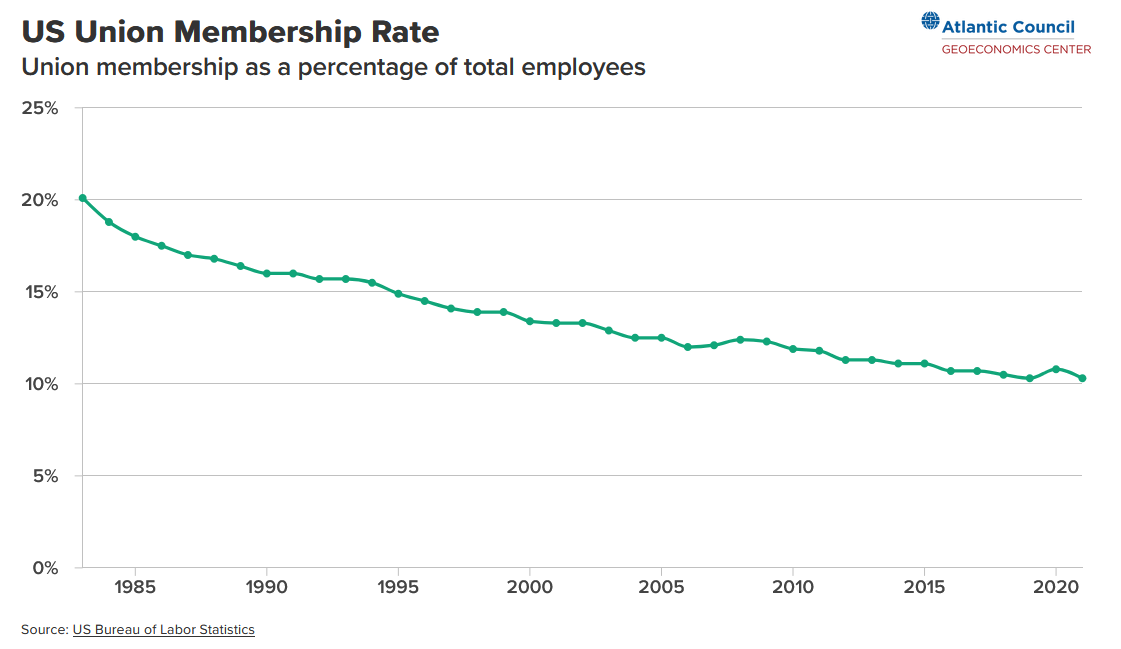
Graph showing the decline of union participation in the US over a 35 year period from 1985 to 2020.[12]
It is no understatement however to say that this is not a situation specific to the United States; the workers are supremely disorganized and unconscious everywhere. When it comes to their organizations, which we can use to test their level of class development, either they have hardly any, like within the U.S., or they have been “granted” them by the capitalist authorities, the country dominated by state-approved “unions” which are more like corrals, keeping the proletariat contained and aligned with the state and interests of the capitalist class, than they are organizations of the working class. Because there are few practical formations for labor, there are also few appropriate outlets for our own revolutionary efforts towards labor as “labor.”
The kind of international proletarian class-consciousness that cuts through bad trends, supports the organization of labor, and builds towards the goals of the socialist movement was promoted by the powerful unities of Communist Party administrators, proletarians, and peasants that made up the ruling sections of both the Soviet Union and the People’s Republic of China in a previous period of history. But now, in no small way due to the defeat of these once strong vanguards of the proletarian revolution, the global working class has been tucked back into sleep.
While we stare defeat square in the face for now, still, the dialectics of history prove that the laboring class is always on the move, and that it will begin to struggle again, and soon — as itself, that is, as its own class with its own aims and politics. When it does, the workers will begin to understand and will be put on the path of actually understanding themselves as the revolutionary leaders of the next era of production: the socialist one. Even before this understanding is grasped, they will build, again, among themselves and for their class, the kind of needed organizations Stalin speaks of, putting forward radical demands as a class in the process. But it will take up these tasks sporadically, and with numerous costly setbacks, without the help of the Communists.
2. “Socialism” on the Rise
Despite labor being much less conscious, not to mention less politically active than they were in previous periods of recent history, and despite the organizational defeats faced by scientific socialism, or, Communism, over the last century, “socialism,” in the loosest sense of the word, is on the rise in recent years and enjoying a public resurgence. An NBC poll of 1,000 U.S. registered voters showed a marked decline in the positive opinions of capitalism over the course of 2018-2025,[13] while a Gallup poll found that Democrats who viewed socialism positively grew from 50% to 66% between 2010 and 2019.[14] How should we account for this change of opinion? Our society’s view towards the general idea of socialism has shifted positively because there has been no answer to the many contradictions plaguing capitalist society. The abject failure of neo-liberalism, Keynesian economics, and all the bourgeois philosophies and “answers” that have been brought forward by society in vain attempts to meet increasingly antagonistic contradictions have necessarily birthed a huge upsurge in alternative politics, and with this, there has understandably been an upsurge in loose socialistic political ideas among the masses broadly. Discontent among the masses is only growing, and favorable ideas of socialism are growing along with it, which is only natural, as socialism sets itself opposite the status-quo capitalist order.
With the growth of political radicals and the prevalence of protests, political actions, and “socialistic” ideas among the masses, so too grow the “socialistic” parties. Despite being an open electoral arm of the U.S. Democrats, in November of last year the country’s largest so-called “socialist” party, the Democratic Socialists of America (DSA), announced that they had reached 90,000 members.[15] Last December, riding the energy of their golden-child Mamdani’s NYC mayoral win, more than 100 of their supposed elected “socialists” headlined a conference in New Orleans titled, “How We Win.”[16] Despite how DSA portrays themselves as the socialist movement, we Communists are not comforted by the supposed “wins” of opportunists.
We know that the socialistic ideas spurring on this latest growth of “the left” are not correct ideas that can move the socialist revolution forward, theories based in principled Marxist dialectical materialism. The new interest in revolutionary theory broadly, including the new interest in socialism, has come spontaneously from the experience of the masses, as they exist now, under liberal capitalism, reacting to the increasingly antagonistic conditions of their existence. These antagonisms have sharpened dramatically in recent years, and with the governments of the world tied more to the motives of capital than ever before in history, entirely unable to practically solve any of the problems plaguing the people, new sections of society have stepped forward with their “answers.” The necessity of change is being understood by more and more people, explaining the current confusion in politics generally — the whiplash between many different voices and opinions — which has also infiltrated the field of socialism and the “left.” We should make no mistake; the growing radical attitude and popular unrest we are seeing has not yet left the realm of spontaneity and is still reflective of the more-or-less “normal” relations of capitalist society. However, its mundanity should not cause us to overlook the fact that it is these spontaneous revolts — correctly utilized by the Communists — which develop into a capable force for the socialist revolution. So far, disregarding its reactionary sections, our “revolt” has only loosely pawed at the lowest hanging points of unity required for the beginnings of a socialist revolution; “anti-fascism,” and a naïve idea of “anti-capitalism” are the only real slogans that have taken hold widely, and the sloganeers themselves are generally involved in bourgeois formations. The masses and the socialists with them are still mired in the spontaneity of liberal society, dominated by the bourgeoisie who generally avoid speaking of Marx and genuine proletarian power at all costs, and the revolt has not been allowed to develop intellectually into class-consciousness. The ruling class has been allowed to dupe the people in such a way due to the lack of Communist organizing, forming all kinds of anti-Communist, revisionist, and “radical” non-class organizations unopposed, and funneling what should be the revolutionary mass fervor that leads to their overthrow into safe, manageable, and divided organizations of liberal reformism.
Despite the confusion and counterrevolutionary work of the bourgeois opportunists, however, principled Marxism, as the most complete scientific socialist theory and the most developed form of class-consciousness, grows as well. Communist formations, both old and new, more revisionist and less revisionist, are taking in new members out of the growing interest, as well as the base “socialists” and other political radicals.
However, while Communism will inevitably win out over all the other radical and socialistic programs, it is incapable of growing into the movement we need it to be as it stands now. While “Marxism” and “socialism” develops among the masses, without the interjection of principled Communist organizers, it will remain a degenerated version, tainted by the teachings of revisionists who dominate the current political landscape. While those who bring up the rear of our movement rejoice that any Marxism is being learned at all, we who are knowledgeable in theory and know where the movement needs to go know that the masses’ current political understandings will forever be stunted under our current circumstances. Due to Communism’s temporary defeat, the loudest and most prevalent “Marxist” voices are not knowledgeable voices for the revolutionary overthrow of the capitalist class and the establishment of worker power, but opportunists and grifters, who may be able to lead the people some way along the revolutionary path but cannot speak to the destination or the way ahead.
As we look at the camp of Marxism, we see that numerous bad trends that were soundly laid to rest by the Marxist forefathers and enfeebled politically in the past have become dauntingly strong today, bringing the baseness of the non-Marxist “socialists” right into Marxism’s living room, so to speak. Many Marxists who should be well-read in theory, knowledgeable, and above such amateurishness fall for the clever way the new opportunists resurrect and mystify these old, tired revisionist theories, and we have not yet seen a firm enough section capable of extended struggle against them. By failing to rise to the intellectual level of a Marxist, or out of sheer cowardice, we are being led away from the ranks of the professional revolutionaries and towards being rank-and-file servants of the capitalists, loyal members in the bourgeois political parties of the “Democratic Socialists” or in revisionist “Communist” parties and formations that are counterrevolutionary in one way or another.
This situation cannot continue, and we have to stop acting like the workers are as bull-headedly dumb as some “Marxists,” and are even capable of allying with a “Communism” that has butchered itself out of revolution and working class theory and into whatever the revisionist bourgeois leaders want it to be. If we are Communists, we must struggle for the proletarian class and against the class of the bourgeoisie. This means to uphold true Communist theory and the advancements made by Leninism, no matter how unpopular it may be at the time. We do this because, as materialists and scientific socialists, we understand that revolution is a material process, and that it requires a material methodology. This methodology is Marxist theory, particularly the worldview of dialectical materialism and the tenets of Marxism-Leninism, and we do no one a service when we distance ourselves from, or otherwise obscure, this fact.
It is of vital and primary importance that we counter all the bad ideas that pass as principled Marxism today, engaging in a broad struggle against every manifestation of revisionism. In order that we can struggle effectively against it, we should understand revisionism thoroughly.
3. The General Character of Revisionism
What is revisionism? Revisionism is a form of opportunism; opportunism that wears the clothes of principled Marxism while actually acting against it. What is opportunism? Opportunism is the distortion, side-lining, or complete liquidating of a movement by its own supposed proponents for individualist reasons or personal gain. Regarding the movement of socialism, opportunists are political actors who sell out the workers in favor of the bourgeoisie, either through their own duplicitousness, ignorance, or cowardice. Opportunism that “revises” foundational Marxist theory, adopting the name Marxist or Communist while actually working against Marx’s most foundational and immutable points, is termed “revisionism.” Revisionism is not just restricted to the realm of theory, but ha s grown whole organizations, with revisionist “Marxists” saturating most “Communist” parties today.
In his well-known and incredibly sapient speech, “On the Correct Handling of Contradictions Among the People,” Mao says revisionists, while paying “lip service to Marxism,” actually attack its “quintessence.” He goes on to describe the work of the revisionists, saying:
They oppose or distort materialism and dialectics, oppose or try to weaken the people's democratic dictatorship and the leading role of the Communist Party, and oppose or try to weaken socialist transformation and socialist construction.[17]
Mao was a follower of Lenin, and his own understanding of revisionism was aligned with Lenin’s brilliant works on the topic from decades earlier. Applying his strong grasp of dialectical materialism, Lenin thoroughly critiqued revisionism in the early 1900’s, delineating true Marxism from several of revisionism’s particular forms, making him an expert that should be thoroughly studied if we are to understand revisionism today.
In “Marxism and Revisionism,” Lenin describes revisionism’s general features as so:
To determine its conduct from case to case, to adapt itself to the events of the day and to the chopping and changing of petty politics, to forget the primary interests of the proletariat and the basic features of the whole capitalist system, of all capitalist evolution, to sacrifice these primary interests for the real or assumed advantages of the moment—such is the policy of revisionism. And it patently follows from the very nature of this policy that it may assume an infinite variety of forms, and that every more or less “new” question, every more or less unexpected and unforeseen turn of events, even though it change the basic line of development only to an insignificant degree and only for the briefest period, will always inevitably give rise to one variety of revisionism or another.[18]
Many revisionists believe they are being practical. They think themselves “good” because, in their minds at least, they are not “dogmatists,” and are capable of comprising their theories with “real life.” In actual real life however, they (to slightly paraphrase Lenin) sacrifice the primary interest of the proletariat for the real or assumed advantages of the moment. This is a terrible thing to do. To sacrifice the interests of the proletariat is to side with the bourgeoisie, since there is no valid new or updated strategy for the revolution outside the conflict of these two great classes.
In What is to Be Done?, Lenin says:
There can be no talk of an independent ideology formulated by the working masses themselves in the process of their movement, the only choice is—either bourgeois or socialist ideology. There is no middle course (for mankind has not created a “third” ideology, and, moreover, in a society torn by class antagonisms there can never be a nonclass or an above-class ideology). Hence, to belittle the socialist ideology in any way, to turn aside from it in the slightest degree means to strengthen bourgeois ideology.[19]
Socialism necessarily implies the best and most developed theories and tactics in support of the class of the proletariat — meaning Communism and the scientific socialist method taken up in the contributions of dialectical materialists like Marx, Engels, Lenin, Stalin, and Mao, which is not dogma but a method of analyzing the world through material classes and their dialectical relations to the productive forces. The masses and especially the proletarian class need to adopt the only scientific socialist method, Marxist-Leninist dialectical materialism, so that they can correctly delineate trends that benefit the capitalist class from those that benefit the proletariat, and make appropriate tactical decisions towards the latter, understanding that each decision they make spirals out into many dialectical consequences. The only way for any real progress to be made by humankind under our epoch of production is to struggle through the conflict between the bourgeoisie and the proletariat — on the side of the proletariat. To understand this fact, and to struggle against contrary ideas, is to uphold materialist dialectics and to understand the foundational point of the Communist worldview. This is what it means to be dialectical materialists, comrades.
All flavors of revisionism sideline dialectical materialism and principled class theory for the “real or assumed advantages of the moment,” which amounts to nothing less than liquidating the movement at its most important foundations.
4. The Historical Development of Revisionism
How did revisionism develop, and how does it come to be within our movement? In “Marxism and Revisionism,” Lenin talks about revisionism’s “inevitability,” and answers the latter half of this question as so:
Wherein lies its inevitability in capitalist society? Why is it more profound than the differences of national peculiarities and of degrees of capitalist development? Because in every capitalist country, side by side with the proletariat, there are always broad strata of the petty bourgeoisie, small proprietors. Capitalism arose and is constantly arising out of small production. A number of new “middle strata” are inevitably brought into existence again and again by capitalism (appendages to the factory, work at home, small workshops scattered all over the country to meet the requirements of big industries, such as the bicycle and automobile industries, etc.). These new small producers are just as inevitably being cast again into the ranks of the proletariat. It is quite natural that the petty-bourgeois world-outlook should again and again crop up in the ranks of the broad workers’ parties. It is quite natural that this should be so and always will be so, right up to the changes of fortune that will take place in the proletarian revolution. For it would be a profound mistake to think that the “complete” proletarianisation of the majority of the population is essential for bringing about such a revolution.[20]
Here, Lenin explains how revisionism inevitably infiltrates the Communist movement because of the workers’ adjacency to the bourgeois classes. The individual petty bourgeois who adopt “socialism” or “Marxism” often view our movement through their petty bourgeois lens. In large part due to their capital, they are able to saturate their bad theories throughout all of society and, with the low level of both class-conscious workers and effective Communist organizers typical of our time, at a greater rate than the principled Marxists and the proletarians. Today, this petty-bourgeois “socialism” has become a dominating force, able to spread more or less unimpeded from the halls of bourgeois power, where it is parroted ceaselessly by all shades of ignorant “socialists,” infecting even many “Marxists,” and resulting in the propagation of revisionist “Marxist” theories.
But revisionism is nothing new, and, even while it must be viciously struggled against, signifies to the enormous clarity of the Marxist worldview. Lenin places Marxist revisionism as originating from the “theoretical victory of Marxism” during the years of 1872-1904, when Marxism was spreading throughout the masses, dominating the other “socialist” ideas, and birthing all kids of revolutionary organizations in its name. Lenin explains this in his article, “The Historical Destiny of Karl Marx.”
The dialectics of history were such that the theoretical victory of Marxism compelled its enemies to disguise themselves as Marxists. Liberalism, rotten within, tried to revive itself in the form of socialist opportunism.[21]
Liberal opportunism had disguised itself under the banner of the utopian “socialists” or bourgeois reformers in Marxism’s infancy. But, as Marxism developed and began to dominate the political landscape, its disguise changed and became “Marxist” — became revisionist — in order to propagate its ideas, expressing the same bourgeois worldview it always had but via new “Marxist” “channels,” as Lenin explains in “Marxism and Revisionism.”
But after Marxism had ousted all the more or less integral doctrines hostile to it, the tendencies expressed in those doctrines began to seek other channels. The forms and causes of the struggle changed, but the struggle continued. And the second half-century of the existence of Marxism began (in the nineties) with the struggle of a trend hostile to Marxism within Marxism itself.[22]
The inherent hypocritical nature of revisionism — the fact that very un-Marxist theories are posited by supposed “Marxists” — is ultimately a sign of the correctness and power of Marxism, an admittance of its philosophical clarity, its international character, and its ability to serve as the vehicle for political action on the part of all oppressed people. Even the most infamous form of reaction and bare-faced capitalist power, Nazism, had to crudely ape the Marxists and disguise itself as “socialism” — “National Socialism” — in order to propagate itself to the workers of Germany in the 1930’s and 40’s, opportunistically riding the waves of popular socialist political excitement that sprang from the success of Bolshevism. Our enemies would not have to disguise themselves in our camp if our camp was not a powerful force against them.
However, we can’t let this fact go to our heads and distract us from the pressing truth that, at our current time, the revisionists are winning. To make matters worse, the Pandora’s Box of non-Marxist and even non-class “socialism” has been opened, making worn-out and unscientific “socialist” trends prominent again. This is decidedly a revolutionary step backwards compared to decades earlier, when Communism was the dominant trend within socialism.
To illustrate this step backward, let’s look at the following statement Lenin made in 1908, which should astound anyone remotely familiar with the modern socialist movement: he said that “pre-Marxist socialism has been defeated,” and that it was now “continuing the struggle, no longer on its own independent ground, but on the general ground of Marxism, as revisionism.”[23]
Today the ground of Marxism is still inundated with revision, but to make matters worse, we can no longer say that “pre-Marxist socialism” has been defeated. However, we can take solace in the fact that it has already received its mortal blows. Opportunism and ignorance take on new clothes, yes, but these bad trends — dead even as they walk among us in great numbers, like zombies — are weak and unstable, and each will fall as zombies do too: by a concerted blow at their heads. We are living in a geriatric, rapidly expiring capitalism; one that has been mercilessly critiqued since the beginning of its existence and, for almost 200 years, has been under near constant assault by class conscious Communist forces engaged in struggle. These forces have made immense victories on all fronts. Their struggle and the victories gained, especially on the ideological front, are chronicled in the theories and writings of the Communist revolutionaries, specifically, Marx, Engels, Lenin, Stalin, and Mao. Revisionism and pre-Marxist socialism threaten us with renewed force today, but we only have to remind the Marxists to redouble their intellectual efforts and get good at theory. The vast majority of the misunderstandings, mystifications, or blatant opportunist ideas that constitute revisionism and the ideological foundations of revisionist formations today are not new, but previously eradicated failed theories that are laid to rest within the literary tradition of our movement. We only need to learn the teachings of our predecessors, and we are well on our way to becoming capable fighters against revisionism today.
5. The Immediate Importance of the Anti-Revisionist Struggle
Why must we be capable fighters against revisionism? Because the fight against revisionism has become the primary battleground of the movement, a field of the most strategic importance, demanding that the comrades today act according to its terrain. Why is the fight against revisionism our primary battleground? As Communism and Communist organizing is the method by which the masses are liberated, we must before all else have a principled and revolutionary Communism clear (to a significant degree) from revisionism and non-Communist influence in all places in society that purport to be Communist; namely, the revisionist “Communist” formations and especially those parties that claim the “vanguard.” Currently, the revisionist “Marxists” in the prominent “Communist” parties garner the lion’s share of whatever attention and energy the masses lend towards Communism and Marxist theory in the course of their spontaneity, constituting themselves as a giant revolutionary roadblock. Under these circumstances, the actual Communists are sidelined out of the movement, forced to struggle uphill and in isolation.
Shamefully, our movement relegates true and principled Communism as just one option in a sea of equally acceptable radical strategies, and this is ensured by the revisionists in the “Communist” parties, who have denied class struggle and true Marxist theory in accordance with their opportunism. We cannot expect to construct a firm ideological and revolutionary Marxist unity among ourselves — not to mention the working class (both of which are necessities for the performance of any real revolutionary work) — while this remains the case. The situation must change.
Lenin understood the importance of the anti-revisionist struggle. In “Imperialism and the Split in Socialism,” he calls for “determined and relentless” struggle against bourgeois labor elements.
The fact is that “bourgeois labour parties”, as a political phenomenon, have already been formed in all the foremost capitalist countries, and that unless a determined and relentless struggle is waged all along the line against these parties—or groups, trends, etc., it is all the same — there can be no question of a struggle against imperialism, or of Marxism, or of a socialist labour movement.[24]
The comrades who are aware of how our movement has fallen into the hands of the bourgeoisie by means of revisionism must rise to the “determined and relentless struggle” against that bourgeoisification. Before we can succeed against the much wider and varied “socialist” camp (not to mention society at large), we must first achieve a victory over the bourgeois elements within our own camp, meaning, within the camp of Marxism/Communism. To sideline this most crucial task is to cede to opportunism — to the bourgeoisie — and to liquidate the revolution.
More than a hundred years ago, Lenin wrote:
Unity with opportunism means unity between the proletariat and its national bourgeoisie, i.e., submission to the latter, a split in the international revolutionary working class. We do not say that an immediate split with the opportunists in all countries is desirable, or even possible at present; we do say that such a split has come to a head, that it has become inevitable, is progressive in nature, and necessary to the revolutionary struggle of the proletariat, and that history, having turned away from “peaceful” capitalism towards imperialism, has thereby turned towards such a split.[25]
In this passage, Lenin speaks to the anti-revisionist task that, in our present day, is long overdue. The dialectical movement of history — the peaks and valleys of revolutionary progress put to words by Lenin — acknowledges that a split with the opportunists is inevitable, and Communists today must uphold the truth of that inevitability.
6. The Dual Problem
While the anti-revisionist struggle is the primary battleground, we can clearly see the problem facing our movement as a dual-sided problem — each part reinforcing the other — that must be tackled simultaneously. The first side of the problem is the revisionist problem; high levels of Marxist revisionism within our movement. These bourgeois theories fuel the second side of the problem, low worker consciousness, which itself creates an audience for the opportunism of the revisionists, thus perpetuating the loop. When we correctly solve both sides of this problem — when we actively work to combat revisionism and raise worker consciousness — we will have eliminated the biggest roadblocks to our movement, and created fertile ground for it to progress. Without this foundation, it is impossible for a true socialist movement to develop and achieve victory.
Achieving victory over Marxist revisionism and the raising of worker consciousness are vital practical tasks; not jobs that can be left up to some invisible hand of history. Without class-consciousness we have no revolutionary proletarian class, and it is impossible to have a revolutionary proletarian class while Marxism, the vehicle for bringing revolutionary class-consciousness to the workers, is infected with counterrevolutionary revisionism. To neglect either part of our dual problem — or to neglect the practical tasks that flow from this problem, namely the work of class education/agitation and the inter-“Marxist” anti-revisionist struggle — is to fail spectacularly as Communists.
Faced with the urgent need to take on both firm anti-revisionism work and propagate Marxism among the working class (as well as the masses at large), we must build for ourselves, as soon as possible, an organization that is capable of uniting the non-revisionist Marxist element, immediately putting it to work at appropriate tasks that lead to the solving of our movement’s dual problem, creating the necessary foundation for socialism’s development.
7. A Country-Wide Media Group
What kind of organization is capable of doing this? Since the majority of socialist and even “Communist” parties today are cozy with the revisionists (if not dominated by them), it is safe to assume that we cannot expect any of the currently dominant “Communist” parties to be this organization. These parties are, in fact, one of the primary stages of the anti-revisionist struggle, and our movement requires an organization outside these current establishments in order that the struggle may be planned and carried out effectively.
Does that mean we found a new Communist Party?
No. Such an action does not practically answer the problem of low worker consciousness. As we mentioned earlier, the workers on the whole are not political, meaning they are not conscious of themselves as a class and are not capable of a Party as they are now, making any “Communist Party” that exists currently a proletarian party with no proletarians — adventurist endeavors that have left the class of the proletariat behind — which explains also their revisionism. A Party, now, even one founded in strong anti-revisionism and possessing a sound political line, would be incapable of bridging the gap between Communism and the working class. “The Party must direct the struggle of the proletariat,”[26] as Stalin says in The Foundations of Leninism, but workers today have forgotten they are even in a struggle, requiring a basic class education (something they will gain through their experience and through the work of Communist propagandists and agitators) before a struggle and a Party can be feasible in a practical way, especially in the more imperial countries where the bourgeoisie and labor aristocracy is strong.
The fact is, the current “Communist” parties are taking the place of the Communist Party, confining our would-be comrades and funneling the masses’ interest in revolution and socialism into themselves, where that interest can be liquidated along bourgeois lines. Under these conditions, the worker’s rise to consciousness is waylaid, and it will continue to be so until revisionism and its organizations are defeated. The current political field of “Communism,” as well as the organizations within it, is the primary stage of the anti-revisionist struggle, and we cannot sidestep this fact and go off on our own as “pure” Marxists founding a “pure” party. Struggling against revisionist Marxism means struggling where revisionist Marxists are, which means struggling within the current “Marxist” political formations.
Besides, founding a new one from the ground up is impractical and would be a waste of time. The current ones are already established, and can be transformed into the Communist Party much easier and faster than if we founded a new party from the ground up.
So should we seize the revisionist formations, “purge” the parties and make concerted efforts to take them over and replace their structure and leadership with proper comrades? This is the goal, for sure, but how could this be done? What form of organization is capable of facilitating the removal of revisionists and revisionist lines from not just one party (since most countries have more than just one prominent revisionist “Communist” party), but many parties? And how could “anti-revisionism,” in a working sense, be communicated in the particular to all comrades so that practical work can be done? Moreover, how can all Marxists (and even wider society) generally be united in view towards this crucial work? Becoming an organization that is capable in the fight against revisionism isn’t done by simply throwing “anti-revisionism” into a constitution or a group’s by-laws. The nuances of revisionism — the many particular trends that each claim to be based in sound Marxist theory — cannot be learned as easily as memorizing lines in a school play. The task of dealing with our fallen away revisionist “comrades” in the current parties itself requires a great deal of planning and coordination. We need an organization that takes up this task, and as this is a task in the wide field of Marxist political formations generally, it must be an organization that is decidedly outside them in order to coordinate this struggle in the widest possible way.
In addition to taking up the anti-revisionist struggle, this organization must also be capable of answering the other side of the dual problem: of engaging in principled and political agitation among the working class, as well as wider society more generally, in order to raise the class-consciousness of the proletarians, preparing them for a Party and political rule.
A country-wide media group, a centralized organization of propaganda, agitation, and political work organized along a Marxist-Leninist line, is the appropriate form for our period. A country-wide media group is alone capable of drawing in comrades who can act in a dual capacity as propagandists for the consciousness of the masses, as well as diplomats and organizers for the struggle against the revisionist formations, against the “socialist” liquidators, and for the organization of labor and the Communist Party of the country in its proper time.
The Party is still the driving force of the dictatorship of the proletariat. We need a principled and revolutionary Communist Party in order to carry out socialist construction. But we, crucially, must always recognize tactics that suit our current situation. A country-wide media group is the appropriate organizational form for our moment, allowing us to perform appropriate tasks that will influence society — and particularly the working class — to the point that our situation changes to one in which the Communist Party is not only viable, but strong and dominant, able to constitute the dictatorship of the proletariat, united with a prominent, international, and revolutionary proletarian class.
8. Ideological Work
The rationale for a country-wide media group as our period’s form of organization stems also from our analysis of the most successful socialist revolution to ever occur, the Bolshevik Revolution, where Lenin and his comrades brought needed material and ideological unity to the socialist movement in order to not only overthrow Russian tsarism, but to establish an industrial Marxist socialist state, giving not only the rights of liberal society to the majority of the Russian citizenry, but also, in one of the few examples in history, guaranteeing the people their right to freedom from exploitation by the capitalists.
We have many comrades today mystified by the Bolsheviks, and do not understand how such an effective Communist organization came to be an effective Communist organization; they do not understand the development of the Bolsheviks and Russian Revolution in a complete way. For the purposes of our topic here, we will emphasize that the Bolsheviks were heavily involved in ideological production, and propagated their theories through a newspaper. In other words, theory and ideological work constituted the majority of their early labor, spreading literature among the trade unions, the proletarian organizations, and the Marxist parties, particularly the Russian Social-Democratic Party.
Lenin called for the founding of an “All-Russian newspaper” in his 1901 article, Where to Begin?, and he and his comrades proceeded to serve on a series of editorial boards for Russian Communist newspapers, of which Iskra (which acted as the official newspaper of the Russian Social-Democratic Party) is the most famous. In the following excerpt from Where to Begin?, notice the many similarities to our own period, even while more than 120 years have passed since the time of Lenin’s writing.
In our opinion, the starting-point of our activities, the first step towards creating the desired organisation, or, let us say, the main thread which, if followed, would enable us steadily to develop, deepen, and extend that organisation, should be the founding of an All-Russian political newspaper. A newspaper is what we most of all need; without it we cannot conduct that systematic, all-round propaganda and agitation, consistent in principle, which is the chief and permanent task of Social-Democracy[1]in general and, in particular, the pressing task of the moment, when interest in politics and in questions of socialism has been aroused among the broadest strata of the population. Never has the need been felt so acutely as today for reinforcing dispersed agitation in the form of individual action, local leaflets, pamphlets, etc., by means of generalised and systematic agitation that can only be conducted with the aid of the periodical press...
If we fail, and as long as we fail, to combine our efforts to influence the people and the government by means of the printed word, it will be utopian to think of combining other means, more complex, more difficult, but also more decisive, for exerting influence. Our movement suffers in the first place, ideologically, as well as in practical and organisational respects, from its state of fragmentation, from the almost complete immersion of the overwhelming majority of Social-Democrats in local work, which narrows their outlook, the scope of their activities, and their skill in the maintenance of secrecy and their preparedness.[27]
Lenin, like all good Marxists, knew how to prioritize ideological work, and understood how to turn propaganda and ideological “content” into practical gains for the revolution. Communists understand that we fail in our tasks as revolutionaries if we leave the ideological struggle to spontaneity, and that it is necessary for knowledgeable comrades to get their hands dirty in the superstructure. Lenin was right to acknowledge that the unity of tactics and thinking created by ideological work is foundational for building not only a successful Party organization, but for the revolution as a whole; history proves him correct. The revisionists of his time (in this instance, Rabocheye Dyelo) portrayed Lenin and his theorizing as “bookish,” and deemed their own infatuation with narrow, local issues as the superior tactic, calling their “strategy” “live political work,” a line of thought that is nearly identical to that of many revisionists today. But Lenin shows that working within the theoretical struggle is the most “alive” work a comrade can do in a period of theoretical disunity, and his insistence on ideological production brought real form to a country-wide socialist movement.
...it is possible to “begin” only by inducing people to think about all these things, to summarise and generalise all the diverse signs of ferment and active struggle. In our time, when Social-Democratic tasks are being degraded, the only way “live political work” can be begun is with live political agitation, which is impossible unless we have an All-Russian newspaper, frequently issued and regularly distributed.[28]
It’s clear today that all the “diverse signs of ferment and active struggle” have been allowed to fumble around in the dark, creating their own idealist “revolutionary” philosophies that actively compete with and, for now at least, dominate principled Marxism and the science of dialectical materialism, birthingan endless parade of revisionist “Marxist” theories that are constantly knocking the legs out from under our movement. Without the work of an organized media group, we would have no active cohesive theory being propagated by which to oppose this eclectic revisionist mess, and no way to pick the revolution up off the ground. Only when we reveal the class antagonisms beneath the problems that plague the people, only when we “summarise and generalize all the diverse signs of ferment and active struggle” in the viewpoint of principled Marxism — the work of our proposed media group — can we actually build a movement capable of acting in the proletariat’s and, for that matter, the masses’ interest.
Today, literacy rates are falling in many countries in the world, including the United States.[29]In addition to the decline in reading, the development of the internet as well as video/audio media makes a newspaper per se a form that is losing its relevancy to the masses. We must make use of the technology and forms of our times. In Lenin’s time, newspapers were popular reading, and groups of all kinds published newspapers as a way to disseminate information. In order to perform “live political agitation” — in order to actually be a presence of agitation within the masses today —we must adopt a form of content that is accessible to them. Our media group will not only produce written periodicals, but also develop audio/visual content and numerous social media accounts in tandem with the development of the masses. This is so that solid Communist theory and tactics concerning the political issues of the day — content which exposes the class of the proletariat to its situation under the capitalist-imperialist system while providing it with strategy for its liberation — are projected into both the current stream of “political discourse,” and the nascent labor movement generally. In other words, so that we may perform “live political agitation.”
The media group must find a way to present Communism and class-consciousness to the working class where they are, inserting the Marxist political message into not only labor issues and labor organizations, but also the field of social and political issues that currently contain (we could say restrain) the workers’ political understandings.
This type of agitation and ideological struggle is being performed now en masse by “the left” and by “socialists” — a portion of them even principled Communists. There are already many comrades who have taken on this work as their primary method of struggle, enthusiastically entering the “discourse” by writing literature, posting on Reddit, on TikTok, YouTube, and other places of ideological production, convinced in the necessity of spreading anti-revisionist Communist propaganda. These efforts should be supported, but they can only be supported effectively if they are performed under the auspices of a centralized organization, with a clear political line and tactics that can bring form to the work of these disunited propagandists, take them up under its wing and train them into professionals for the proletarian revolution. Under our media group, these previously divided propagandists will not only perform ideological work in a more efficient and productive way, but also become well-rounded revolutionaries in other respects, capable of taking on the many tasks needed by socialism now and of adapting tactics to what is needed in the future. Without a centralized country-wide media group to bring form and organization to this effort, comrades doing this vital work now are mostly doomed to burn out in isolation, yelling into their phones. Through a country-wide media group, we will unite these isolated comrades and put their labor to use in a way that builds constructively towards the goals of the revolution.
Marxism must expand its reach not just throughout “labor issues,” but throughout political discourse generally. Even with its lack of understanding, and even with all their inadequacies, the current discontent from the liberals and their non-class political ideas constitute as our period’s “signs of ferment and active struggle,” a struggle which the masses are just beginning to grasp. As is usual at the beginnings of “active struggle,” due to their greater adjacency to capital, it is the most privileged sections of society who give public voice to this ferment in utero. They understand “struggle” in a very privileged way, a way that is very alienated from the masses of laborers: the real source of the ferment. Hence our current “signs of ferment” have not yet escaped the form of bourgeois revolt. But that does not mean that the ferment is incapable of developing into something useful for the socialist movement and, in fact, it will develop into such a thing under proper circumstances. As it stands, any proletarian who is in the least bit political now, not to mention revolutionary, is likely part of this spontaneous liberal ferment, part of the liberals’ never-ending stage production they call “activism” and even “revolution,” revolving around all the parading issues, sit-ins, protests, and the like that the opportunists direct them towards, trying (and failing) to bring some sense to it all and form a consistent worldview.
We build the labor outcomes we need when we can raise the prestige of Communism generally (which is at an all-time low) by sealing up these “signs of ferment and active struggle” — these spontaneous and disunited manifestations of oppression — and reveal to the masses, again, that the contradictions plaguing the people are all symptoms of the primary antagonism of class oppression, and that Communism is the only consistently materialist (that is, scientific) philosophy which stands against that oppression, making its universal adoption by the masses inevitable. It is difficult to imagine a mass labor movement adopting Communism (which they must) without this kind of revelation happening among a good portion of the masses generally. It is ignorance to think that the low-level of esteem general society holds towards Communism now has not also translated into the class of the proletariat, which lives in this society and, moreover, has very little means of influencing it towards its own class opinion at all, since it is oppressed by the ruling class of the capitalists.
But the proletariat will change into a Marxist force for class revolution in due time, and our media group will be a primary agent of that change. Through our sound scientific socialist explanations of the antagonisms of society — antagonisms that so mystify the liberals and all interested members of the working class — we will reveal the necessity and the relevance of the Communist worldview again, which, because it unites workers under a revolutionary worldview in which they are the “rulers,” can only help to hasten the organization of labor generally. Having orchestrated the ideological struggle along firm class lines, the media group will be well-equipped to orchestrate also the labor struggle, especially those labor elements that have “grown-up” in the content we produce.
In addition to clearing Marxism of revisionist influence, our media group will supply the consistent worldview of Marxist dialectical materialism to the workers and to the masses generally via literary and multimedia content, exposing each isolated political “issue” as a related consequence of our system of production, which any actual Marxist should be capable of doing to at least some degree. After engaging with our material across only a few of these “issues,” the workers and the masses in general will have, in fact, begun the process of breaking their current narrow liberal understanding of separate “issues,” and adopting a more correct holistic and class-conscious understanding. If they possess even a little of an understanding of their oppression by the capitalists, the workers who come in contact with our work will appreciate a class analysis, and, after coming in contact with our work across a wide range of “social issues,” they will be pushed towards the scientific socialist view and full class-consciousness, becoming our staunchest supporters and willing comrades in service to the media group and to our movement.
9. The Organizing Angle
Beyond fulfilling the need for ideological work, the unification and growth of revolutionary cadres, an outcome that follows directly from the day-to-day operations of the organization, is another crucial reason we must adopt the strategy of a country-wide media group. As the following excerpt from Where to Begin? shows, the construction of literary and ideological products is crucial for forming any practical organization:
The role of a newspaper, however, is not limited solely to the dissemination of ideas, to political education, and to the enlistment of political allies. A newspaper is not only a collective propagandist and a collective agitator, it is also a collective organiser. In this last respect it may be likened to the scaffolding round a building under construction, which marks the contours of the structure and facilitates communication between the builders, enabling them to distribute the work and to view the common results achieved by their organised labour. With the aid of the newspaper, and through it, a permanent organisation will naturally take shape that will engage, not only in local activities, but in regular general work, and will train its members to follow political events carefully, appraise their significance and their effect on the various strata of the population, and develop effective means for the revolutionary party to influence those events. The mere technical task of regularly supplying the newspaper with copy and of promoting regular distribution will necessitate a network of local agents of the united party, who will maintain constant contact with one another, know the general state of affairs, get accustomed to performing regularly their detailed functions in the All-Russian work, and test their strength in the organisation of various revolutionary actions. This network of agents will form the skeleton of precisely the kind of organisation we need—one that is sufficiently large to embrace the whole country; sufficiently broad and many-sided to effect a strict and detailed division of labour; sufficiently well tempered to be able to conduct steadily its own work under any circumstances, at all “sudden turns”, and in face of all contingencies; sufficiently flexible to be able, on the one hand, to avoid an open battle against an overwhelming enemy, when the enemy has concentrated all his forces at one spot, and yet, on the other, to take advantage of his unwieldiness and to attack him when and where he least expects it...
If we join forces to produce a common newspaper, this work will train and bring into the foreground, not only the most skillful propagandists, but the most capable organisers, the most talented political party leaders capable, at the right moment, of releasing the slogan for the decisive struggle and of taking the lead in that struggle.[30]
A media group possesses the exact same organizational capabilities Lenin ascribes to a newspaper, most importantly allowing for “a permanent organization” to “take shape that will engage, not only in local activities, but in regular general work,” capable of training “its members to follow political events carefully, appraise their significance and their effect on the various strata of the population, and develop effective means for the revolutionary party to influence those events.” The construction of a country-wide media group within each country will also serve as the “frame” upon which to construct the “permanent organization” of the Communist Party of each country at the proper time. We cannot build a Communist Party with revisionist comrades or class-unconscious workers, and since our movement is inundated with both, a principled Party is not viable now. The media group would serve as a kind of “pre-Party” formation that tackles the most pressing tasks of our movement at the same time as it builds towards the eventuality of a Party in the future by the very nature of its work. In our current period, and so long as the “free speech” afforded to media in the liberal societies holds out, the work we do is mostly public, aimed at the whole society; ideological production meant to unite the developed Marxists and draw out the conscious element among the working class. But the connections made between the media group cadres, labor organizations, and allied members of the masses in the course of this public work will birth more than just ideological workers, creating a whole network that is capable of going underground if need be, and, most importantly, capable of diverse work.
In the following quote from The Foundations of Leninism, Stalin explains how it was the newspaper, Iskra,that united the Russian Communist movement. The products produced by our media group would have a similar effect in uniting the Communist movement today.
In the period of the formation of the Party, when the innumerable circles and organisations had not yet been linked together, when amateurishness and the parochial outlook of the circles were corroding the Party from top to bottom, when ideological confusion was the characteristic feature of the internal life of the Party, the main link and the main task in the chain of links and in the chain of tasks then confronting the Party proved to be the establishment of an all-Russian illegal newspaper (Iskra). Why? Because, under the conditions then prevailing, only by means of an all-Russian illegal newspaper was it possible to create a solid core of the Party capable of uniting the innumerable circles and organisations into one whole, to prepare the conditions for ideological and tactical unity, and thus to build the foundations for the formation of a real party.[31]
A crucial part of “preparing the conditions of ideological and tactical unity” within our movement is achieving victory over revisionism.
10. The Media Group’s Relationship to the Current “parties” and to the Party
We should specifically clarify the relationship between our proposed media group and the current Marxist political establishment.
Regarding the small Marxist “parties” and organizations which represent little more than disconnected groups of local Communists doing “local work” — like mutual aid, student clubs, or study circles — the media group hopes these will be won over by its arguments and assimilated into its structure and mission.
Regarding the larger “Marxist” political parties that purportedly represent the whole country, in the final view, the media group’s relation is one of opposition. As Lenin predicted and we have attempted to show in this work, Communism’s split from opportunism — from revisionism — is necessary if we are to make any serious progress in our movement and is past overdue in our current day. In the final view, our media group is opposed to the current state of “Marxism” as a whole, as well as the success of the majority of “Marxist” parties today, which we recognize are dominated by revisionism due in no small part to the existence of the revisionist “Marxists” within them, who have built party policy and organizational tenets in their own revisionist image, choking out principled Communists within their parties.
While we are generally opposed to the revisionist organizations, we must understand them correctly, not as a monolithic group that must be completely suppressed from the outside, with its membership ridiculed and chastised as a whole, but as a theater of struggle, with each revisionist formation within a country constituting its own “front.” Throughout this entire country-wide theater of anti-revisionist struggle, we must maintain our position on all of these fronts, prioritizing the biggest and most powerful of these groups, just as the most populous front in a war must also receive the lion’s share of the recruits. Who are our fighters in this front? They are our sympathizers within the revisionist formations. Within each front, that is, within each big revisionist party, we must form sympathetic defenders of our own side to “hold the line” and to act as our agents, reporting the goings-on of the party and engaging in secretive diplomatic work within it. We must train these defenders up out of their narrow party consciousness and into capable cadre members; ready them for the assault by uniting them towards a common plan of attack, one which takes into account not just the internal politics of their specific revisionist organization, but of the entire theater as a whole. From underneath the noses of the many revisionist leaders who arbitrate over the many diverse revisionist parties and formations, we will unite all the revolutionary elements they have long ignored and sidelined, namely the principled Marxists, preparing our forces secretly for the proper time. At the proper time, when our work has reached an appropriate level of development, we will coordinate the execution of our preparations, make our presence known within the revisionist organizations, call on the entire organization to adopt proper Marxism, and seize the organization for principled Communism.Only through such a real split with revision can the country gain a proper Communist Party.
As the anti-revisionist struggle is demanded by the dialectics of history, we will not shy away from the necessity of this kind of subversive strategy towards the revisionist formations, and we will promote it openly in all our propaganda, specifically naming the organizations which are in need of this kind of subversion. By exposing the state of revision within these organizations, comrades within them who are already forming associations with these kinds of “splits” in mind will be emboldened, joining the media group so as to increase their own efficacy and unite with a broader mission. In this case, the media group serves as a sort of centralized federation-structure by which to facilitate the actions of different subversive groups, bringing them needed coordination within many parties simultaneously. The theory produced according to the media group’s anti-revisionist line acts as the light house that pulls these divided groups together ideologically, and as the media group will have open avenues for volunteers (and is always looking to invite those who are principled, tested, and capable into the ranks of its professional cadres), a working body of sound anti-revisionist collaborators will be built in the course of the media group’s every-day work. All of the divided subversive anti-revisionist groups in current revisionist parties will be inspired and affirmed in their own understandings when they see a prominent Communist media group exposing the treachery of their organizations, and, when they see also the treachery of other organizations like theirs, not only in their country but all over the world, exposed by the comrades working in the media group, they will be brought into the international struggle for Communism, and via our media group, which is directly connected to that wider struggle.
So, what about the actual Communist Party of our country? How does the media group fit into it?
The Communist Party of our country will be formed as a direct result of the media group’s efforts; namely, the solving of the dual problem of pervasive revisionism and low class-consciousness. Once these problems are solved, we will have a situation in which the workers are class-conscious, militant, and possessing a Marxism that is revolutionary and free from revisionism. The new unities that form as a result of these changes in our situation will be revolutionarily capable, and our media group, the organization that oversees both the anti-revisionist struggle and the developing of class-consciousness, should “unofficially” hold, as tightly as it can, both the new political unities and the new militant labor organizations under itself while it prepares for the Party. The more our movement can maintain this level of centralization, the more effective our movement will be and the more seamlessly we can transition into the Party at the proper time, in which case the media group would subordinate itself to the Party and serve as its ideological wing.
11. The Media Group’s Particular Tasks and Structure
The proposed structure of the media group — composed of an Editorial Board, specialized departments, field workers, and the public themselves — are listed below.
The Editorial Board
The center of the media group is the Editorial Board, which, in addition to acting as the executive head of the whole organization, is responsible for the production of a central periodical. While a newspaper or magazine is not enough in this day and age to garner a wide audience, there is no more efficient way to convey information, to report on all the major issues affecting the proletarians of the country, and, most importantly, convey and maintain a political line of action than the written word, which, when coupled with the internet, can be broadcasted in a very short amount of time and with minimal effort in a digital form.
This central periodical represents the height of the media group’s theory, and its political line, enforced among the whole organization. It must be created and maintained by an Editorial Board that has mastered Marxism. The content of the central periodical should generally be:
Articles that highlight the different opportunist trends within Communism and socialism, educating readers on the proper principled dialectical materialist view towards these issues. This includes exposures of the revisionist organizations and political players in line with the practical anti-revisionist struggle.
Articles that relate to the current situation of the proletariat across the world.
Articles that report on the current state of spontaneous lower-class revolt, skillfully dissecting individual occurrences for the wider lessons pertinent to the proletarian class in the course of its ascendance.
The central periodical should be released regularly and be international in character, unafraid to speak on the conditions of the working class in different countries and capable of illuminating the uneven development of capitalist-imperialism, serving as a literary product for the ascending class-conscious international proletariat. At the same time, the Editorial Board must keep in mind that the media group is a vehicle for organizing the proletariat of its particular country, so care must be made to tie the domestic proletariat of the nation to the international proletarian cause.
As mentioned before, the Editorial Board should act as the “core” of the entire media group, as well as its chief executive body. All departments and duties (regarding both the ideological products of the media group and the actions it takes in the wider sphere of organizing) are authorized and overseen by it. Only by demanding this kind of staunch adherence to the Editorial Board and its central periodical can we hope to maintain organizational coherence and ideological unity within the group and our movement as a whole. At the same time, the media group depends on the active participation and critiques of both its membership and the public. Both organization membership and the wider public should be routinely polled, and they must be tacked into the tactical and strategic discussions which occur at higher levels.
The members of the Editorial Board should be chosen based on their ability and knowledge of Marxism and dialectical materialism. Because of its vital importance, the Editorial Board’s membership should be secret, and organizational systems should be put in place within the media group that trains all members up to its level of work.
Specialized Departments
Since the media group is a working organization, it must also have a division of labor. In service to the Editorial Board, there must also be several specialized departments of talented ideological workers. At least a few of these departments should be dedicated to propagating the central periodical of the Editorial Board throughout numerous traditional and social media platforms, and some should also be tasked with doing the same with foundational Marxist ideas. In order to, as Lenin says, “summarise and generalise all the diverse signs of ferment and active struggle,” however, it is important that we also dedicate the labor of some comrades in specialized departments to illuminating the diverse political struggles of the masses — struggles that are not usually portrayed along class lines and sit soundly in the camp of the liberals — by the light of dialectical materialism.
The political “issues” of the liberals’ news cycles are never solved and rarely develop beyond the answers already given by Marxist science (for instance: “police protect private property” in the field of police brutality, the capitalist-imperial relation in the field of racism and national antagonisms, and a few key points from Marx’s Capital when struggling against any one of the numerous contradictions that fall under the liberals’ phrase of “crony capitalism”). Under its own oversight, authority, and policies, a principled Editorial Board will create a division of labor within the media group where separate specialized departments produce ideological products that answer these political issues and much more. It is not necessary that all the comrades who work within these departments possess a high degree of Marxist theoretical knowledge; only that the departments be overseen by such comrades. By adhering to the guidelines of the more advanced Marxists in the Editorial Board, the departments may unite with and set to work comrades who still possess a level of amateurishness in their political outlook.
The specialized departments constitute the bulk of the media group’s formal membership, with cadres within the departments being responsible for their day-to-day work (per the policies implemented by the Editorial Board) as well as other miscellaneous tasks as the situation requires.
The Field Teams
In addition to formal membership within the Editorial Board and specialized departments, the organization must have an open pathway to take in energetic non-member volunteers, and to put their enthusiasm to use in productive labor towards our goals, building field teams from our audience base. The work of the field teams are mostly to propagate the content put forward by both the central literary organ and the specialized departments, more or less, reproducing it and broadcasting it from specific platforms according to the wider tasks of the organization and the movement.
Under the direct supervision of either the departments or the Editorial Board, some activities of the field team would include the maintenance of social media accounts to promote the media organization’s content, being a presence at protests, the passing out of leaflets, or other volunteer work.
The Public
Not being a capitalist company, but an organization for socialism, the media group requires an “audience” that is not an audience — that is, not a passive consumer — but an active participator in the work. This means that the public themselves must be taken into consideration and considered a vital component of operations as well.
Because the media group is an actual organization of professionals which aims to raise amateurs up into professional status, it requires funds. The tasks of the public are to propagate the media group’s content, as well as source its continual funding. This is of vital importance. Without consistent funds it is impossible to raise up cadres who can perform necessary work on a professional basis, meaning, to the best of the organization’s ability, unhampered by the many duties and trials of wage-slavery to capitalist employers. Our media group can never be successful if its members do not transcend the wage-relation and become professional revolutionaries, able to devote the majority of their lives to the work of the movement. The public should be made aware of our tactics and our strategy, and they should be continually reminded of the role they play in our success, especially by donating as they are able. Principled diplomatic relationships with donors should be maintained, and we should make every effort to make them feel included in our overarching mission.
In addition to becoming donors, our readership should be tacked into our efforts in a practical way, directed by constant campaigns to share our content. In this way, our marketingeffort is communicated to the people directly, and they are able to consciously participate in the spreading of propaganda with a clear vision of what these efforts aim to bring about, which will inspire them to act energetically and as an actual member of the historical movement we aim to create.
Conclusion
We revolutionary Social-Democrats, on the contrary, are dissatisfied with this worship of spontaneity, i.e., of that which exists “at the present moment.” We demand that the tactics that have prevailed in recent years be changed; we declare that “before we can unite, and in order that we may unite, we must first of all draw firm and definite lines of demarcation.[32]
— Lenin, What is to Be Done?, 1901
It is time to get to work, comrades; not as wage-slaves, but as revolutionaries, and as representatives of the inevitable socialist revolution of the working class. We must begin by imparting the necessity of a country-wide media group to our whole movement, so that our movement may immediately begin the work of building this kind of organization. We must also, and without delay, make “firm and definite lines of demarcation” between sound Marxism and “Marxist” revisionism throughout all our spaces, preparing the common ground necessary for another militant march of the international proletariat.
It is only a matter of time and effort that our situation will change from one of sleepy proletarians and misled “socialists” to one in which the working class is on the move, making gains, and claiming its “birthright” as the rulers of the next epoch of production, led by a strong and unified Communist Party. We are a ways away from this circumstance now, but things will certainly develop in that direction. There is ample reason to believe that, someday quite soon, imperial war, or any number of catastrophes caused by our capitalist-imperialist mode of production, will push revolution to the forefront of the masses’ minds, even within the densest minds in the dominant imperial “West.” When the entire world is thrown into revolutionary education, we Communists will have to move at break-neck speeds. By establishing country-wide media groups across the world with the objectives we mentioned, now, and in a time when these revolutionary circumstances have not yet arrived generally, we are preparing the way for these circumstances to come, and we will be ready to take the lead when they do, not caught unawares.
The Sparkyl Editorial Board has a public email address, sparkylmag.eb@protonmail.com, and we encourage our readers to get serious about organizing and to unite their efforts with our own as we struggle on together. Please send us an email and ask how you can get involved today!
Appendix: Prominent Revisionist Trends
Because the anti-revisionist struggle is a practical struggle, we should understand revisionism in a practical way; that is, more particularly than the general definition provided so far. Otherwise, our understanding may linger in too broad a view, and we could fail to gain a working definition capable of influencing our praxis. To explore revisionism’s particularities, we will explore three of the most pernicious revisionist trends today, whose exploration will shed further light to revisionism as a whole. The three we will explore are reformism, eclecticism, and social-chauvinism. All three of these varieties of revisionism are zombies whose prominence in our movement was killed (at least) once by the Marxist revolutionary leaders. We will be pulling from their sound critiques throughout in order to slay them again for our own time.
1. Reformism:
In 1924, speaking of the “Communists” who rejected the true Marxist strategy of revolution put forward by the Bolsheviks, Stalin wrote:
...the parties of the Second International are unfit for the revolutionary struggle of the proletariat...they are not militant parties of the proletariat, leading the workers to power, but election machines adapted for parliamentary elections and parliamentary struggle. This, in fact, explains why, in the days when the opportunists of the Second International were in the ascendancy, it was not the party but its parliamentary group that was the chief political organisation of the proletariat. It is well known that the party at that time was really an appendage and subsidiary of the parliamentary group. It scarcely needs proof that under such circumstances and with such a party at the helm there could be no question of preparing the proletariat for revolution.[33]
Stalin’s depiction of the “parties of the Second International” here is a good example of an organization that belongs to the first revisionist trend we will discuss: reformism. Reformism is a very old trend of the revisionists that holds that the revolutionary seizure of the state and private property by the proletarian class is unnecessary, outdated, too violent, “authoritarian,” or otherwise outside the realm of proper tactics. Instead of the workers seizing power and organizing the state as the dictatorship of the proletarian class, they believe that “social activism” and the electoral process of bourgeois society can serve the workers’ revolution and should be the primary tactics used.
Many reformist “Marxists” deny the revolutionary overthrow of the bourgeoisie entirely, while others do not display their ignorance so boldly. They might even profess their allegiance to revolution in words,but they deny it by their actions. Though they think themselves different, they become energetic dues payers and laborers in parties of reform, or even outright liberal parties, but, in their own minds at least, they are all for a revolutionary overthrow of the oppressor, and are only engaging in the basest reformism as a temporary tactic until things “pick up;” a revolutionary in words only and a reformist in action. Whatever flavor, and disregarding any individual justifications, reformists of all varieties deny actual revolution, either outright in their theories or, like the deluded rearguardists just described, through their inability to understand how it may come about organizationally, and their subsequent bowing to unrevolutionary bourgeois politics as a “middle-ground.”
Liberal “Democracy,” the Dictatorship of the Bourgeoisie
Despite what the reformist “Marxists” say, the recognition of the limits of bourgeois democracy and the necessity of propagating revolution has always been a foundational tenet of Marxism. From this tenet, the demand for practical revolutionary preparedness on the part of the working class as a whole, and especially the Communists, follows. There really is no excuse on the part of the reformist “Marxists” for denying the “immediate aim of the Communists” that Marx and Engels themselves made clear in the Manifesto:
The immediate aim of the Communists is the same as that of all the other proletarian parties: formation of the proletariat into a class, overthrow of the bourgeois supremacy, conquest of political power by the proletariat.[34]
A huge portion of probably Lenin’s most famous work, The State and Revolution, is a critique of the reformists who deny the Marxist foundational truth that the proletariat must conquer political power and carry out the “overthrow of the bourgeois supremacy.” We include a section of that work below, in which Lenin references Engels’ concerns about the limits of voting and “universal suffrage” within the bourgeois state.
We must also note that Engels is most explicit in calling universal suffrage as well an instrument of bourgeois rule. Universal suffrage, he says, obviously taking account of the long experience of German Social-Democracy, is “the gauge of the maturity of the working class. It cannot and never will be anything more in the present day state.”
The petty-bourgeois democrats, such as our Socialist-Revolutionaries and Mensheviks, and also their twin brothers, all the social-chauvinists and opportunists of Western Europe, expect just this “more” from universal suffrage. They themselves share, and instil into the minds of the people, the false notion that universal suffrage “in the present-day state” is really capable of revealing the will of the majority of the working people and of securing its realisation.[35]
As it was in Lenin’s time, whatever passes for “democracy” within the class-rule of the capitalists is not capable of bringing about real societal change of the kind we desperately need — and the kind all Communists necessarily advocate for — meaning the overturning of bourgeois power and the empowering of the proletarian class. The democracy of capitalist society belongs to the capitalist system. It grew up as a way of solving the inter-class disputes between rival landowners, and as a way to justify the rule of the state post-feudalism. Those without capital are unable to have any real voice in this “democracy” in any meaningful way, and are, instead, led along and away from their own class interests by one bourgeoisie or another. In the following passage, Lenin elaborates on the “narrow limits” of capitalist democracy, showing how it can never be a substitution for a worker’s revolution, and, in fact, hardly includes the working class at all.
In capitalist society, providing it develops under the most favourable conditions, we have a more or less complete democracy in the democratic republic. But this democracy is always hemmed in by the narrow limits set by capitalist exploitation, and consequently always remains, in effect, a democracy for the minority, only for the propertied classes, only for the rich. Freedom in capitalist society always remains about the same as it was in the ancient Greek republics: freedom for the slave-owners. Owing to the conditions of capitalist exploitation, the modern wage slaves are so crushed by want and poverty that “they cannot be bothered with democracy”, “cannot be bothered with politics”; in the ordinary, peaceful course of events, the majority of the population is debarred from participation in public and political life.[36]
To believe, as many “Marxists” do today, that the work of the revolution is simply the work of a bourgeois political party — canvassing, raising awareness, currying favor with voters, promoting candidates, winning elections, passing legislation, etc. — is to commit a huge error. So long as our movement pursues elections and seats — so long as it pursues parliamentarianism — as its primary organizational tasks, we will be forever divorced from both the revolution (an event that will be occurring quite outside the established government and its elections), not to mention the working class, which is hardly political and won’t be made so by the Mormon-esque tactics of the “Democratic Socialites” in organizations like the DSA and CPUSA, who posture themselves as socialist working class parties but play the same bourgeois political games every even semi-conscious worker loathes.
The revolutionary overthrow of the bourgeoisie and the conquest of political power — the seizure of their state — is the only foundation that allows for socialism to develop with any amount of success. Even under good conditions, all the energetic opportunists clamoring around the election cycles can bring about are “reforms,” legislation that, if it can even be implemented, may work in the favor of the proletariat for a time, but having been brought up within the government of the capitalists, is always liable to be overturned by their greater power; occurring when the mass tide of discontent which led to its being implemented in the first place gives way. In fact, the reform itself is at least partly to cause for the discontent fading away, because large sections of the mass movement hang up their hats and go back to their individual lives after the “victory” of passing reformist legislation. And what else could they do when the opportunists are portraying the petty struggle to gain reforms from the capitalist masters as the sum total of the people’s movement! The tide of discontent — a tide we revolutionaries depend on and foster the growth of — always will give way so long as the movement remains relegated to electoral actions. So long as the active revolutionary element and the masses’ discontent are consigned to the bourgeois election cycle, the revolution can be effectively defeated by opportunism, eaten up by the capitalists’ parliaments and government. We must unflinchingly instruct revolution as the only method that can guarantee actual peace, as Lenin writes in the below passages:
...the theory of Marx and Engels of the inevitability of a violent revolution refers to the bourgeois state. The latter cannot be superseded by the proletarian state (the dictatorship of the proletariat) through the process of “withering away”, but, as a general rule, only through a violent revolution... The necessity of systematically imbuing the masses with this and precisely this view of violent revolution lies at the root of the entire theory of Marx and Engels.[37]
The Communists and Parliamentarianism
Imparting this proper view towards revolution does not mean that we should reject bourgeois parliamentary politics entirely, as a dogmatic rule. That would be to throw the problem out of one ditch and into the other one. It would be immensely foolish and impractical of our movement to reject an opportunity to run socialist candidates within the government of our enemies, which would allow us to put proletarian legislation in front of the whole society, carry out numerous reforms, and increase the tactical efficacy of our movement. But we should partake of this eventuality not out of some childish notion that doing so alone is capable of bringing about a revolution, or that winning votes and seats is always the best use of our resources. Additionally, the candidates themselves would certainly be members of a centralized and sound Communist Party of ideologically unified Marxists that possessed and propagated revolutionary aims and tactics outside the realm of bourgeois “government” (and, when needed, “legality” for that matter).
This is a stark contrast to the “socialist” politicians as they are now, willing members usually of liberal, bourgeois political parties, only “socialists” in the minds of the ignorant non-class “socialists,” and in the idealist and absurd mental schemas ignorant rearguard “Marxists” dream up and substitute for material dialectics, justifying their “theories” by mindlessly repeating the words “material conditions.” These rearguardists must have forgotten that winning reforms from the bourgeois government will be immensely more effective if we adhere to revolutionary preparedness and revolutionary aims; revolution serving as the material force pressurizing the establishment to bend to the demands of the working masses and enact reforms.
In The Foundations of Leninism, Stalin breaks down the difference between revolutionary and reformist tactics as follows:
The revolutionary will accept a reform in order to use it as an aid in combining legal work with illegal work and to intensify, under its cover, the illegal work for the revolutionary preparation of the masses for the overthrow of the bourgeoisie.
That is the essence of making revolutionary use of reforms and agreements under the conditions of imperialism.
The reformist, on the contrary, will accept reforms in order to renounce all illegal work, to thwart the preparation of the masses for the revolution and to rest in the shade of “bestowed” reforms.
That is the essence of reformist tactics.[38]
Revolutionary preparedness in conjunction with parliamentary work gives us the benefit of direct connections inside the establishment of the enemy, which is why it is not proper to reject parliamentarianism entirely but, as Stalin says, to “use it as an in aid” to “intensify” the movement’s “illegal work.” The proper orientation of the Communist towards parliamentarianism is to understand the very real limits of socialist electoral power under a capitalist government, and to subordinate parliamentarianism to the aims of revolutionary materialist dialectics and Marxist-Leninist science, which shows us a more profound path of political strategy than bourgeois “democracy” is capable of. We cannot reject parliamentary struggle, but we definitely cannot be like the reformists, accepting the high-sounding ideas of bourgeois parliamentarianism as a substitution for Marxist dialectics and the empowerment of the proletarian class. Rather, we must always subject parliamentarianism to “genuinely revolutionary proletarian criticism,” as Lenin says in the below passage. By doing so, we can understand parliamentarianism in a holistic way, and put it to actual revolutionary use.
The professional Cabinet Ministers and parliamentarians, the traitors to the proletariat and the “practical” socialists of our day, have left all criticism of parliamentarism to the anarchists, and, on this wonderfully reasonable ground, they denounce all criticism of parliamentarism as “anarchism”!! It is not surprising that the proletariat of the “advanced” parliamentary countries, disgusted with such “socialists” …has been with increasing frequency giving its sympathies to anarcho-syndicalism, in spite of the fact that the latter is merely the twin brother of opportunism.
For Marx, however, revolutionary dialectics was never the empty fashionable phrase, the toy rattle, which Plekhanov, Kautsky and others have made of it. Marx knew how to break with anarchism ruthlessly for its inability to make use even of the “pigsty” of bourgeois parliamentarism, especially when the situation was obviously not revolutionary; but at the same time he knew how to subject parliamentarism to genuinely revolutionary proletarian criticism.
To decide once every few years which members of the ruling class is to repress and crush the people through parliament — this is the real essence of bourgeois parliamentarianism not only in parliamentary-constitutional monarchies, but also in the most democratic republics.[39]
The revolution is a process, one that will undoubtedly include elections and the winning of offices in governments (by representatives of the revolution, not representatives of the capitalists), but it also necessarily includes levels of organization that far exceed the parliamentary process, the typical tasks of political parties, and the current purview of governments, making the movement’s relegation to elections and parliamentary struggles by the reformists completely inappropriate.
Our organizational tasks are many and varied, and will be determined by the particular circumstances of the moment, but the point we emphasize here is that our tasks must be informed by our end goals. Our movement is doomed before it really even has gotten started if we obscure or downright deny the necessity of the ruling class’ violent overthrow, as the reformists and all liberals do.
While the reformists are a dominating force for now, we should take heart in the fact that we, as principled Communists, stand with the revolutionary class, the proletariat. Even while they sleep in low class-consciousness, the workers are stirring, sometimes more and sometimes less, sometimes as workers and (more often these days) as something else, but they are still stirring, still expressing their discontent, and, in the final view, walking the path that can only lead to them seeing themselves as a global and revolutionary class of labor again. When they do, they will want nothing more than to separate themselves from the reformists and adopt a revolutionary stance. We Communists build the stage for the revolution now and we agitate among the workers that they may join us, standing at the movement’s head, educating the masses in its importance and where it is going. In the 1911 article, “Reformism in the Social-Democratic Movement,” Lenin explains our role in this regard as follows:
The bourgeoisie (particularly since 1905) fears revolution and loathes it; the proletariat, on the other hand, educates the masses of the people in the spirit of devotion to the idea of revolution, explains its tasks, and prepares the masses for new revolutionary battles. Whether, when, and under what circumstances the revolution materialises, does not depend on the will of a particular class; but revolutionary work carried on among the masses is never wasted. This is the only kind of activity which prepares the masses for the victory of socialism.[40]
We must work to inspire revolutionary fervor in the people — “devotion to the idea of revolution,” as Lenin says — explaining why a violent revolution is needed so that proper tasks towards its completion can be performed. If we continue to educate the people against the necessity of a violent revolution, or against making appropriate preparations towards such an aim, as the reformists do, we make the people unprepared for the circumstances they are facing, and ultimately work against the people and their interest, not to mention Marxism.
2. Eclecticism
A second prominent revisionist trend is eclecticism. Reflecting the forced “get-alongedness” of “polite” bourgeois society, this is the erroneous idea that “left unity,” or otherwise diluting unified Communist organizing with the many different trends and opinions of the spontaneous revolt of the masses is in the best interest of the socialist revolution, gives it a far reach, is being “democratic,” etc. Eclecticism is also reflected in “multi-tendencyism,” how many Marxists accept the various Marxist “tendencies” as inevitable groupings or even personal identities. These different “Marxisms,” allowed to exist side by side, lead to blatant sectarianism and organizational disunity, and the current “Marxist-Leninists” have not risen above the mess. Instead, they have bowed to the eclecticists, and failed in the proper struggle of all Communists to assert the supreme truths of Marxism-Leninism. By being dutiful, rank-and-file members of non-class “socialist” or revisionist “Marxist” organizations, many “Marxist-Leninists” have debased themselves with eclecticism, turned Marxism-Leninism into just one of many “Marxist” tendencies and forced it to share a home with many half-baked and degenerated “Marxisms,” many of which are abjectly counterrevolutionary.
Under these circumstances, it is impossible for us to build the kind of class-specific and revolutionary organization we need, one based in Marxism-Leninism. Instead, and under the influence of the eclecticists, we are building an individualist circus of well-wishers, a hodge-podge of the whole society that is supremely incapable of transforming itself into a unified proletarian revolution due in no small part to its “come one, come all!” nature. Stalin pejoratively described this kind of unity as a “banquet” when he critiqued the Menshevik, Julius Martov, in 1905.
As a result of Martov’s formula we would have a queer “party,” whose “members” subscribe to the same programme (and that is questionable!), but differ in their tactical and organisational views! What ideal variety! In what way will our Party differ from a banquet?[41]
In the same piece, Stalin wrote:
If unity of views collapses, the Party collapses. Consequently, only one who fully accepts the Party’s programme, tactics and organizational principle can be called a Party member. Only one who has adequately studied and has fully accepted our Party’s programmatic, tactical and organisational views can be in the ranks of our Party.[42]
An organization of revolution must be united. Despite all the handwringing that comes from the liberals and the anarchists regarding this point, organizational and theoretical unity based on Marxist science — the absolute bare minimum required for any practical Marxist organization — is all that is essentially demanded by us so-called Leninist “authoritarians.” Any actually thinking Marxist must adopt the “vanguardist” strategies of Marxism-Leninism if they want an actual Communist movement that is actually capable. While our movement must perform work with many different groups with many different ideologies, to uphold eclecticism and stupidly fight against centering our movement on the enormous contributions of Marxism-Leninism when it comes to our theory, and on unity of view, tactics, and strategy when it comes to the Communist organization, is to perform the work of the counterrevolutionary bourgeoise. Eclecticism upholds our movement’s current state of fragmentation, suppresses Marxism’s theoretical development, suppresses class consciousness, misleads the workers, and invites our movement’s disintegration into sectarianism and factionalism; invites its defeat.
Eclecticism is a common revisionist error because it seems to be more practical when compared to us so-called “authoritarian” Communists that “gatekeep” around theory. At first glance, the diverse organizations and groups the eclecticists produce may seem to be more open to information, energetic, and on the ground with the movement. However, as Lenin explains in the following excerpt from The State and Revolution, this is just an illusion:
Dialectics are replaced by eclecticism—this is the most usual, the most wide-spread practice to be met with in present-day official Social-Democratic literature in relation to Marxism. This sort of substitution is, of course, nothing new; it was observed even in the history of classical Greek philosophy. In falsifying Marxism in opportunist fashion, the substitution of eclecticism for dialectics is the easiest way of deceiving the people. It gives an illusory satisfaction; it seems to take into account all sides of the process, all trends of development, all the conflicting influences, and so forth, whereas in reality it provides no integral and revolutionary conception of the process of social development at all.[43]
While the eclecticists see their unities with revisionists or non-Marxists as practical, a real practical consequence of their bad Marxism is the inevitable sidelining of proper Marxism and its tactics with idealism and the non-revolutionary tactics of the revolting bourgeoisie, who saturate the spontaneous movement due to their greater capital and power. Eclecticism denies the objective utility of the dialectical materialist outlook and the tactics that flow from it — the very foundations of Marxism — muddying its truths with un-scientific outlooks and ineffective tactics. This only obscures the material relations between people — their class relation — and keeps actual revolutionaries from creating appropriate divisions, like the ones that must be made between good tactics and bad tactics, and between oppressor classes and the oppressed. Without this shared understanding, our movement is incapable of development. Unity of understanding — the shared understanding of the truth of the situation and the general outline of tactics that Marxism-Leninism provides — is the prerequisite to performing material action with any amount of effectiveness. To act without ideological unity is to act without direction; our actions sit in isolation from any wider strategy, divorced from any broader method that can give them direction, and without any means of assessing their efficacy. To unite strong revolutionaries for the cause of socialism requires strong theory, and this means we must divide from weak theories and weak “Marxists,” as Lenin says in the below passage from What is to Be Done?:
We revolutionary Social-Democrats, on the contrary, are dissatisfied with this worship of spontaneity, i.e., of that which exists “at the present moment.” We demand that the tactics that have prevailed in recent years be changed; we declare that “before we can unite, and in order that we may unite, we must first of all draw firm and definite lines of demarcation.”[44]
Asserting the strength of Marxism-Leninism against all other theories is necessary for the development of socialism, but under the influence of the eclecticists, our principles are forced to contend with so many faulty theories that Marxism-Leninism is disabled from becoming the dominant ideology, which it must be if the working class is to achieve its revolutionary goals.
By rejecting the heights of Marxism-Leninism and preferring the company of the lowly spontaneous revolters, eclecticists showcase the typical opportunism Lenin ascribes to revisionists generally. They perfectly display what he means when he says that revisionism sacrifices the primary interest of the proletariat for the “real or assumed advantages of the moment.”[45]The eclecticists assume that, since they are in a wide group of many different opinions and persons, that the problems of the movement will be solved due to having so many solvers on the job. This assumption is based in ignorance; ignorance of Marxism, which has already revealed true strategy and tactics to the masses. It is also based in opportunism, since upholding true Marxism-Leninism is not known to bring you many personal treats, and opportunists of all flavors will remain where the struggle is light and breezy, or deny it entirely, maintaining always their bourgeois ways of life before letting Marxism influence it in any real way.
Upholding Marxism-Leninism and Developing Marxism
Marxism-Leninism is the most advanced contribution to Marxism to date, and set the historical path of the revolution for the age of capitalist-imperialism we currently occupy. It was given to the world through the works of Lenin, and put into practice by the Bolsheviks and the Communist Party of the Soviet Union, who made his theories more profound while they carried out socialist construction up to the revisionist period of the 1960’s. It was by the light of these contributions that Mao and his comrades carried out the socialist revolution in China, a revolution which experienced oscillating success up until its own revisionist turn and defeat under Deng in the 1980’s, which put revisionist “Marxist” China on the road of capitalist reform it currently occupies.
The defining and implementation of the dictatorship of the proletariat, a united revolutionary force of “state” that acts for the whole proletarian class, is one of the most integral contributions to Marxism made by Lenin, and its necessity must be upheld. Stalin describes this necessity in the following section from The Foundations of Leninism:
The dictatorship of the proletariat is the instrument of the proletarian revolution, its organ, its most important mainstay, brought into being for the purpose of, firstly, crushing the resistance of the overthrown exploiters and consolidating the achievements of the proletarian revolution, and, secondly, carrying the proletarian revolution to its completion, carrying the revolution to the complete victory of socialism. The revolution can defeat the bourgeoisie, can overthrow its power, even without the dictatorship of the proletariat. But the revolution will be unable to crush the resistance of the bourgeoisie, to maintain its victory and to push forward to the final victory of socialism unless, at a certain stage in its development, it creates a special organ in the form of the dictatorship of the proletariat as its principal mainstay.[46]
Speaking of Leninism generally, earlier in the same text, he says:
Leninism is Marxism of the era of imperialism and the proletarian revolution. To be more exact, Leninism is the theory and tactics of the proletarian revolution in general, the theory and tactics of the dictatorship of the proletariat in particular. Marx and Engels pursued their activities in the pre-revolutionary period (we have the proletarian revolution in mind), when developed imperialism did not yet exist, in the period of the proletarians’ preparation for revolution, in the period when the proletarian revolution was not yet an immediate practical inevitability. But Lenin, the disciple of Marx and Engels, pursued his activities in the period of developed imperialism, in the period of the unfolding proletarian revolution, when the proletarian revolution had already triumphed in one country, had smashed bourgeois democracy and had ushered in the era of proletarian democracy, the era of the Soviets.
That is why Leninism is the further development of Marxism.[47]
It is because Lenin developed Marxism for our current period of capitalist-imperialism, and because his theories have been put into practice with great success by numerous revolutionary movements (living “proof” of their efficacy) that his writings and the methodology of the Marxist-Leninists constitute the most advanced theory Marxism has provided us so far, and should therefore be held at an appropriate level above other writers and “tendencies” of its time. This doesn’t mean that we should follow Lenin in a dogmatic way, rejecting all forms of struggle unless they are specifically sanctioned by “Marxist-Leninists.” On the contrary, we must develop Marxism-Leninism into something immediately and practically applicable to today’s situation and circumstances, while retaining its foundational tenets. This necessarily involves us “changing” it in some way, for we are “changing” it from an intellectual tradition among would-be radicals (the position it maintains now in our unrevolutionary period, especially within the imperially dominant countries) to an alive and breathing revolutionary ideology of the working class, regaining its “birthright” so to speak but, more than this, developing it further, just as Marxism-Leninism itself was a further development of the Marxism of the Second International and left it behind.
Eclecticism in the “Tendencies”
Because we must develop Marxism further and unite under its most advanced theories, it is unacceptable for us to allow the field of Marxism to exist as it currently does, dominated by many diverse and often confusingly contradictory Marxist “tendencies.” The demand for a firm Marxist unity which adheres to the most developed theory means that we must also commit to a firm struggle within the eclectic field of the Marxist “tendencies” themselves, in order to unify them under an advanced program for the proletariat today.
The masses looking in on us from the outside already understand that the different “tendencies” are too often taken on as identities and dogmatic belief structures for history fanatics. Far from offering some light on the organizing of today, the adherence to personal tendencies by today’s comrades reflects a supremely un-Marxist trend of eclecticism which seeks to divide the international proletariat and its Communist movement through the ideological lines that pertained to certain points in our movement’s past. Revolutionary Marxism did not develop evenly, and it is solely due to the forces of counterrevolution and the bourgeoisie that it was not able to remain united in the course of its development. The existence of separate Marxist tendencies within the proletarian class represents a division in the international proletarian movement along national, cultural, historical, or even tactical lines, a division that is very undesirable for our movement and should be struggled against. This division is a problem for our movement before we even consider the most egregious feature of “multi-tendencyism:” while some of these tendencies are based in some degree of principle, some are entirely counterrevolutionary and anti-Marxist in reality (e.g. Trotskyism), making multi-tendencyism a dangerous trend that should not be tolerated in our organizing.
It is clear today that principled Marxist Communism took on the “tendency” of Marxism-Leninism, the Marxism expressed by Lenin, Stalin, Mao, and the respective Parties and revolutions they led. Replacing the dialectical materialist method they instruct us in with any group of tendencies repeats the exact same eclectic patterns many of our comrades recognize when dealing with the non-Marxist “socialist” formations, but overlook within Marxism itself. Instead of allowing the tendencies to become a shield each individual uses to ward off ideological and programmatic unity (not to mention one’s personal political development), we should always seek to work through all particular “tendencies,” substituting the different “camps” for one united “camp,” the “camp” of the international Communist movement. This does not mean dulling our theories, creating a wide unity of rearguardists. No, it means that we must, as a movement, demand that our members be Marxists, that they rise to the level of their namesake and to the destiny of the class they claim to fight for. Before any specific ideological adherence to any revolution of the past, we must have all comrades subordinated to the revolution of the now. Our movement must apply the most developed theories of Marxism-Leninism to the situation of the international working class as it exists today, creating a political line upon which all our work can be subordinated. True Marxists incorporate their knowledge of the past to build the future, and we fail to do that so long as we cling to our own personal identity and revolutionary “camp” instead of building a unity based around the most advanced theory and the situation today.
To combat the divisive effect of the tendencies, we should not paint ourselves as “Marxist-Leninists” advocating for the supremacy of the “Marxist-Leninist” tendency (though surely we are and we do advocate for this), but as revolutionary Marxists utilizing the most advanced revolutionary theory (Marxism-Leninism) with the intention of advancing it further in the course of our revolutionary activities, taking it out of history and into living and breathing revolutionary life. Leninism is the further development of Marxism, but we will develop it further. We make no apologies about this fact, and those who cannot come along are no Marxists at all. They wish Marxism had stayed a baby, but it has already grown strong through Marxism-Leninism, and today’s Communists will have it grow stronger still by rejecting all eclecticism and making use of this most advanced theory.
3. Social-Chauvinism
“The obligations of Social-Democracy, which defends the interests of the proletariat, and the rights of a nation, which consists of various classes, are two different things.”
— J. V. Stalin, “Marxism and the National Question,” 1913[48]
The last revisionist trend we will cover is one that disregards the international character of the proletarian class, and, instead, reduces the proletariat to a base national level, replacing proper international proletarian class solidarity with the chauvinisms of unrevolutionary and petty bourgeois national movements. Because it represents socialists falling into national chauvinism, this type of revisionism is called social-chauvinism. A simple slogan that illustrates social-chauvinism (and that we have unfortunately seen with our own eyes) is this: “Communism is the evolution of the American Dream.”
By turning away from the class of the proletariat, which is an international class brought together by their relation to the productive forces, the social-chauvinists substitute, instead, a dogmatic or idealist definition based on the workers of only one country or a few of them. In making this substitution, they provide ample ideological ground not for the growth of socialism and the development of the proletarian class, but for the power of certain groups of bourgeoisie tied to the nation(s) in question, as well as for the growth of national chauvinism, reaction, and imperialist aggression — all elements that act against both socialism and the interests of the workers for obvious reasons.
Lenin first diagnosed this type of revisionism among many so-called “Marxists” at the time of the First World War. Many “Marxists” were mystified by the violence of open and wide-spread capitalist-imperial war, and, rather than promote the interests of the proletarian class, they hid behind their own nationalities in “defense of the fatherland,”[49] putting forward theories that this was in the best interest of the proletarians. These social-chauvinists preached that national defense, the proletariat going to war for their national bourgeoisie, should take priority over any kind of revolution of the class, thus selling out Marxism entirely by removing it from both revolution and the realm of class struggle.
Speaking of this period in 1915, Lenin wrote the following in his article, “The Social-Chauvinists’ Sophisms:”
For decades, a conflict between revolutionary Social-Democratic and the opportunist elements was developing within European socialism. The crisis has come to a head. The abscess has burst as a result of the war. Most official parties have yielded to the national liberal-labour politicians, who defend the privileges of their “own” bourgeoisie, and the latter’s privilege to possess colonies, oppress small nations, etc. Both Kautsky and Potresov defend and justify the national liberal-labour policy instead of exposing it to the proletariat. That is the essence of the social-chauvinists’ sophisms.[50]
In the same article, Lenin also talks about the true interests of the bourgeois nation, saying:
Long before the war, all Social-Democrats in all countries said that any Great Power strives in fact to build up and extend its domination over the colonies, oppress small nations, etc...The war is being waged for the partitioning of colonies and for the plunder of other lands; thieves have fallen out, and it is a brazen bourgeois lie to claim that, at this particular moment, some thief is getting the worse of it; to do so is to present the thieves’ interests as those of the people or the fatherland. We must speak the truth to the “people”, who are suffering from the war; that truth is that no defence can be put up against sufferings of wartime unless the government and the bourgeoisie of every belligerent country are overthrown. To defend Belgium by means of throttling Galicia or Hungary is no “defence of the fatherland”.[51]
Here, Lenin expertly reveals the logic of those social-chauvinist “comrades” of ours who bow to the base and often jingoistic national sentiments of countries. Paraphrasing slightly, Lenin calls their thinking the logic of “thieves” and not of the “people.” This is because it supports the class of thieves: the bourgeoisie.
Actual Communists understand that, underneath the system of global capitalism, “the nation” means a bourgeois nation, and that the measure of any nation’s autonomy is really a measure of how big a hunk of imperialist superprofit can, or cannot, be gained by that nation’s bourgeoisie. Accordingly, the real class nature of national movements is that they are movements of one country’s bourgeoisie against another’s. The bourgeoisie involved in the national struggle require the proletarians to serve as their foot soldiers and as the rank-in-file of their organizations, otherwise there would hardly be a movement of the “nation” at all. The bourgeoisie cater to the working class to drag it into their own struggles for profit, and thus national movements often take on popular “working class” character, but, as Stalin says in “Marxism and the National Question,” in its essence, the movement remains bourgeois.
...the national struggle under the conditions of rising capitalism is a struggle of the bourgeois classes among themselves. Sometimes the bourgeoisie succeeds in drawing the proletariat into the national movement, and then the national struggle externally assumes a "nation-wide" character. But this is so only externally. In its essence it is always a bourgeois struggle, one that is to the advantage and profit mainly of the bourgeoisie.[52]
Look at how Lenin describes “national culture” in his 1913 article, “Critical Remarks on the National Question”:
The elements of democratic and socialist culture are present, if only in rudimentary form, in every national culture, since in every nation there are toiling and exploited masses, whose conditions of life inevitably give rise to the ideology of democracy and socialism. But every nation also possesses a bourgeois culture (and most nations a reactionary and clerical culture as well) in the form, not merely of “elements”, but of the dominant culture. Therefore, the general “national culture” is the culture of the landlords, the clergy and the bourgeoisie. This fundamental and, for a Marxist, elementary truth, was kept in the background by the Bundist,[2] who “drowned” it in his jumble of words, i.e., instead of revealing and clarifying the class gulf to the reader, he in fact obscured it. In fact, the Bundist acted like a bourgeois, whose every interest requires the spreading of a belief in a non-class national culture.[53]
Later in the same text, Lenin speaks in even plainer terms:
The question is whether it is permissible for a Marxist, directly or indirectly, to advance the slogan of national culture, or whether he should oppose it by advocating, in all languages, the slogan of workers’ internationalism while “adapting” himself to all local and national features...
Those who seek to serve the proletariat must unite the workers of all nations, and unswervingly fight bourgeois nationalism, domestic and foreign. The place of those who advocate the slogan of national culture is among the nationalist petty bourgeois, not among the Marxists.[54]
To obscure the bourgeois nature of “the nation” and “national culture” is to fall for the same “brazen lie” of benevolent “thieves” Lenin ascribes to the social-chauvinists: that by supporting the capitalists, who use their nations to throttle one another in search of profit, the proletariat can gain freedom.
Marxism has never stood for the nations of the bourgeoisie, and has always taught that the proletarian class must necessarily transcend them if it is to gain political power. Marx and Engels expressed exactly this opinion of nationalism in many of their works, like in The Condition of the Working Class in England and On the Jewish Question. In the Manifesto, they make this point expressly clear when they say:
The working men have no country. We cannot take from them what they have not got. Since the proletariat must first of all acquire political supremacy, must rise to be the leading class of the nation, must constitute itself the nation, it is so far, itself national, though not in the bourgeois sense of the word.
National differences and antagonism between peoples are daily more and more vanishing, owing to the development of the bourgeoisie, to freedom of commerce, to the world market, to uniformity in the mode of production and in the conditions of life corresponding thereto.[55]
Read these (admittedly) somewhat long selections taken from Stalin’s “Marxism and the National Question,” which explains the development of the bourgeois nation in some detail.
A nation is not merely a historical category but a historical category belonging to a definite epoch, the epoch of rising capitalism. The process of elimination of feudalism and development of capitalism is at the same time a process of the constitution of people into nations. Such, for instance, was the case in Western Europe. The British, French, Germans, Italians and others were formed into nations at the time of the victorious advance of capitalism and its triumph over feudal disunity.
But the formation of nations in those instances at the same time signified their conversion into independent national states. The British, French and other nations are at the same time British, etc., states...
Matters proceeded somewhat differently in Eastern Europe. Whereas in the West nations developed into states, in the East multi-national states were formed, states consisting of several nationalities. Such are Austria-Hungary and Russia. In Austria, the Germans proved to be politically the most developed, and they took it upon themselves to unite the Austrian nationalities into a state. In Hungary, the most adapted for state organization were the Magyars — the core of the Hungarian nationalities — and it was they who united Hungary. In Russia, the uniting of the nationalities was undertaken by the Great Russians, who were headed by a historically formed, powerful and well-organized aristocratic military bureaucracy...
This special method of formation of states could take place only where feudalism had not yet been eliminated, where capitalism was feebly developed, where the nationalities which had been forced into the background had not yet been able to consolidate themselves economically into integral nations...
The nations were becoming economically consolidated. Capitalism, erupting into the tranquil life of the nationalities which had been pushed into the background, was arousing them and stirring them into action. The development of the press and the theatre, the activity of the Reichsrat (Austria) and of the Duma (Russia)[3] were helping to strengthen "national sentiments." The intelligentsia that had arisen was being imbued with "the national idea" and was acting in the same direction...
But the nations which had been pushed into the background and had now awakened to independent life, could no longer form themselves into independent national states; they encountered on their path the very powerful resistance of the ruling strata of the dominant nations, which had long ago assumed the control of the state. They were too late! ...
The struggle began and flared up, to be sure, not between nations as a whole, but between the ruling classes of the dominant nations and of those that had been pushed into the background. The struggle is usually conducted by the urban petty bourgeoisie of the oppressed nation against the big bourgeoisie of the dominant nation (Czechs and Germans), or by the rural bourgeoisie of the oppressed nation against the landlords of the dominant nation (Ukrainians in Poland), or by the whole "national" bourgeoisie of the oppressed nations against the ruling nobility of the dominant nation (Poland, Lithuania and the Ukraine in Russia).
The bourgeoisie plays the leading role.
The chief problem for the young bourgeoisie is the problem of the market. Its aim is to sell its goods and to emerge victorious from competition with the bourgeoisie of a different nationality. Hence its desire to secure its "own," its "home" market. The market is the first school in which the bourgeoisie learns its nationalism.
But matters are usually not confined to the market. The semi-feudal, semi-bourgeois bureaucracy of the dominant nation intervenes in the struggle with its own methods of "arresting and preventing." The bourgeoisie — whether big or small — of the dominant nation is able to deal more "swiftly" and "decisively" with its competitor. "Forces" are united and a series of restrictive measures is put into operation against the "alien" bourgeoisie, measures passing into acts of repression. The struggle spreads from the economic sphere to the political sphere. Restriction of freedom of movement, repression of language, restriction of franchise, closing of schools, religious restrictions, and so on, are piled upon the head of the "competitor." Of course, such measures are designed not only in the interest of the bourgeois classes of the dominant nation, but also in furtherance of the specifically caste aims, so to speak, of the ruling bureaucracy.
But from the point of view of the results achieved this is quite immaterial; the bourgeois classes and the bureaucracy in this matter go hand in hand — whether it be in Austria-Hungary or in Russia.
The bourgeoisie of the oppressed nation, repressed on every hand, is naturally stirred into movement. It appeals to its "native folk" and begins to shout about the "fatherland,” claiming that its own cause is the cause of the nation as a whole. It recruits itself an army from among its "countrymen" in the interests of ... the "fatherland." Nor do the "folk" always remain unresponsive to its appeals; they rally around its banner: the repression from above affects them too and provokes their discontent.
Thus the national movement begins.[56]
It’s clear from Stalin’s excellent explanation of the national movement and the development of countries that the nations are not all equal, and that dominant nations always try to impose their will on the weaker ones, but Lenin and Stalin both understood, as do all principled Marxists, that the nation is an organization for the market first and foremost, and an organization for the bourgeoisie. What was Lenin and the Bolsheviks’ alternative to the thieves’ slogan, “defense of the homeland?”
The only correct proletarian slogan is to transform the present imperialist war into a civil war. This transformation flows from all the objective conditions of the current military disaster, and only by systematically propagandizing and agitating in t h a t direction can the workers’ parties fulfil the obligations they undertook at Basle.[4]That is the only kind of tactics that will be truly revolutionary working-class tactics, corresponding to the conditions of the new historical epoch.[57]
Clearly, to advocate for civil war in the face of imperialist war is quite a different tactic than hiding like a coward behind the legs of one’s national bourgeoisie. Lenin is being a consistent Communist in this case, never forgetting the central aim of the revolution — political power for the proletariat —and correctly seeing the opportunity to gain it due to the antagonisms between rivaling states. We must educate the workers and the masses not to be afraid of turmoil, civil war, or occupation by foreign governments, because these are signs of instability in the rule of our oppressors and ultimately signify immense revolutionary opportunity.[58],[59]In short, we must adapt to any political form the bourgeois state above us takes as it shakes and reels from its many contradictions and antagonisms (both internal and external) in our period of decaying capitalism. We must expect (and exploit) this change, guiding the process towards its inevitable conclusion in proletarian revolution and the “state” form of the dictatorship of the proletariat, recognizing that only by rejecting the bourgeoisie and their state entirely can the masses achieve liberation.
“International” National-Chauvinism
In our time, and due to the decaying capitalist-imperial system, social-chauvinism is still expressed for one’s own country (think the national chauvinism of the American Communist Party), but it also finds an expression outward, where foreign dependent nations are the object of chauvinism. Many social-chauvinists today preach that socialism must “critically support” bourgeois nations against their stronger imperial rivals, and this contradiction, the weak countries vs. the strong countries, takes the place of the real class contradiction of the bourgeoisie vs. the proletariat; class is sidelined for the nation. Because they raise the doings of bourgeois nations (the completion of a successful national revolt or the defense of land or productive forces) to the level of socialist revolution,these “Marxists” actually support capitalist countries and the bourgeoisie within them in a very uncritical way, in a blind and ignorant way, and, in the immediate sense, in a way that corresponds to the current ongoing labor of state intelligence agencies worldwide, in accordance with their policy to foment national antagonisms within rival countries.
We can see this kind of social-chauvinism on display regarding the current discussion around the government of Iran. While the people of Iran definitely constitute a nation oppressed by the dominating imperial countries (the U.S. most prominently), and with a government that has loudly taken up that struggle, to bizarrely uphold the current reactionary government of the ayatollah, a religious oligarchy in service to the bourgeoisie that can in no way be said to serve the proletariat of any country, not to mention the majority of the Iranian people, is to completely fall for not only the national-chauvinism of the Iranian bourgeoisie, but to support also their general reaction in numerous other unprincipled ways. And yet, the social-chauvinists think they are standing for Iranian liberty when they give their full-throated support to the Iranian people’s oppressors! True support for the movement of the international proletariat dialectically entails opposition toward the international bourgeoisie of all countries. The national resistance movement of the Iranian people against U.S. aggression (or the aggression of any other country)should be supported, but Communists and the working class cannot support reactionary forms of this struggle, and must struggle against any form of reaction taking the lead in it.
To give our support to all the institutions and national artifacts of a dependent oppressed nationwould be to bow to the base movement of the bourgeoisie absolutely, and to abandon the class of the proletariat, who is often oppressed by the national relics that the social-chauvinists maintain in their theory and practice. Stalin explains this as so:
The right of self-determination means that only the nation itself has the right to determine its destiny, that no one has the right forcibly to interfere in the life of the nation, to destroy its schools and other institutions, to violate its habits and customs, to repress its language, or curtail its rights. This, of course, does not mean that Social-Democracy will support every custom and institution of a nation. While combating the coercion of any nation, it will uphold only the right of the nation itself to determine its own destiny, at the same time agitating against harmful customs and institutions of that nation in order to enable the toiling strata of the nation to emancipate themselves from them...
A nation has the right even to return to the old order of things; but this does not mean that Social-Democracy will subscribe to such a decision if taken by some institution of a particular nation. The obligations of Social-Democracy, which defends the interests of the proletariat, and the rights of a nation, which consists of various classes, are two different things.[60]
Individualistic “Nationhood”
When analyzing the nation we should always remember Stalin’s brief definition, which we repurpose here:
A nation is a historically constituted, stable community of people, formed on the basis of a common language, territory, economic life, and psychological make-up manifested in a common culture.
It goes without saying that a nation, like every historicalphenomenon, is subject to the law of change, has its history, its beginning and end.
It must be emphasised that none of the above characteristicstaken separately is sufficient to define a nation.More than that, it is sufficient for a single one of thesecharacteristics to be lacking and the nation ceases to bea nation.[61]
This Marxist and materialist definition of the nation distinguishes itself from the idealist “nationhood” of many of our social-chauvinists, who, in addition to blindly supporting bourgeois states, often grant nationhood to individuals based on their national relics alone, their national culture alone, even while these individuals have no national territory, no state of their own, and exist divided inside other nations. As Stalin explains below, this kind of personal “nationhood,” sometimes called “national autonomy,” is “contrary to the whole course of the class struggle.”
National autonomy is contrary to the whole course of development of nations. It calls for the organization of nations; but can they be artificially welded together if life, if economic development tears whole groups from them and disperses these groups over various regions? There is no doubt that in the early stages of capitalism nations become welded together. But there is also no doubt that in the higher stages of capitalism a process of dispersion of nations sets in, a process whereby a whole number of groups separate off from the nations, going off in search of a livelihood and subsequently settling permanently in other regions of the state; in the course of this these settlers lose their old connections and acquire new ones in their new domicile, and from generation to generation acquire new habits and new tastes, and possibly a new language. The question arises: is it possible to unite into a single national union groups that have grown so distinct? Where are the magic links to unite what cannot be united? Is it conceivable that, for instance, the Germans of the Baltic Provinces and the Germans of Transcaucasia can be “united into a single nation”? But if it is not conceivable and not possible, wherein does national autonomy differ from the utopia of the old nationalists, who endeavoured to turn back the wheel of history?
But the unity of a nation diminishes not only as a result of migration. It diminishes also from internal causes, owing to the growing acuteness of the class struggle. In the early stages of capitalism one can still speak of a “common culture” of the proletariat and the bourgeoisie. But as large-scale industry develops and the class struggle becomes more and more acute, this “common culture” begins to melt away. One cannot seriously speak of the “common culture” of a nation when employers and workers of one and the same nation cease to understand each other. What “common destiny” can there be when the bourgeoisie thirsts for war, and the proletariat declares “war on war”? Can a single inter-class national union be formed from such opposed elements? And, after this, can one speak of the “union of all the members of the nation into a national-cultural community”? Is it not obvious that national autonomy is contrary to the whole course of the class struggle?[62]
We can see the social-chauvinists make this same mistake today concerning many oppressed minorities, like with Black people here in the U.S., Kurds in Syria, Jewish people, and, especially prevalent, the descendants of pre-colonial indigenous nations. While these are certainly oppressed cultural groups who disproportionately face enormous violence at the hands of class society, they cannot be considered nations because there is no actually materially unifying force holding them together as a nation. Namely, they do not fulfill the qualifications of a nation; there is no “home market” or organizational structure of a state, and they exist as individuals. To portray a group of divided individuals as a nation, and then to insist on this nation’s right of self-determination is to be an idealist, as well as to stand against the proletariat and with capitalist “class-collaboration” and capitalist exploitation. The only way for oppressed minorities to achieve lasting rights is through winning the struggle for socialism, removing the economic system which enables their continued oppression.
Nationalism and Proletarian Revolution
Marxists do not support “the nation,” national culture, or the idealist non-class national aspirations of oppressed minorities within countries, but we still cannot excuse ourselves from the struggle of the oppressed nations (the actually existing ones) against national oppression — against the violence of dominating nations. National struggle is the result of the existence of nations, and, so long as we have capitalism, we will have nations and national struggle between them, with the movement for working class liberation always having to find its footing in this tumultuous field. Because national struggle is the form that revolt inevitably gravitates towards, Communists must enter into the national struggles regarding the dependent nations’ right to self-determination, and we should recognize that passing through the national liberation movements of oppressed nations is how the socialist revolution will likely develop due to the unevenness of the capitalist-imperial system. If we sit on the sidelines of these struggles, we can hardly call ourselves revolutionaries or representatives of the interests of the masses.
In fact, in The Foundations of Leninism, Stalin explains that:
The road to victory of the revolution in the West lies through the revolutionary alliance with the liberation movement of the colonies and dependent countries against imperialism. The national question is a part of the general question of the proletarian revolution, a part of the question of the dictatorship of the proletariat.[63]
Both the Bolshevik revolution and Mao’s revolution in China were crucially informed by the national liberation movement of their respective countries against stronger imperial adversaries. However — the crucial point! — the bourgeois character of these movements was able to be subordinated to the Communist Party, the Party of the revolutionary proletarian class.
Due to its dependent status as a nation, China especially was able to carry out a socialist revolution by incorporating sections of their “nation” — sections of the petty and small-level bourgeoisie — utilizing the nationalistic fervor of these sections in order to take out the country’s biggest capitalists. The nationalism of China was acceptable to the revolution because the country was severely underdeveloped and dominated by stronger powers, with the most powerful capitalists dictating over the nation’s policies not actually part of the country,but foreigners: Japanese, American, and European capitalists who drained the economy and labor of the nation dry. Because both the revolution and the bourgeois national liberation movement shared a common initial enemy — the foreign capitalist-imperialists — Mao and his comrades utilized the spontaneous Chinese national liberation movement and its national sentiment for the international proletarian revolution, making even sections of the “semi-proletariat and the petty bourgeoisie” the revolution’s “closest friends,”[64] calling them the “national bourgeoisie.” In “On the Question of the National Bourgeoisie and the Enlightened Gentry,” Mao describes this section as follows:
The national bourgeoisie is a class which is politically very weak and vacillating. But the majority of its members may either join the people's democratic revolution or take a neutral stand, because they too are persecuted and fettered by imperialism, feudalism and bureaucrat-capitalism. They are part of the broad masses of the people but not the main body, nor are they a force that determines the character of the revolution. However, because they are important economically and may either join in the struggle against the United States and Chiang Kai-shek or remain neutral in that struggle, it is possible and necessary for us to unite with them.[65]
In both Russia and China, the socialist revolution found its footing with the masses within the field of the national struggle, even while the mass movement, especially in its initial stages, reflected the nature and class aims of a section of disgruntled national bourgeoisie. The people themselves wanted relief from foreign oppression, and walked willingly with the imperially-dominated “national bourgeoisie” in their revolt in order to throw off their mutual foreign aggressors and reclaim the national economy. The Communists led and supported this action of the people, but they and the revolution only walked with the bourgeoisie that far. After national peace was established, the revolution began the long road of liquidating its big bourgeoisie, collectivizing agriculture and industry, and of explaining to the small “national bourgeoisie” the imminent fact of collectivization and of moving with the revolution past wage-slavery and private property entirely; goals which both Russia and China, with their respective “states” organized as dictatorships of the proletariat, made great progress in. As both countries had been semi-feudal and dominated by more powerful bourgeoisie abroad, the “national bourgeoisie” who followed the Communists in both cases were relatively weak for a time, and close to the class of the proletariat. Because of their weak status and the strength of the vanguard Communist Party, their liquidation was done under the power of the dictatorship of the proletariat in a way that was non-antagonistic to them as a whole, and even voluntary in many cases.
This same tactic should still be utilized by Marxists within dependent nations — nations whose economy is not “developed,” and whose bourgeoisie is not powerful enough to assert itself on the global stage, sufficiently dominated by the more powerful capitalists of foreign countries. The nationalism of highly underdeveloped countries can still be utilized today to throw off imperialists and their comprador capitalists, a goal that the socialist revolution shares with both the proletariat and the national bourgeoisie of the dominated country. Mao was correct to tie these weak strata of revolting petty bourgeois to the proletarian revolution and put petty bourgeois national sentiment to the use of Communism. Even while the Parties lost control of this section and fell to revision in the course of their development, the revolution would not have been able to gain power over society without the alliance it made with the small bourgeois. Within the dependent countries, our goal as Communists and proletarians is to take charge of the spontaneous national liberation movement and turn it into a socialist revolution by educating the people on the fact that true national liberation only comes with economic liberation; liberation from bourgeois oppression, and from wage-slavery.
It’s obvious that this correct Marxist tactic and view of the situation regarding dependent nations is not the same as the bare-faced nationalism of the social-chauvinists. Communists do not support nationalism, but we still must see the national movement with clear eyes and recognize that we miss out on enormous revolutionary opportunity when we fail to make use of the national movement within the dependent countries — creating temporary alliances with the bourgeoisie who are weak. The situation within these countries is always more or less turning towards national revolt due to the oppression caused by foreign financial capitalists, and Communists must enter into this revolt on the side of the working class. They must ensure that the proletariat is heard and their class demands are met in an otherwise bourgeois-dominated movement, all the while educating the masses in their right to take power and establish the dictatorship of the proletariat over and against the bourgeoisie who usually head the national movement. Communism must enter into the national movement in oppressed countries and transform it out of a base movement of the bourgeoisie for national liberty (market profit), and into a socialist revolution for the whole class of the proletariat.
The uneven capitalist-imperial system requires differing tactics for the dominant vs. the dominated countries, and different views towards the national movements depending on which side of the contradiction they land. To support national movements for the imperially dominant nations is to become a reactionary in the purest way, whereas to not support the national movements of dependent nations is to put oneself outside the revolution, and hence be an unwitting abettor to reaction and counterrevolution by other means.To be able to discern proper revolutionary tactics within the capitalist-imperial system and avoid the pitfalls of bourgeois nationalism and social-chauvinism requires a sound dialectical materialist understanding, as well as a firm grasp of theory, global economy, and a general understanding of the working class situation among different locales.,
Footnotes
[1] “Social-Democracy” was a term used by early socialist parties and adopted by Lenin and the Russian Social Democratic Labour Party to denote the Marxist political movement of the revolutionary proletariat. It was a term and moniker that Lenin grew to dislike, and which the Bolsheviks later abandoned due its lack of a scientific basis within Marxism. The term was replaced with “Communism.”
[2] The “Bundists” were a group of Jewish socialists who promoted national autonomy and sectarianism for Jewish workers.
[3] “Reichsrat” and “Duma” refer to Austria and Russia’s respective parliaments.
[4] Footnote from Lenin Collected Works: “A reference to the Extraordinary International Socialist Congress held at Basle on November 24 and 25, 1912. It was called to decide on the question of fighting the looming danger of an imperialist world war, a danger; that was intensified by the outbreak of the First Balkan War. The Congress was attended by 555 delegates. The R.S.D.L.P. C.C. sent 6 delegates. On the opening day, there was a massive anti-war demonstration and an international rally against war.”
Endnotes
[1] Lenin, V. I. What is to Be Done? 1902. Iskra.No. 19. 1 Apr 1902. Lenin Collected Works. Vol 5. Progress Publishers. 1977. Pg. 369.
[2] Ibid.
[3] Ibid.
[4] Ibid. Pg. 372.
[5] Ibid. Pgs. 369-370.
[6] Stalin, J. V. “Briefly About the Disagreements in the Party.” Caucasian Union Committee of the R.S.D.L.P. May 1905. J. V. Stalin: Works. Vol 1. Foreign Languages Publishing House. 1953. Pgs. 116-117.
[7] Lenin. What is to Be Done?. Pg. 383.
[8] Stalin. “Briefly About Disagreements in the Party,” Pgs. 100-101.
[9]Lenin. What is to Be Done?. Pg. 500.
[10] Stalin, J. V. The Foundations of Leninism. Pravda. No. 24. 1924. J. V. Stalin: Works. Vol 6. Foreign Languages Publishing House. 1953. Pg. 184.
[11] Van Green, Ted. “Majorities of adults see decline of union membership as bad for the U.S. and working people.” Pew Research Center. 27 Aug 2025. https://www.pewresearch.org/short-reads/2025/08/27/majorities-of-adults-see-decline-of-union-membership-as-bad-for-the-us-and-working-people/.
[12] Graph sourced from Goldstein, Jeff. “How the US compares to the world on unionization.” Atlantic Council. 28 Oct 2022. https://www.atlanticcouncil.org/blogs/econographics/how-the-us-compares-to-the-world-on-unionization/. Economic data provided by U.S. Bureau of Labor Statistics. “Union membership rate 10.5 percent in 2018, down from 20.1 percent in 1983.” The Economics Daily. 25 Jan 2019. https://www.bls.gov/opub/ted/2019/union-membership-rate-10-point-5-percent-in-2018-down-from-20-point-1-percent-in-1983.htm ibid.
[13]Kasimir, Ben. “NBC News October 2025 Poll.” NBC/Hart Research Associates. 28 Nov 2025. https://www.documentcloud.org/documents/26310998-nbc-news-october-2025-poll/.
[14] Jones, Jeffrey. “Image of Capitalism Slips to 54% in U.S.” Gallup. 8 Sep 2025. https://news.gallup.com/poll/694835/image-capitalism-slips.aspx.
[15]Democratic Socialists of America (@demsocialists). “DSA is officially over 90,000 members strong (and counting)!”. Instagram. 11 Nov 2025. https://www.instagram.com/p/DRfJS4dDjpS.
[16] Marcetic, Branko. “American Socialists Aren’t Tired of Winning.” Jacobin. Dec 2025. https://jacobin.com/2025/12/democratic-socialism-municipal-state-strategy.
[17] Tse-tung, Mao. “On the Correct Handling of Contradictions Among the People.” Speech at the Eleventh Session (Enlarged) of the Supreme State Conference. 27 Feb 1957. Published in People’s Daily.19 Jun 1957. Selected Works of Mao Tse-Tung. 2nd Edition. Vol 5. Foreign Languages Press. Pg. 395.
[18] Lenin, V. I. “Marxism and Revisionism.” Symposium of Karl Marx. 1908. Lenin Collected Works. Vol 15. Progress Publishers. 1977. Pgs. 37-38.
[19] Lenin. What is to Be Done?. Pg. 384.
[20] Lenin. “Marxism and Revisionism.” Pg. 39.
[21] Lenin, V. I. “The Historical Destiny of Karl Marx.” Pravda. No. 50. 1 Mar 1913. Lenin Collected Works. Vol 18. Progress Publishers. 1977. Pg. 584.
[22] Lenin. “Marxism and Revisionism.” Pg. 32.
[23] Ibid. Pg. 33.
[24] Lenin, V. I. “Imperialism and the Split in Socialism.” Sbornik Social-Demokrata No. 2. Dec 1916. Lenin Collected Works. Vol 23. Progress Publishers. 1977. Pg. 118.
[25] Lenin, V. I. “Opportunism, and the Collapse of the Second International.” Written in 1915. Proletarskaya Revolutsia. No. 5. 1924. Lenin Collected Works. Vol 21. Progress Publishers. 1977. Pg. 444.
[26] Stalin. The Foundations of Leninism. Pgs. 180-181.
[27] Lenin. Where to Begin?. Iskra. No. 5. Jun 1901. Lenin Collected Works. Vol 5. Progress Publishers. 1977. Pgs. 20-21.
[28] Lenin. What is to Be Done?. Pg. 501.
[29] Kahloon, Idris. “America Is Sliding Toward Illiteracy.” The Atlantic. 14 Oct 2025. https://www.theatlantic.com/ideas/archive/2025/10/education-decline-low-expectations/684526/.
[30] Lenin. Where to Begin?. Pgs. 22-23 & 24.
[31] Stalin. The Foundations of Leninism. Pgs. 170-171.
[32] Lenin. What is to be Done?. Pg. 367.
[33] Stalin. The Foundations of Leninism. Pg. 176.
[34] Marx, Karl. Engels, Friedrich. Manifesto of the Communist Party. Feb 1848. Marx and Engels Collected Works. Vol 6. Lawrence & Wishart Electric Book. 2010. Pg. 498.
[35] Lenin, V. I. The State and Revolution. Written in 1917. Kommunist Publishers. 1919. Lenin Collected Works. Vol 25. Progress Publishers. 1977. Pg. 399.
[36] Ibid. Pg. 465.
[37] Ibid. Pg. 405.
[38] Stalin. The Foundations of Leninism. Pg. 173.
[39]Lenin. The State and Revolution. Pg. 427-428.
[40] Lenin, V. I. “Reformism in the Russian Social-Democratic Movement.” Sotsial-Demokrat. No. 23. 14 Sep 1911. Lenin Collected Works. Vol 17. Progress Publishers. 1977. Pg. 239.
[41] Stalin, J. V. “The Proletarian Class and the Proletarian Party.” Proletariatis Brdzola. No. 8. 1 Jan 1905. J. V. Stalin: Works. Vol 1. Foreign Languages Publishing House. 1953. Pg. 73.
[42] Ibid. Pg. 65.
[43] Lenin. The State and Revolution. Pg. 405.
[44] Lenin. What is to be Done?. Pg. 367.
[45] Lenin, V. I. “Marxism and Revisionism.” Pgs. 37-38.
[46] Stalin. The Foundations of Leninism. Pg. 112.
[47] Ibid. Pg. 73.
[48] Stalin, J. V. “Marxism and the National Question.” Prosveshcheniye. Nos. 3-5. 1913. J. V. Stalin: Works. Vol 2. Foreign Languages Publishing House. 1953 . Pg.322.
[49] Lenin, V. I. “On the Struggle Against Social-Chauvinism.” Sotsial-Demokrat No. 42. 1 Jun 1915. Lenin Collected Works. Vol 21. Progress Publishers. 1977.
[50] Lenin, V. I. “The Social-Chauvinists’ Sophisms.” Sotsial-Demokrat. No. 41. 1 May 1915. Lenin Collected Works. Vol 21. Progress Publishers. 1977. Pg. 185.
[51] Ibid. Pgs. 186-187.
[52] Stalin. “Marxism and the National Question.” Pg. 319.
[53] Lenin, V. I.. “Critical Remarks on the National Question.” Prosveshcheniye. Nos. 10, 11, and 13. 1913. Lenin Collected Works. Vol. 20. Progress Publishers. 1972. Pg. 24.
[54] Ibid. Pg. 25.
[55] Marx, Karl. Engels, Friedrich. Manifesto of the Communist Party. Pgs. 502-503.
[56] Stalin, J. V. “Marxism and the National Question.” Pgs. 313-317.
[57] Lenin, V. I. “On the Slogan to Transform the Imperialist War into a Civil War.” Written in 1914. First published in the Russian edition of Collected Works. Vol 26. 1961. Lenin Collected Works. Vol. 41. Progress Publishers. 1972. Pg. 337.
[58] Engels, Friedrich. “Introduction (to Sigismund Borkheim's Pamphlet, In Memory of the German Blood-And-Thunder Patriots. 1806-1807).” Marx and Engels Collected Works. Vol 26. Lawrence & Wishart Electric Book. 2010. Pg. 451.
[59] Lenin, V. I. “Prophetic Words.” Pravda No. 133. 2 Jul 1918. Lenin Collected Works. Vol 27. Progress Publishers. 1977. Pgs. 494-499.
[60] Stalin. “Marxism and the National Question.” Pg. 322.
[61] Ibid.” Pg. 307.
[62] Ibid. Pgs 339-340.
[63] Stalin. The Foundations of Leninism. Pg. 146.
[64] Mao, Tse-tung. “Analysis of the Classes in Chinese Society.” Mar 1926. Selected Works of Mao Zedong. Vol 1. Foreign Languages Press. 2021. Pg. 6.
[65] Mao, Tse-tung. “On the Question of the National Bourgeoisie and the Enlightened Gentry.” 1 Mar 1948. Selected Works of Mao Zedong. Vol 4. Pg. 204.